In the span of half a century, Rosalia Araujo has gone from keeping house for Portuguese dictator Antonio de Oliveira Salazar to supplying the villagers of Favaios with their daily bread.
“She’s the last living maid of Salazar,” says guide and translator Gabriela Revas, pointing to a photograph of the pair hanging on the wall of Rosalia’s bakery. In it, Araujo leans over a frail Salazar, her hair as dark as her starched maid’s uniform. It was snapped not long before the dictator’s death in 1970, almost 40 years after he’d taken power. Four years later, on April 25, 1974, Portugal’s Carnation Revolution would usher in democracy.
“She was about 19 years old at that time, and she said that Salazar was like a father to her, he was very loving, very caring, and also he worried about her,” Revas says.
It was a long road from dictatorship to democracy – and from Lisbon’s Sao Bento Palace, the prime minister’s official residence where Araujo worked, to the family bakery in her hometown, Favaios. Straddling the plateau high above the Douro River, the village is encircled by vines bearing moscatel (muscat) grapes, judged to produce some of the world’s best wines.
Get exclusive travel deals delivered straight to your inbox. Sign up now.
“I think Dona Rosalia is the fifth generation of bakers, she was born practically here, that’s why she says she was born under these tables, she was brought up here,” Revas says. “She only stopped when she went to work for Salazar. [After he died] she came back to the family business.”
There are seven bakeries in this settlement, but none so famous as Rosalia’s. I meet her on a visit to Favaios during Viking’s River of Gold journey by road and river from Lisbon to Salamanca in Spain (Viking’s new itinerary visits a replica bakery in a new hotel down the road from Rosalia’s). Her loaves of four-cornered bread – a local specialty – are baked in the 170-year-old ovens her forebears used. White hair tucked beneath a floury black baker’s cap, she’s assisted by her two sons as she shapes the loaves with strong, steady hands. While “some secrets are secrets forever”, she says of her Salazar days, the recipe for her bread is declassified: yeast, flour, water and salt.
“But there’s one secret here: they never know the temperature they are cooking in,” Revas says. “They just grab the wood, put it inside the oven, light up the fire and let all of that burn. When all is burned out, they just look inside – the stones inside, are they white? That’s how they know it’s time to put the bread in. Thirty minutes in the oven, that’s enough.”
The crusty bread and cups of moscatel stomped by foot in a nearby vineyard taste sacramental: I tear off a loaf’s corner, spread it with butter and pear jam and wash it down with nectar from the hills rippling towards the Douro River. Perhaps it’s true, as Viking tour escort Tryfon Toumpakaris quipped earlier, that the 1000 or so residents of this village live on bread and wine alone. Amid their bacchanalian reverie, the reason for such peculiarly shaped loaves has been lost to time.
“Four corners, why?” Revas says. “Well, we don’t know. Some people say this is a shape that comes from the times of the Romans, but we are not so sure. Since I’ve been doing tours here in the bakery, people have been calling this some different names like bow-tie, butterfly, neck pillow, dog bone, dog biscuits, game controller. But we just like to think that it has these four corners as it’s easy to break into.”
My journey had begun in Lisbon, close to the Sao Bento Palace from which Araujo returned home all those years ago. The end of that chapter is distilled in the 25 April Revolution Monument at the top of Parque Eduardo VII, a greenbelt sliding towards the Tagus River. The monument’s crumbling marble pedestals symbolise a crushed dictatorship; its obelisk represents liberation; the buttresses upholding the column embody the revolutionaries who brought about freedom.
“The people are leaning against it,” says guide Silvia Dores. “That means that all of the military forces are joining together to overcome the regime.”
A sculpted carnation recalls the flowers for which the revolution is named. A restaurant had bought the blooms in celebration of its first birthday, but with trouble brewing it had closed shop for the day and given the flowers to staff. One of them lived close to the National Republican Guards’ headquarters, which was surrounded by tanks and soldiers.
“As she walked up the street to go back to her home, she saw the soldiers, and one of them asked her if she had a cigarette,” Dores says. “She said, ‘Well, I don’t smoke, but I have these’. And she gave the flowers to the soldiers. They started to put the flowers in the barrels of their guns, and that became the symbol of the revolution … a symbol of liberty in Portugal.”
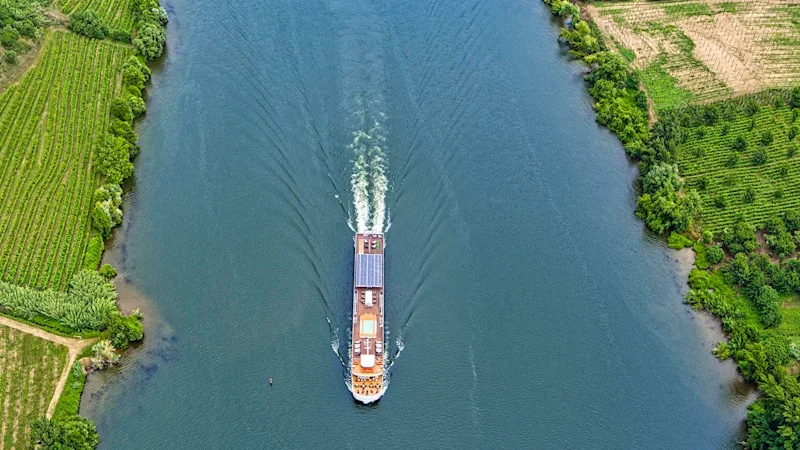
History is sandwiched between bread and wine, as I discover on the journey north through Coimbra, a medieval university city tucked into a bend of the Mondego River, and on to Porto, where the Viking Helgrim is moored. Dancing beside the jetties are brightly painted rabelos that once transported the port wine for which this region is famous. As we set sail for the Spanish border, the World Heritage-listed Alto Douro Wine Region billows beside us. We pass through five locks on our way there, rising with the longship to meet the hills, then sinking into insignificance on this vineyard-bulwarked river. Ports signpost the route – Regua, Pinhao, Barca d’Alva; terracotta-roofed quintas eye us from terraces pleated with vines plump from summer heat and winter rainfall trapped by a bedrock of schist.
“The water in the schist is always lukewarm,” says Bianca De Jong, Viking Helgrim’s program director. “[We] have such good wines … not only because they have to work very hard to get to the water, but the water is not cold, it’s warm.”
The Viking Helgrim’s wine list practically writes itself. Drops swirl peppery, sweet or crisp in our wine glasses, Portuguese varietals like Arinto and Touriga Nacional, and the faintly fizzy Vinho Verde, a green wine from the western Douro. On the night of the longship’s Taste of Portugal feast we pair these hyper-local tipples with traditional dishes – plump sardines and bacalhau (salted cod), black mussels steamed in wine, Portuguese fish soup.
“And then let’s not forget the sweet side,” says executive chef Cesar Mata. “You will find the port wine pudding, the rice pudding, the pasteis de nata and the baba de camelo – a combination of condensed milk and meringue. The taste is very unique, very Portuguese.”
Next morning, we lumber onto a bus and cross into Spain. Fallow fields and groves of olive and cork trees trail on for miles. Our entrance into Salamanca is unremarkable: street signs, office blocks and roundabouts obscure the medieval fortress clasped like an ingot at its core. Spain’s dictator, Francisco Franco, whose reign overlapped with Salazar’s, is but a blip in this antiquated city’s history.
“The first people who came here to live were the Celts, 500 years before Christ,” says guide Maria Jose Garcia Tarrio. “Then came the Romans, then the Visigoths, then the Moslems. It was in the 11th century that the real repopulation started with people from France, Portugal and the north of Spain.”
But the most important event in the city’s history was the foundation of Salamanca University in 1218, Tarrio says. Everybody came to this sandstone-sculpted city with a “centre of wisdom” at its heart: Spanish monarchs, writers like Miguel de Cervantes of Don Quixote fame, explorers like Christopher Columbus. And, in the 20th century, the dictator Franco.
“He was living here during the Spanish Civil War,” Tarrio says.
She leads us through Plaza Mayor. Its spandrels are affixed with medallions featuring historical figures. During his Salamanca tenure, Franco demanded a cameo of his face be placed among the greats. It hung here until his death in 1975, whereupon Spain transitioned to democracy. There were no carnations placed in the barrels of guns in Salamanca; residents responded to Franco’s death pragmatically. Today, the spandrel once occupied by his medallion is empty.
“We thought 40 years was long enough for a dictator to be here,” Tarrio says. “And so we took him out.”
THE DETAILS
FLYEtihad flies direct from Sydney and Melbourne to Abu Dhabi with onward connections to Lisbon. See etihad.com/en-au
STAYViking’s 8-day River of Gold Douro River cruise starts in Lisbon, with road transfers to Porto and Salamanca, Spain. See vikingrivercruises.com.au
The writer was a guest of Viking.