By Kim Seung-yeon
SEOUL, July 24 (Yonhap) -- A recent partnership framework agreement on small modular reactors (SMR) signed by the United States, South Korea and Japan reflects "tight strategic" cooperation among the three countries in energy security, the top U.S. envoy to ASEAN said Friday.
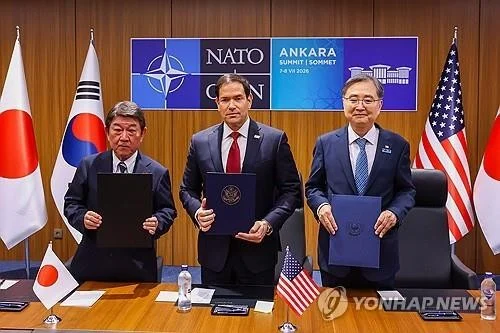
U.S. Ambassador to the Association of Southeast Asian Nations (ASEAN) Kevin Kim made the remarks, referring to the trilateral agreement on SMRs signed between the top diplomats of the three nations on the sidelines of the North Atlantic Treaty Organization summit in Ankara, Turkey, earlier this month.
The memorandum of cooperation calls for joining forces to advance into the SMR market in the Indo-Pacific, amid surging energy demand and rising geopolitical competition with countries like China and Russia in energy security.
"This is a growing industry in the United States," Kim said during an online press briefing with Asian media outlets. "The SMRs will play a critical role in supplying energy in the future."
"This is an absolute priority for the (Trump) administration ... The recent MOU that was signed between the three countries continues to illustrate the tight strategic cooperation that exists among the three countries," he said.
While declining to detail how this cooperation framework will unfold in the short term, Kim stressed in-depth discussions are under way regarding next steps in a more official capacity.
"The reality is that the substance will be discussed no matter what," he said. "Those are discussions that are still sensitive and governments are exchanging their views."
Since the SMR cooperation largely targets the Indo-Pacific market, the MOU announcement has given rise to the view that ASEAN countries will likely be joint partners to move the cooperation framework forward.
A Seoul official said earlier that the SMR cooperation will center on enabling commercial nuclear industries of the three countries to enter the Indo-Pacific region.
Singapore, Indonesia and the Philippines are considered likely partners for the SMR cooperation.
SMRs are increasingly gaining traction as the U.S. and its like-minded countries seek reliable and carbon-free power to meet surging grid demand driven by artificial intelligence (AI) and data centers.
The technology is regarded as a more flexible and potentially less costly alternative to traditional large-scale nuclear power plants.
South Korea is known for its nuclear power plant construction capabilities, while the U.S. possesses proprietary reactor design technologies. Japan has strengths in manufacturing key nuclear power plant components.
elly@yna.co.kr
(END)
- 'Dracula' featuring Jennie maintains No. 5 on Billboard 100
- (LEAD) BTS headlines first halftime show at World Cup final
- Hybe to launch new 7-member girl group Tuide this year
- 'Agent Kim Reactivated' reigns atop Netflix's weekly non-English chart for 3rd week
-
BTS headlines first halftime show at World Cup final
-
Hybe to launch new 7-member girl group Tuide this year
- (LEAD) BTS headlines first halftime show at World Cup final
- Disney+ to release 2nd season of 'Made in Korea' in Sept.
- (LEAD) S. Korea, U.S. open shipbuilding partnership center to advance MASGA initiative
-
(URGENT) S. Korea's Daejeon selected as host city for 2029 Invictus Games: veterans ministry
-
U.S. announces 12.5 pct tariffs on S. Korea, Japan over forced labor concerns
- (LEAD) S. Korea, U.S. open shipbuilding partnership center to advance MASGA initiative
- Unification minister says policy on N. Korea has shifted to peace-first approach
- S. Korea, U.S. open shipbuilding partnership center to advance MASGA project
- (LEAD) U.S. House Appropriations subcommittee officials visited S. Korean shipyards in July: sources