When the Korean Meteorological Administration launched its proprietary weather forecasting framework in 2020, it placed Korea in an elite fraternity: one of just nine nations worldwide to build an independent, end-to-end global numerical prediction system.
Now, Seoul is broadening its operational footprint into Southeast Asia and Oceania, crossing the equator to deliver real-time data to some of the most climate-vulnerable regions.
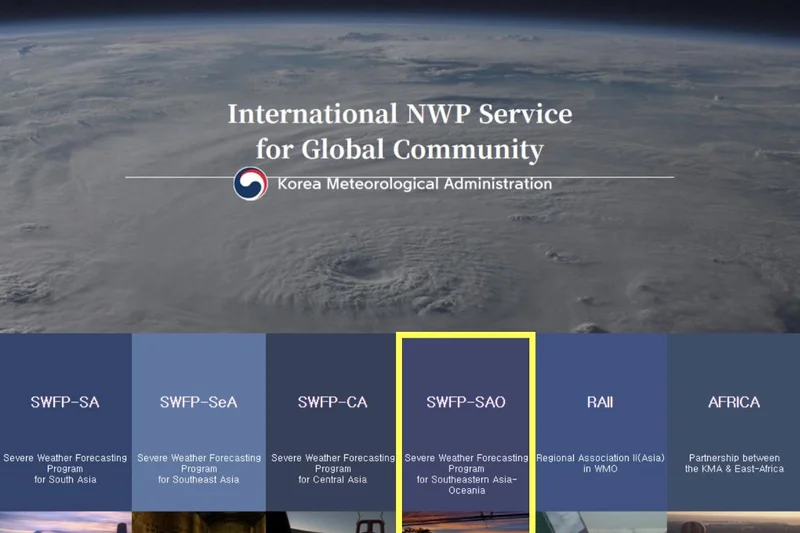
The agency said Friday that it has officially broadened the operational reach of its signature system — the Korean Integrated Model, or KIM — to encompass 33 distinct meteorological data feeds across Southeast Asia and Oceania. The expansion brings granular, high-altitude wind and temperature intelligence to 117 cities across five island states: Indonesia, Malaysia, Papua New Guinea, East Timor and Brunei.
The initiative aligns with the World Meteorological Organization’s Severe Weather Forecasting Program, a global effort designed to equip developing and archipelagic nations with advanced forecasting tools to anticipate extreme weather events before disaster strikes.
For island nations grappling with intensifying tropical storms, unpredictable monsoon patterns and rising sea levels, high-resolution atmospheric modeling is often out of reach due to the immense computing infrastructure required. By opening up KIM’s real-time numerical maps and city-specific atmospheric soundings via its international portal, Korea effectively hands local meteorologists the computational firepower of a major weather hub.
"Sharing our proprietary numerical weather prediction technology with the global community is critical for boosting disaster resilience in developing nations that struggle with a lack of meteorological infrastructure," said Lee Mi-seon, administrator of the Korea Meteorological Administration. "We will continue to strengthen cooperation with the WMO to fulfill our international obligation to protect human life and property from climate disasters."
The data rollout is not merely an act of scientific diplomacy. It represents a major milestone in Korea's ambition to position its indigenous technology as a standard-bearer for global climate resilience. Forecasters in cities ranging from Jakarta and Kuala Lumpur to Port Moresby can now access Korea's customized wind and temperature profiles directly through the agency's dedicated international portal.
As extreme weather continues to test the limits of global emergency response, the KMA said Korea is ensuring that the nations on the front lines of climate change are not left navigating the storm in the dark.
This article was published with the assistance of generative AI and edited by The Korea Times.