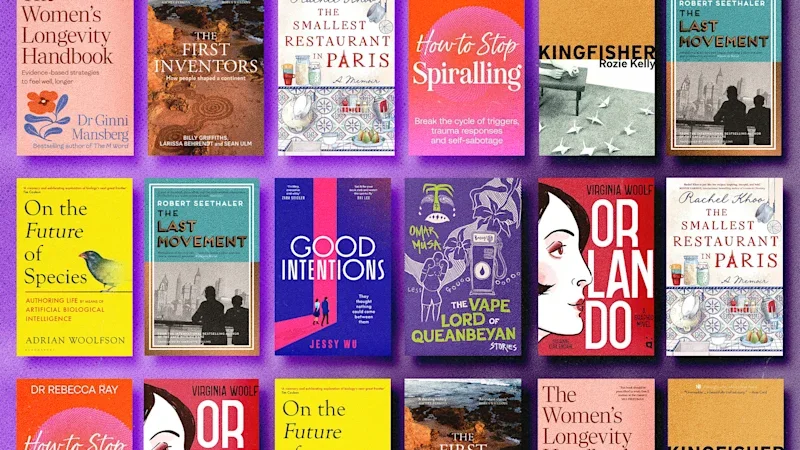
Modernist classics, speculative short stories and literary love affairs make for a wide-ranging fiction line-up this week, while the non-fiction shelves traverse Australian history and mental health to Parisian kitchens and the unsettling future of synthetic biology. Our critics deliver their verdicts on 10 new releases so you know whether they’re books to buy, borrow or skip.
Fiction
Orlando by Virginia Woolf, adapted by Susanne Kuhlendahl (Helvetiq, $50)
I’ve kept only a ripple from the huge tsunami of free books I’ve received over the years. This graphic novel, based on Virginia Woolf’s Orlando, is one of the keepers. It’s a lustrous hardback, beautifully illustrated by Susanne Kuhlendahl, and the adaptation seems to fillet Woolf’s text for passages that any reader might dog-ear from it. Woolf’s time-travelling, gender-bending, speculative picaresque looks more relevant than ever in the 21st century.
Following Orlando’s adventures across centuries – and, memorably, the gender binary – the novel of ideas offers a sharp critique of gender inequity, expectation and performance, and an erudite historiography of English literature, to boot. It’s funny, wildly transgressive, and full of incident, as the seemingly immortal Orlando survives into Woolf’s own time, long enough to see their own literary efforts published.
There’s a risk with graphic novels that they’ll discourage reading (or re-reading) of the original, but the opposite is likelier here. Kuhlendahl has produced a gorgeous graphic novel, as fresh and complete in its vision as the 1992 film of Orlando starring Tilda Swinton; it should act as a seductive introduction to new readers, as well as spur the initiated to revisit a modernist classic.
The Vape Lord of Queanbeyan by Omar Musa (Penguin, $35)
Omar Musa’s first book since the Miles Franklin shortlisted Fierceland is a globetrotting collection of stories supercharged by the rocket fuel of surrealism. It brings the author’s rebellious wit, compassion, and unflinching pursuit of truth to an eclectic array of tales exploring humans under inhuman pressures. The award-winning title tale is narrated by a recovering drug addict, fresh out of rehab. When he seeks out a friend-of-a-friend who sells black market vapes, an otherworldly odyssey beckons, leaving the reader with complex feelings and pointed questions about addiction.
From talking animals to flying cars, Musa’s creativity has the experimental ambit of speculative fiction, but his whimsy and creativity are usually in service to intelligent critique. You’ll find everything from Sufism to the future of AI broached in this anthology, and it’s a pleasure to read an author with such a thoughtful approach to, and formal command of, the rhythm and cadence of language – even if, in one story about Islamophobia, words themselves fail, and must be abandoned to finish the tale.
Good Intentions by Jessy Wu (Macmillan, $35)
Nadia Kuan and Jake Sullivan met at university. Young, idealistic, and committed to speaking truth to power, they worked on the student newspaper together, landed themselves a scoop exposing high-level corruption, and fell in love. It didn’t last. They parted ways in adult life: Jake to become a respected (and feared) investigative journalist, Nadia into a high-flying corporate world with stratospheric remuneration and depthless ethical compromise. The old flames are reunited years later, on opposite sides of a brewing biotech scandal that will be dramatically resolved in the courtroom.
Jessy Wu folds relationship drama into a sharp, unforgiving exploration of journalistic and corporate ethics, and the difficulty of principled behaviour within systems that reward the opposite. Good Intentions could easily have collapsed into a simplistic idealism v pragmatism schema. Wu creates something sharper, wittier, more nuanced and true-to-life, artfully framing the human dimensions of social problems with multiple perspectives and many shades of grey.
The Last Movement by Robert Seethaler (Canongate, $25)
Biographical novels about famous artists are rarely as slender or as lyrically composed as Austrian writer Robert Seethaler’s The Last Movement. It takes up the final transatlantic voyage of Gustav Mahler in 1911. The celebrated composer broods on music, love, legacy, and the struggles and triumphs of his career – from the ill-health that has always plagued him to the antisemitism he suffered, from the heights of his success in the US to his uxorious devotion to his wife Alma. The last is poignant and layered with frustrations. Alma comes to resent her role as Mahler’s carer and starts an affair with another man. (Alma was also an accomplished composer herself, though she lived in the shadow of her husband.) There’s a framing device featuring a cabin boy that comes across as superfluous artifice, but it’s a small part of a meticulously researched and condensed imaginative engagement with the life of a musician who remains rightly and widely admired.
Kingfisher by Rozie Kelly (Saraband, $33)
Shortlisted for this year’s Women’s Prize for Fiction, Rozie Kelly’s Kingfisher establishes an unusually daring portrait of a volatile romance, before retreating into something more conservative and predictable. The unnamed narrator is a male creative writing academic, 35, who’s in a stable but stale relationship with another man, Michael. When the narrator falls passionately in love with a woman – a poet 17 years older than him – everyone’s surprised, including him. Still, they’re well-matched: the Kingfisher, as he comes to call her, is charming, clever, not to mention rich and well-connected, and they’re both writers (which of course means they’re both vampires when it comes to using their lives as material).
The polyamorous adventure that erupts is a tangle of wild sex, emotional tension, drollery, and complicated power dynamics that are upended upon a sudden role reversal. Kelly eventually wanders to the edge of gothic fiction, a shift that loses some of the vitality, and the perversity of desire, that power the book’s strong opening.
Non-fiction
** The First Inventors by Billy Griffiths, Larissa Behrendt and Sean Ulm (Allen & Unwin, $37)**We have been schooled to think of invention as the brainchild of a solitary genius who, in a moment of inspiration, dreams up something unheralded. But as the authors of this work point out, “invention is not a fleeting moment or individual epiphany.” It is a much more complex, collective process that unfolds over time and place. Challenging past stereotypes of Indigenous culture as unsophisticated and unchanging,
The First Inventorstestifies to the ingenuity and dynamism of every phase of the history of Indigenous peoples in Australia.
Ecological modelling and genetics shed light on the long-distance voyages of the “great age of maritime exploration” that brought the first people here 65,000 years ago. Archaeology unearths some of the oldest examples of technology on the planet in the grindstones of Arnhem Land and the stone-walled fish traps of Western Victoria. Invention also lies in the nuanced kinship systems and poetic song cycles that encode sustainable behaviour, map Country and transmit distant events. To read this exciting, paradigm-shifting work is to see the history of our continent anew.
The Smallest Restaurant in Paris by Rachel Khoo (Ultimo, $37)
Londoner Rachel Khoo didn’t speak French, knew no one in Paris and didn’t have a job lined up when she spent all her savings on a Cordon Bleu patisserie course. It was a gamble, but her love of being creative with food combined with business savviness gave her the confidence to take the leap. Her story of how she went from au pair to French cookbook author and mastermind behind the “smallest restaurant in Paris” is full of the usual self-deprecating tropes of an outsider trying to make it the Gallic capital– language faux pas, food faux pas, relationship faux pas – along with gentle humour at the expense of the French themselves.
But Khoo puts her own stamp on this potentially cliched formula through her sheer verve, entrepreneurial talent and flair for capturing, in light-hearted prose, the blow-by-blow dramas of her quest to find “a home among people who shared my love for food”. And, she is genuinely funny. On her first day at the Cordon Bleu course, she catches her reflection in a mirror. The “horrendous uniform” her savings had purchased was, she reflected, “less haute cuisine, more haute asylum”.
How To Stop Spiralling by Rebecca Ray (Macmillan, $37)
When psychologist Rebecca Ray starts to spiral, her traumatised ‘Weird-Barbie- self’ launches into an avalanche of self-criticism. But now, instead of whipping herself for going backwards, she is able to pause, recognise what’s going on and take a different path. As a survivor of sexual abuse, she knows that trauma doesn’t evaporate just because you’ve done the necessary work. But she also knows that it doesn’t have to dictate your future. Many of the women cited in this book have developed coping strategies for past traumas that make them appear to be high functioning despite feeling empty inside.
This is a guide to addressing the patterns of thought and behaviour behind self-sabotage or burnout, and how to rewire these reflexive responses or mental loops. The trauma can’t be undone but Ray offers survivors a way to be present in their own lives and to understand that triggers are not to be feared but seen as “messages to respond differently”.
** On the Future of Species by Adrian Woolfson (Bloomsbury, $37)**Just when you thought AI couldn’t get any scarier, contemplate this. In the not too distant future, scientists will use AI and genome technologies not just to resurrect extinct species but to design new species. In effect, says Adrian Woolfson, “Organisms could be engineered to order, converted into living machines with multiple potential utilities.” It’s a chilling thought that brings to mind the hubris of Mary Shelley’s Dr Frankenstein when he created his “monster” who eventually went feral.
Woolfson is well aware of the dangers and ethical dilemmas raised by his vision, which is why he has included a manifesto with principles to govern this brave new world. However, as the co-founder of a biotechnology company specialising in synthetic genome design and construction, he is clearly in the thrall of the possibilities he entertains and somewhat starry-eyed about humanity’s capacity to use this potential wisely. While well-written and grimly fascinating, the triumphalist tone of On the Future of Species also makes it profoundly disturbing.
The Women’s Longevity Handbook by Ginni Mansberg (Murdoch Books, $37)
Unlike the blueprints for immortality flogged by tech bros, this is a measured, systematic and scientifically-informed reference for women in midlife to turn to when considering how to best manage and understand their health with an eye to living as long and well as possible. How do you find the right medical professionals? Is there any scientific evidence backing the buzz about certain supplements and vitamins? What are the benefits of weight-bearing exercise? Should you be concerned about sporadic palpitations or arrhythmias? Why are statins so effective in lowering cholesterol?
General practitioner, Ginni Mansberg, is particularly alert to the differences between the way certain conditions express themselves in women and men, and why it is important for women to be aware of this. If you want to avoid the doom scroll spiral of Dr Google, this is a good place to start.
What else is happening in the book world?
- This novel has plenty of sex - but it’s far more than a racy read.
- These are all the reasons why you shouldn’t feel guilty about re-reading your favourite novel.
- Can’t get published by the Big Five? Win a major prize instead!
- Here are five thrilling and chilling new novels to keep you up at night.
- Our critic shares 10 of the best audiobooks of 2026 (so far)