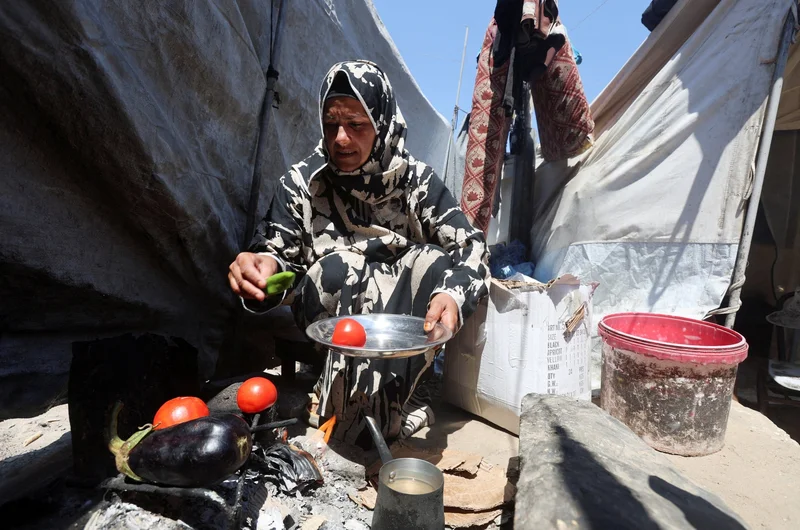
The humanitarian situation in Gaza has improved since famine conditions were declared in parts of the territory last year, but millions remain trapped in a deep food crisis, with aid agencies warning that funding shortages and reduced humanitarian access could erase recent gains by the end of 2026.
A new report released Wednesday by the Integrated Food Security Phase Classification (IPC), the global authority that assesses food insecurity, found that improved aid deliveries and reduced fighting following the October 2025 cease-fire between Israel and Hamas significantly lowered acute malnutrition rates, particularly among children.
However, the organization warned that the recovery remains fragile and could quickly unravel if humanitarian assistance continues to decline.
The IPC estimates that between April and June, about 1.2 million people, or 59% of Gaza's population, experienced acute food insecurity classified as Phase 3 "Crisis" or worse. Of those, more than 212,000 were living under Phase 4 "Emergency" conditions, one step below famine.
Unless aid levels are sustained, the number of people facing acute hunger is expected to climb to more than 1.4 million, roughly 67% of Gaza's population, by the end of the year.
Although famine conditions identified in parts of Gaza in August last year have eased, the IPC stressed that food consumption remains insufficient for most households. Many families continue to skip meals, rely on charity kitchens, beg for food or scavenge for anything edible as the territory struggles to recover after nearly two years of war, repeated displacement and widespread destruction.
The report credited increased humanitarian deliveries after the cease-fire with driving measurable improvements, but emphasized that those gains have been uneven across Gaza and remain heavily dependent on continued international assistance.
"Even small disruptions to humanitarian access could rapidly reverse recent gains," the IPC warned.
Children remain among the most vulnerable. While acute malnutrition has declined to levels considered acceptable by international standards, prolonged food shortages have contributed to rising cases of stunting, a condition caused by chronic undernutrition that can permanently impair physical and cognitive development.
UNICEF Executive Director Catherine Russell said many children continue to suffer from hunger despite the improvement.
"Many children are still going hungry, and some children may never fully recover from prolonged lack of proper nutrition," Russell said.
The IPC also warned that nutrition programs are already shrinking. Supplementary feeding initiatives for pregnant and breastfeeding women saw the number of beneficiaries fall by half, to around 6,000 people between January and May, largely because of funding shortages. Further reductions are expected as humanitarian organizations face financial constraints and uncertainty over their ability to continue operating in Gaza.
Aid organizations have also raised alarm over the collapse of Gaza's water and sanitation infrastructure, warning that failing sewage systems, limited clean water and overcrowded living conditions continue to fuel disease outbreaks.
Most of Gaza's 2.1 million residents remain displaced, living in overcrowded tent camps or heavily damaged neighborhoods where access to clean water, healthcare and other essential services remains severely limited.
Residents say food remains scarce and unaffordable despite the increase in aid.
"The situation is very tragic," said displaced mother Rana Abu Bakr, whose family depends on a charity kitchen in Khan Younis for daily meals.
"There's no water, no food, nothing to drink. Prices are exorbitant."
Israel rejected suggestions that it is restricting food supplies to Gaza.
The Israeli Ministry of Foreign Affairs said the country has facilitated the entry of more than 1.8 million tons of food into the enclave since the October 2025 cease-fire and maintains that it does not block food shipments.
COGAT, the Israeli military agency responsible for coordinating aid into Gaza, dismissed the IPC findings as biased, arguing that the report ignores Israeli data showing that the volume of aid entering the territory exceeds requirements based on World Food Program benchmarks.
Israeli officials contend that the main obstacle is not the amount of aid entering Gaza but the distribution of supplies inside the territory. They accuse Hamas of diverting and looting humanitarian assistance, allegations Hamas denies.
Aid organizations dispute Israel's assessment, saying an increasing share of food entering Gaza comes through commercial traders rather than humanitarian agencies. Medical workers have warned that commercially available foods are often less nutritious than emergency food assistance, posing additional risks for children recovering from severe malnutrition.
COGAT acknowledges that commercial goods account for roughly half of all supplies entering Gaza since the cease-fire but denies prioritizing commercial shipments over humanitarian aid.
The war began following Hamas' Oct. 7, 2023 incursion into southern Israel, which killed about 1,200 people and took 251 hostages, according to Israeli authorities.
Israel's military campaign in Gaza has since killed more than 73,000 Palestinians, most of them civilians, according to Gaza health officials. Israeli strikes and shelling have also killed more than 1,185 people since the October 2025 cease-fire agreement, the territory's Health Ministry says.
The IPC, whose assessments are relied upon by the United Nations and major humanitarian agencies, warned that Gaza's modest recovery remains entirely dependent on continued humanitarian access and international funding.
World Food Program emergency preparedness and response director Ross Smith said the recent improvements demonstrate what sustained aid can achieve, but cautioned that the progress could disappear without continued support.
"These gains are good, but they are due to the level of humanitarian assistance, particularly food assistance, we've been able to bring into Gaza in the past seven months," Smith said. "It's really critical that these gains are maintained. And for that we need to have continued access and continued funding."