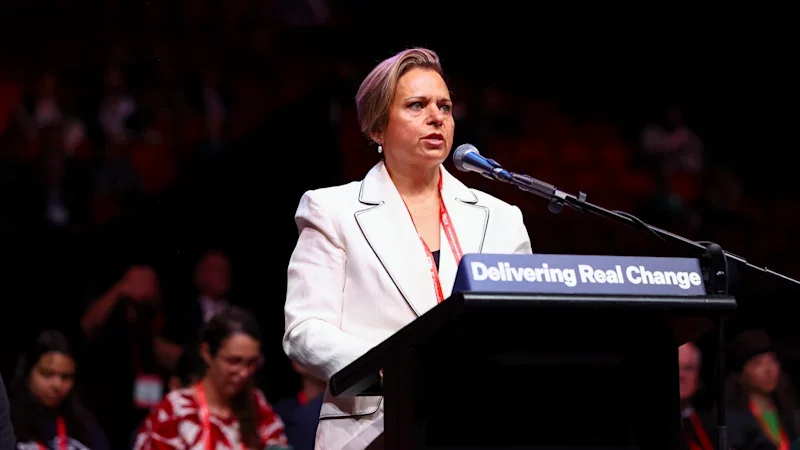
Labor’s membership wants the government to remove a legal barrier to voluntary assisted dying that stops doctors talking to patients over telehealth, but Attorney-General Michelle Rowland said she retained concerns about loosening any guardrails in case they enable elder abuse.
While the majority of delegates at Labor’s national conference in Adelaide on Friday voted in favour of an amendment to change the criminal code as it related to euthanasia, they inserted a guarantee in the party’s constitution to always grant a conscience vote on the issue.
It will be just the second topic guaranteed a conscience vote in Labor’s rules, next to abortion. The motion to extend telehealth to voluntary assisted dying was the only issue that had attracted official dissenting remarks on the conference floor by Friday afternoon.
While it is mainly a state issue, doctors who consult patients about euthanasia over telehealth or the phone have been at risk of prosecution since the Federal Court in 2023 ruled that voluntary assisted dying was considered suicide under the Commonwealth’s criminal code.
The ruling clarified a previous grey area, and meant doctors could be charged under federal laws that prohibit using a carriage service – such as telehealth, email or phone calls – to incite or provide information about suicide.
That could include a single phone call over a months-long course of consultations, which meant the ruling risked restricting access for terminally ill Australians in rural and regional areas who must travel long distances to speak in person with a qualified doctor.
State governments have been pushing the Commonwealth to change the law for years. Catholic Health Australia, however, has warned that allowing telehealth for assisted dying would make it more accessible in regional areas than ordinary end-of-life and palliative care.
A line added to the party’s national policy platform on Friday said: “Labor will remove barriers that exist in federal law to the provision of end-of-life care (including via telehealth) as part of lawful access to voluntary assisted dying in the states and territories, while maintaining appropriate clinical safeguards.”
One speaker, NSW MP Sally Quinnell, argued against the motion. “When voluntary assisted dying was adopted and introduced and debated over many, many years, many people who had very real concerns about it being passed were told there were going to be strong guardrails,” she said.
“Now we need to be careful that we don’t pull those guardrails down bit by bit … I think we all agree this is complex, nuanced, and shouldn’t be done over a Zoom call. It happens in person with empathy, careful listening, and human interaction.”
The motion still passed with a majority of votes, although the next resolution changed the party’s constitution so that MPs would not be bound to the position.
Rowland, who moved the conscience motion, said she was not convinced by all arguments to change the criminal code. She said there had been “well-intentioned advocacy” on the issue, particular regarding remote and regional patients, but that state government reasoning about resources was not persuasive.
“These provisions are there for good reason; they were enacted to deter ill-intentioned individuals from encouraging vulnerable people to self-harm or commit suicide,” she said.
Rowland raised concerns that removing federal safeguards could facilitate more elder abuse, when adult children or caregivers might inappropriately influence a vulnerable older person’s end-of-life decisions.
“This is an issue that I take extremely seriously, and I’m discussing it with states and territories … My view is that this is fundamentally a health policy issue, and any movement in this area needs to be supported by strong evidence and rigorous safeguards to prevent abuse,” she said.
“I am personally not convinced that a person confronting an end-of-life decision shouldn’t be afforded the dignity of a personal face-to-face consultation with a medical practitioner. The passage of this motion will allow a conscience vote on this issue, and I expect that any further work on this will be accompanied by rigorous evidence and safeguards.”
It was one of few points of contention in a conference noted for lacking zeal, although a bigger debate over Israel and Gaza is expected on Saturday.
Debates over gambling reform were settled before they reached the conference floor, with members of the party’s left coming to an agreement with Communication Minister Anika Wells on the wording of an amendment that urged tougher oversight of the government’s advertising rules.
“We will endeavour to strengthen the powers of the relevant national regulators,” the motion said.
“We will ensure our reforms are operating as intended and continue to work with states and territories to ensure regulatory responses prevent harm as gambling technologies, digital platforms and advertising practices evolve.”
It also committed Labor to exploring better ways to stop online gaming and social media platforms from offering young people inducements that normalise gambling. But the changes to the party platform will not compel the government to go significantly further than its current plans, which have been challenged by both the Coalition and crossbench for being too weak.
NDIS Minister Jenny McAllister, meanwhile, agreed to amendments that said Labor must take a human-centred approach to reforming the National Disability Insurance Scheme, and ensure nobody is left behind in efforts to fund new foundational supports outside the scheme.
“Labor will support equitable, timely, and person-centred access to disability supports,” one amendment said.
It also said Labor would ensure that the parliament had oversight of any use of automation in the NDIS, which must be transparent, and all automated decisions should be reviewable – additional safeguards that the Greens fought for in negotiations last month.