- 'Terror In The Skies: Stopping The Liquid Bomb Plot', ITV1 on Sunday at 10.20pm
- See more Daily Mail on Google - save us as a Preferred Source
MI5 agents have revealed for the first time how an extraordinary surveillance operation averted a devastating UK terror attack killing up to 5,000 people.
British-born Islamic fanatics wanted to smuggle liquid explosives disguised as soft drinks on board planes bound for the US and Canada and destroy them in the sky.
The plot would have caused carnage to rival 9/11 five years earlier, with plans for more attacks on the Houses of Parliament, tourist attractions and UK gas terminals.
The conspiracy in 2006 was directed from Pakistan by Rashid Rauf, Al Qaeda's mastermind behind the July 7 London bombings, and could have been catastrophic.
But it was foiled by Operation Overt, the biggest surveillance operation in UK history which was run by more than 800 officers and staff across MI5 and Scotland Yard.
The discovery of the plot still however brought chaos to international airports as restrictions were imposed overnight on how much liquid can be taken on to a plane.
Now, in a new ITV Exposure documentary airing on Sunday, serving MI5 officers have spoken publicly for the first time about what they did to ensure disaster was avoided.
Speaking on 'Terror in the Skies: Stopping the Liquid Bomb Plot', the then-Home Secretary John Reid also reveals it could have brought down the UK government.
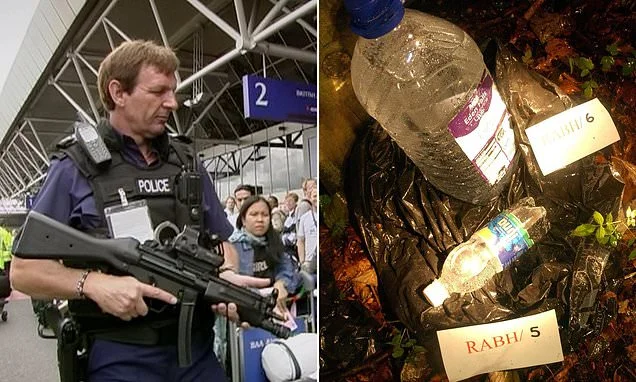
Armed police monitor passengers at London Heathrow Airport in 2006 after restrictions were imposed on how much liquid can be taken on to a plane as a result of the foiled bomb plot
Former home secretary John Reid says the plot could have brought down the UK government
A plastic bottle containing hydrogen peroxide, part of the plotters' bomb-making materials
Ex-MI5 deputy director Jonathan Evans says the death toll could have exceeded that of 9/11
One MI5 officer explained how he secretly entered a flat in east London to install surveillance equipment amid growing suspicions bombs were being made there.
He said: 'There was an imperative to get in there and find out what these guys were doing. I (have) worked on hundreds of operations, lots of terrorist properties mainly.
'Sometimes you're breaking into someone's house, you're standing in a terrorist living room, (and) they have no idea. It feels like the clock's ticking but we're through that door very quickly.
'When the door opened and you're looking up into the darkness and you're not quite sure if there's anyone in there and you think God, 'if I f*** this up, this is going to bring to an end maybe the biggest counter terrorism investigation in the country's history'.
'There is a degree of pressure and obviously there's a potential consequence of, not just f***ing up an operation, but being hurt. You're using almost no lights. You're not giving the game away.
'There were a row of bottles lined up sort of neatly equidistant, they all seem to be empty. This box contained, different glass jars. There was one that was full of batteries there was big, jar, full of some white and gloopy liquid in in the middle.
'At the end, we put the things back. I said to the locksmith, 'sometimes I f***ing love my job!'.'
Another officer said she 'dropped off the face of the earth for a few weeks' during the operation but added: 'These are the kind of jobs that we all join to work on.'
Mr Reid also explained what was at stake, claiming the government was at risk of 'falling' if the conspirators had murdered thousands of people.
Ringleader Abdulla Ahmed Ali had targeted seven flights to San Francisco, Toronto, Montreal, Washington, New York and Chicago that departed within two-and-a-half hours of each other
Tanvir Hussain (left) and Assad Sarwar (right) were both convicted of conspiracy to murder
CCTV footage of Assad Sarwar at a Woolworths store in High Wycombe in July 2006
He said: 'The more you thought through the nature of this plot, which was to bring down airliners, sitting like ducks in a row over the Atlantic, that they wanted to do it that way, because then you would not have the proof of how it had been done.
'If as a result of delaying we miscalculated and the conspirators murdered two, three thousand people, my judgement was that no government could have sustained that. The government would've been in grave danger of falling.'
Mr Reid was under pressure from civil servants to raise the threat level to aviation and warn the public, but MI5 feared this could alert the plotters to the operation.
They therefore decided to keep the conspirators unaware until the police were ready to move in.
Jonathan Evans, who was MI5 deputy director at the time, recalled how Mr Reid told him: 'We're not going to publish the fact that the threat level's gone up.'
Mr Evans added: 'Then he looked at me and it's one of those points you remember, and he said, 'if this goes wrong, I'm out of a job, you're out of a job, and the government will fall'.'
He claimed that Britain 'would not have recovered fully' from the attack, and the eventual death toll could have exceeded that of 9/11 which claimed the lives of 2,977 victims in 2001.
Michael Chertoff, then US Homeland Security Secretary, also said the impact of an attack on the planes could have been such that 'you might not even have civil aviation now'.
And former US National Security Advisor Juan Zarate revealed there were discussions in the White House about whether the plotters were 'on the brink' and concerns were raised that the authorities might 'wait too long'.
In 2009, Abdulla Ahmed Ali, 28, Assad Sarwar, 29, and Tanvir Hussain, 28, were convicted for their roles in the plot and jailed for a total of 130 years.
Michael Chertoff, then US Homeland Security Secretary, says the impact of a terror attack on the planes could have been such that 'you might not even have civil aviation now'
The bomb plot involved inserting liquid explosives into empty bottles of Lucozade and Oasis
A digital thermometer which was part of the bomb-making materials involved in the plot
The ringleader Ali had targeted seven flights to San Francisco, Toronto, Montreal, Washington, New York and Chicago that departed within two-and-a-half hours of each other.
He was inspired by Osama Bin Laden and even considered taking his baby son on his suicide mission.
Suicide videos made by the plotters warned Brits to expect 'floods of martyr operations' that would leave body parts scattered in the streets.
The plotters were caught because MI5 and anti-terror police tracked Ali after being alerted by his numerous trips to Pakistan.
They planted a bug into the terraced house he and Hussain were using as a bomb factory, which revealed the pair discussing attacking as many as 18 flights at the same time.
Ali, of Walthamstow, was given a minimum sentence of 40 years; his 'quartermaster' Sarwar, of High Wycombe, was ordered to serve at least 36 years; and his right-hand man Hussain, of Leyton, was sentenced to at least 32 years.
The cost of the police and security service investigation, the largest ever in the UK at the time, was £35million - and the court cases added an estimated £100million.
The attackers had claimed the plot was an elaborate publicity stunt to draw attention to an internet propaganda documentary - complete with spoof martyrdom videos - attacking UK foreign policy.
But the trio were found guilty of conspiracy to murder by a jury at Woolwich Crown Court at the end of a retrial in September 2009.
A series of other members of the network were found guilty of conspiracy to murder and terrorism preparation offences.
'Terror In The Skies: Stopping The Liquid Bomb Plot' is ITV1 on Sunday at 10.20pm