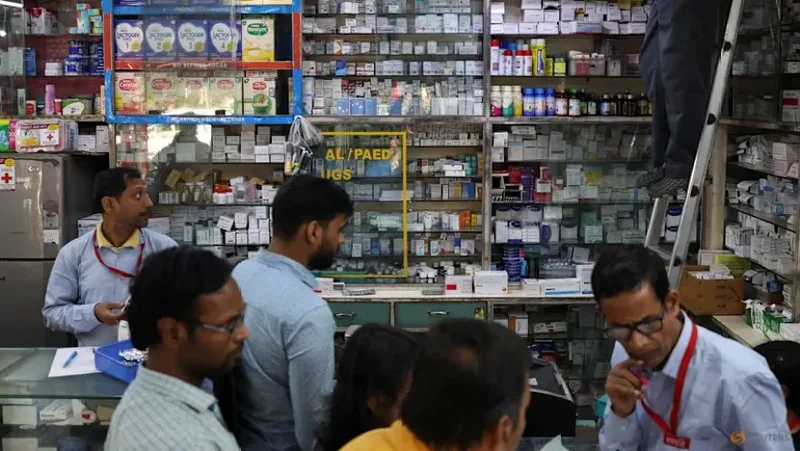
India's pharma sector braces for impact of proposed Trump tariffs on generic drugs
Analysts warn the levies could disrupt global drug supply chains, push up medicine prices for Americans and force Indian drugmakers to rethink their manufacturing strategies.
MUMBAI: India's pharmaceutical industry is scrambling to assess the impact of proposed tariffs on generic drugs announced by United States President Donald Trump.
Analysts warn the measures could disrupt global drug supply chains, push up medicine prices for Americans and force Indian drugmakers to rethink their manufacturing strategies.
The planned levies target one of India's most important export industries. Drugs and pharmaceutical products accounted for about 5.8 per cent of India’s total goods exports last year.
Often described as the "pharmacy of the world", India supplies nearly half of the generic medicines consumed in the US, making it the largest overseas source of low-cost prescription drugs for American patients.
Trump announced on Tuesday (Jul 21) that imported generic medicines will continue to enter the US tariff-free for two years, giving manufacturers time to shift production to America.
From August 2028, tariffs would rise to 100 per cent for one year before increasing to 200 per cent from August 2029.
“This is done in order to RESHORE Generic Pharmaceutical Production into America, with a penalty to those Companies that decide not to build Plant and Equipment within the stated period of time given to them,” Trump said in a social media post.
HIGH STAKES FOR INDIA'S DRUG EXPORTERS
More than 90 per cent of prescriptions filled in the US are generic medicines, according to the Food and Drug Administration.
They contain the same active ingredients as brand-name drugs but typically cost far less. Around 70 per cent of those medicines are sourced from overseas.
The US is by far India's largest pharmaceutical export market, accounting for US$9.7 billion – nearly 38 per cent – of the country's US$25.8 billion in pharmaceutical exports in 2025.
The shipments include low-cost off-patent medicines such as painkillers, antibiotics and cancer drugs.
Existing policies on patented and branded drugs remain unchanged after major global drugmakers secured exemptions through pricing and investment deals last year.
But generic medicines present a far greater supply chain challenge because of their lower margins and reliance on global manufacturing networks.
Uncertainty remains over whether the tariffs will ultimately be implemented only on finished medicines or also on drugs manufactured in the US using imported active pharmaceutical ingredients.
China dominates global production of many key pharmaceutical ingredients, including amoxicillin used in antibiotics.
If tariffs are imposed only on finished medicines, companies may still be able to import ingredients into US factories. But if imported ingredients are also targeted, manufacturers – and ultimately, consumers – could face substantially higher costs.
Analysts said the industry was caught off guard by the phased tariff plan, although the two-year transition period provides companies with some breathing room.
Chandrachur Datta, a partner at Vector Consulting Group, said that pharmaceutical firms with existing manufacturing facilities in the US will be better positioned to weather the tariffs.
“Most of the large Indian manufacturers have US facilities, but they have to augment the capacity. The first problem will be to select which (products) should be manufactured and supplied from the US facilities,” he said.
HIGHER COSTS TO FALL ON US CONSUMERS
Industry experts say the additional costs are unlikely to be absorbed by manufacturers and will instead be passed on, at least in part, to American patients through higher medicine prices.
“The tariff is a tax imposed on imported goods, so it would be paid for by the US consumers, with the revenue going to the US government,” said Joseph Carrello, a research fellow at the Melbourne School of Population and Global Health.
He added the tariffs are intended to make imported drugs less competitive than medicines produced domestically, encouraging companies to manufacture in the US. However, the policy could also reduce competition, giving domestic manufacturers greater pricing power.
“Generics are very important in the global pharmaceutical system … to help keep costs sustainable because they provide the same active ingredients at a cheaper cost,” he noted.
“This will affect the US consumers most because these tariffs would … lead to less competition and (hence higher) prices.”
Carrello said Indian drugmakers effectively have two options: comply with Trump’s wishes to move production to the US or diversify into other export markets.
“They can shift more manufacturing to the US (but) there’s operational capacity (and) I don't know if that would be commercially viable,” he told CNA’s Asia First.
“They (could) look at other markets to make up for that loss. But the US does make up quite a sizable market so they would have to look far and wide to maintain their profit margins.”
Industry experts say some companies may find it difficult to adapt.
“The question is which companies have a balance sheet and the US footprint to make it big, which companies will be able to survive the reshoring and which will not be able to,” said Anirudh Garg, a fund manager at Mumbai-based investment firm INVasset PMS.
Indian pharmaceutical stocks have fallen since the tariff proposal was announced, reflecting investor concerns over the industry's largest export market.
Attention is now turning to the upcoming quarterly earnings season, when executives at major Indian drugmakers are expected to outline how they plan to respond.
Investors will be watching closely for updates on manufacturing plans, potential changes to pricing strategies and the outlook for future investment, whether in the US or elsewhere.