Preparing for disruption: Offline messaging apps join India’s protest toolkit
As concerns over connectivity disruptions grow, protesters in India are turning to offline messaging apps as part of an emergency toolkit. How do they work, and what are their limitations?
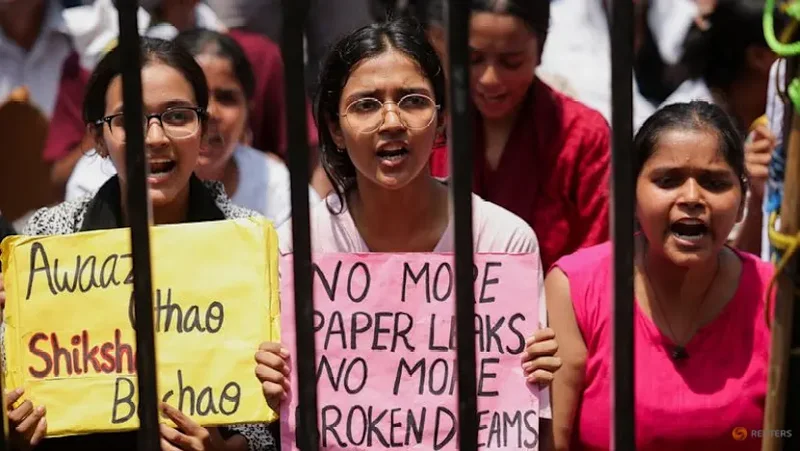
BENGALURU: As tens of thousands of young Indians protested in Delhi this week over exam paper leaks and alleged failures in the country's education system, local media reports of signal jammers and internet disruptions around the protest site prompted many to look for ways to communicate offline.
Downloads of messaging apps that work without mobile networks or Wi-Fi surged in India over the past week, led by a more than eightfold jump in installs of Bitchat, reflecting how protesters in India are increasingly preparing for connectivity disruptions.
Experts say such apps can provide a useful emergency backup, but caution that they are not substitutes for reliable internet access.
Nigam Mishra, a 22-year-old software entrepreneur, told CNA that he began exploring offline messaging apps after hearing protesters describe connectivity problems at the Jantar Mantar protest site on Monday (Jul 20).
He said ChatGPT led him to Bitchat, which uses Bluetooth to connect nearby users without internet access.
“I downloaded and tested it with a few people first,” said Mishra.
“When I felt that it works well in short distances, I shared it with other protesters.”
He made an Instagram video listing useful tools protesters could carry or download, which quickly spread among those heading to the protest site and became part of an emergency “offline” toolkit.
OFFLINE APPS GAIN TRACTION
Bitchat, recently launched by Twitter co-founder Jack Dorsey, recorded an over eightfold increase in downloads in India this week, according to data from market intelligence firm Sensor Tower.
Downloads of other offline messaging apps, including Bridgefy and Briar, rose 193 per cent and 57 per cent respectively.
The sharpest increase in downloads came on Jul 20, coinciding with a protest march to Parliament.
Led by the youth-driven Cockroach Janta Party (CJP) movement, the demonstrations have become one of India's largest student-led protests, with calls for greater government accountability and the resignation of Education Minister Dharmendra Pradhan.
Daily active users also rose across all three apps, with Bitchat surpassing 250,000 active users on Jul 22, a record for the platform.
Mishra said the apps work significantly better as more people install them because each new device extends the Bluetooth mesh network through which messages are relayed.
Unlike conventional messaging platforms, the apps allow nearby devices to connect directly using Bluetooth rather than mobile networks or Wi-Fi. Messages are passed from phone to phone, allowing them to travel farther as more users join the network.
Protesters and volunteers also circulated checklists advising those heading to demonstrations to carry power banks, download offline maps, save emergency contacts, wear protective goggles and install offline messaging apps as backup communication tools, Mishra said.
However, the Indian government moved against one of these platforms, Bithub, late on Thursday night.
India's Ministry of Home Affairs directed GitHub to remove or disable access to three repositories hosting Bitchat within three hours under the Information Technology Act and the Information Technology Rules, 2021.
Downloads of other offline messaging apps, including Bridgefy and Briar, rose 193 per cent and 57 per cent respectively.
The sharpest increase in downloads came on Jul 20, coinciding with a protest march to Parliament.
Led by the youth-driven Cockroach Janta Party (CJP) movement, the demonstrations have become one of India's largest student-led protests, with calls for greater government accountability and the resignation of Education Minister Dharmendra Pradhan.
Daily active users also rose across all three apps, with Bitchat surpassing 250,000 active users on Jul 22, a record for the platform.
Mishra said the apps work significantly better as more people install them because each new device extends the Bluetooth mesh network through which messages are relayed.
Unlike conventional messaging platforms, the apps allow nearby devices to connect directly using Bluetooth rather than mobile networks or Wi-Fi. Messages are passed from phone to phone, allowing them to travel farther as more users join the network.
Protesters and volunteers also circulated checklists advising those heading to demonstrations to carry power banks, download offline maps, save emergency contacts, wear protective goggles and install offline messaging apps as backup communication tools, Mishra said.
However, the Indian government moved against one of these platforms, Bithub, late night on Thursday.
India's Ministry of Home Affairs directed GitHub to remove or disable access to three repositories hosting Bitchat within three hours under the Information Technology Act and the Information Technology Rules, 2021.
It stated that Bitchat's decentralised architecture could impede lawful interception and investigation, and “be misused to coordinate unlawful assemblies, violent protests, organised crime and other activities during internet shutdowns or periods of public disorder”.
About 15 hours after the notice was issued, CNA found the Bitchat link was still available to download on GitHub repositories.
PREPARING FOR COMMUNICATION DISRUPTIONS
Digital rights advocates said the growing interest reflects a broader concern about maintaining communications during periods of uncertainty.
“Internet access is essential for people to exercise their fundamental rights, including freedom of expression, peaceful assembly and access to information,” said Namrata Maheshwari, interim Asia Pacific policy manager and encryption policy lead at Access Now, an international non-profit organisation for digital civil rights.
Technology policy researcher Srinivas Kodali said the discussion around offline messaging apps shows protesters are preparing for the possibility of internet or communication disruptions.
“If there is a complete breakdown of communications, people are trying to prepare for it,” Kodali told CNA, adding that apps relying on Bluetooth mesh networking have significant practical limitations, particularly during large, fast-moving demonstrations.
"It works well during a concert or an assembly where people are densely packed. But if there's an internet shutdown, there's only so much these offline apps can actually do,” he said.
The apps’ effectiveness is limited by Bluetooth's relatively short range and depends on having enough nearby users to relay messages from one device to the next.
Maheshwari echoed that view, saying such apps help fill an important gap when internet or mobile services are disrupted, but “cannot fully replace the scale, reliability and accessibility of an open internet”.
“Compared to WhatsApp or Instagram, it doesn't perform at that level,” the software entrepreneur Mishra said.
“But if you've gone with friends and you get separated, you can still communicate.”
The growing interest in offline messaging apps in India follows a pattern seen during protests elsewhere, where concerns about internet disruptions have driven people to seek alternative ways to communicate.
Sky News and BBC reported that Hong Kong protesters turned to Bridgefy during the 2019 pro-democracy protests to prepare for possible internet restrictions. During Myanmar's 2021 military coup, the same app saw a surge in downloads as internet blackouts spread.
“People have seen what happened this time,” Mishra said. “Whenever they go to a protest now, they'll install these apps beforehand.”