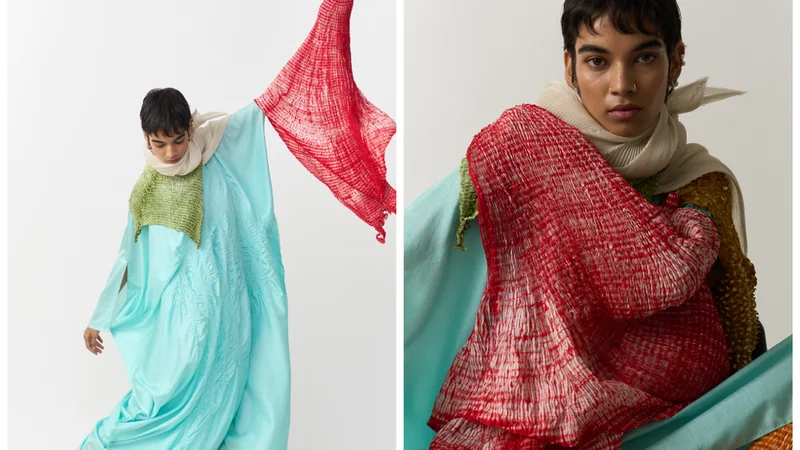
A seven-foot shibori canopy hangs overhead, suspended like a monsoon cloud. Dyed in deep blues and greens, it filters across the white walls of a 60-year-old Chennai home, casting shadows that evoke the rhythm of rain through dye of the cloth and its geometry.
The immersive setup forms the backdrop of Studio Medium’s Pre-Festive 2026 collection, Beat, Repeat, recently unveiled at Collage in Chennai and hosted by architect and interior designer Gowri Adappa. Featuring saris, kurtas, dresses, kaftans and shirts, the collection explores the intersection of architecture and textiles, where the process of making is placed on equal footing with the finished garment.
Inspired by geometry
For the founders Riddhi Jain and Dhruv Satija, the collection began with the simple but enduring element — water.
“Since the very beginning, we have been working with various dyeing techniques,” says Riddhi. “The primary part of the process is that you restrict water from certain areas to create a pattern. So water has always been an integral part of the process,” she says.
Their previous collection, Roots Routes, explored geometry in organic forms inspired by roots. This season, rain became the natural progression.
“What’s amazing about the rain and our textile-making process is that it’s unpredictable but you can still plan for it,” adds Riddhi.
The collection is monsoon in all its forms: circular motifs, eco raindrops and expanding ripples, which are translated across bandhani, arashi, shibori and mothra techniques. The colour palette shifts from burgundy, rani, greens, blues, red and navy, mirroring skies before and after rainfall.
“Rain has been an inspiration, but we have also been inspired by the sound of it, the music of it, by what it leads to and the patterns it creates. We didn’t romanticise the rain in a way that people do. We looked at what it actually does and tried to bring that into the patterns,” says Riddhi.
More than a vessel
Central to the installations is a Pateela, an element that keeps emerging in almost all their collections. For the designer duo, the Pateela is more than a utilitarian vessel; it is through it that the cloth, colour and craftsmanship come together.
“To us, the pateela becomes a very interesting focal point for a lot of different aspects of our work,” says Dhruv. “A lot of our work comes from dyeing, and this is where it happens. This is a tool of transformation. Anything that comes out of the studio first goes into this vessel and then becomes whatever garment it is,” adds Dhruv.
Another important aspect is that the pateela is in the form of a circle, which has been a recurring motif in almost all their works.
Architecture has become an equally significant influence on the studio’s design language. “We rely on three basic forms — the square, the circle and the triangle — and so does architecture. Without these forms, there is nothing. It could be the dye pattern of a triangle that we achieved through resist, or an architect looking at a triangle to design a building; there is a connection there,” says Dhruv.
The relationship extends into the textile artworks presented alongside the garments. A four-panel piece maps the idea of home —through eent (brick), eent pe eent (brick on brick) that makes the foundation, then the ghar (house) and the parivar (family).
“It’s essentially like looking at the top view of a house plan,” Riddhi says. “The house becomes a home because of these experiences,” she adds.
The collection itself has been developed in collaboration with master craftspeople across Gujarat and Bengal alongside Studio Medium’s atelier in New Delhi. For the designers, rather than blending traditions into a single aesthetic, they become living systems that continue to evolve.
At a time when conversations around fast fashion seem to dominate the narrative, the duo sees the craft’s future with confidence. “The next 10 years will be crucial,” says Dhruv. “I don’t think the younger generation will stop appreciating this part of the culture. But it’s important for people working in craft to keep innovating and keep it contemporary,” he adds.
Ultimately, the launch becomes a way for one to experience a garment beyond a finished product. Here, rain makes craft fluid, patient, and transformative.
The collection is on at Collage, Rutland Gate and is priced from ₹21,500 onwards.
Published - July 24, 2026 04:37 pm IST