My eyes kept going back to the hand, so tender and gently placed that you could forget these were bodies forged from marble. For all of the grabbing passion and sexual infatuation of Auguste Rodin’s The Kiss, the hands always seemed to suggest something much softer and loving. The woman, leaning back and on the edge of the rough base stone, could easily slip. But without any grabbing or force, his hand steadies her. His palm and thumb hover over her leg, and the only touch is by the tips of his fingers, as if she is breakable and precious. The bodies embrace haphazardly, but the hands are patient and deliberate. The lovers were modeled after the adulterous lovers, Francesca and Paulo, from Dante’s Divine Comedy. But I could never feel anything doomed or sinful about the pair. All I saw was the tension between the hesitancy and the urgency of a first kiss—the feeling of fear and desire all wrapped up in one.
The Kiss was my first introduction to the works of Rodin. From then on, I became fascinated by the stone figures Rodin seemed to capture in motion, as well as the depths of feeling he built from the subtle details of the body. My first summer in Philadelphia, I spent many afternoons journeying to the Rodin Museum, sitting in the sculpture garden or wandering the small rooms to take in the subtleties. Just like with The Kiss, my eyes are always drawn to the hands.
Writing on his weeks spent observing Rodin, the poet Rainer Maria Rilke wrote,
Hands are a complicated organism, a delta into which many divergent streams of life rush together in order to pour themselves into the great storm of action. There is a history of hands; they have their own culture, their particular beauty; one concedes to them the right of their own development, their own needs, feelings, caprices and tendernesses. Rodin, knowing through the education which he has given himself that the entire body consists of scenes of life, of a life that may become in every detail individual and great, has the power to give to any part of this vibrating surface the independence of a whole.
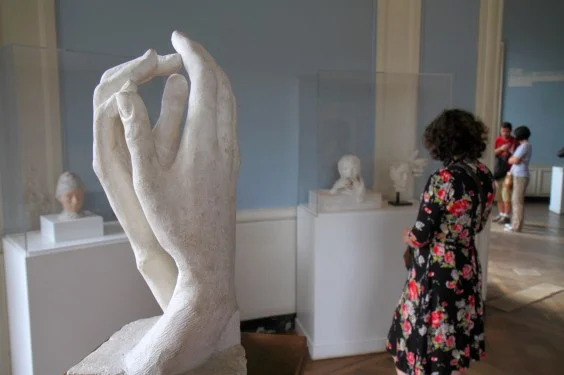
In the main hall of Philadelphia’s Rodin Museum, hands surround me, grasping out of the air. Each hand embodies a unique world of emotion: agonized hands, not quite clenched but splayed and seized with damned emotion; a desperate and curious hand outstretched as it rises from the grave, begging to crawl back to the world of the living; the partially open, hypnotic palm of the devil cradling a woman in despair; two lovers' hands almost intertwined yet just barely out of reach; soft, tender, and tortured hands. I can feel the whole inner life of whoever these hands belong to with just five fingers molded from clay and stone.
In one corner of the room, a bronze cast of Two Hands depicts the hand of Rodin and that of his longtime companion, Rose Beuret. Rodin's hand gently holds Beuret’s open hand by the wrist, as if studying it. No contextual plaque or complete figure is necessary to indicate that this is the hand of an artist. But like The Kiss, the grasp is tender and delicate, and the attraction nearly palpable in the space that exists between the hands. Rodin’s thumb softly strokes Beuret’s. Her hand is naturally posed, her palm open and fingers slightly curled, suggesting a comfort with the artist. I could easily close my eyes and picture the bodies attached to these hands, conjuring in my mind the sort of image that would take place moments before The Kiss. But doing so feels almost like a betrayal to the art. As Rilke pointed out, the hands have their own story, their own needs, their own feelings.
On the other side of the room, The Hand of God depicts creation as a sculptor carefully crafting Adam and Eve from clay. God’s hands emerge in human form from the Earth, big and strong in contrast to the fragile figure he is forming so delicately from the stone. Much like Rodin's typical style of sculpture, God forms his creations out of coarse blocks so that the smooth figures almost melt into the jagged material. As I observed the sculpture, my mind went to the book I was reading, Pure Colour. In it, Sheila Heti writes of the universe as a first draft, and her narrator constantly wonders how the rough edges will be polished in the next one. Early on, she observes, “Here in the first draft of existence, we crafted our own second drafts—stories and books and movies and plays—polishing our stones to show God and each other what we wanted the next draft to be, comforting ourselves with visions.”
In art, Rodin fashions himself into a god creating a new universe out of stone. Unlike the traditional, idealized sculptures that were popular and commonplace at the end of the 19th century, Rodin embraced rough edges and realism. His vision closely resembled that first draft which the Hand of God molds from stone, but on a smaller scale. No jagged edges are cut or refined, and instead he treats them as central to his vision. But if the first draft of the universe is a chaotic and overwhelming mass of tension and emotion, Rodin’s vision is one in which those complicated tensions and big emotions can be understood in small space. He does not make the feelings any less complicated or all-consuming. Instead, he breaks them down to fit within the tiny details of the body.
Perhaps this is why Rodin became so special to me in my first months in Philadelphia. I was overwhelmed by transition, spit out of college into adulthood with a plethora of traumatic experiences to process: two years of police raids, kidnappings, suspensions, and evictions. I was in a new city before I had fallen in love with it, where at the time all I knew was the Liberty Bell and a baseball team I hated. I was and still am in that chaotic period of life where I don't know where the next year is going to take me. Nothing is planned, and little seems to be looking up. But in the Rodin museum, I can walk among the vision of the universe that I so desperately need. I can focus on the weight on my hands and the tension in my fingers, and hold the worlds of emotion in my palm.