Brazil is using forensic science to tackle illegal gold mining in the Amazon, a top threat to the rainforest, Indigenous groups and other communities there that has accelerated deforestation and driven mercury contamination to dangerous levels.
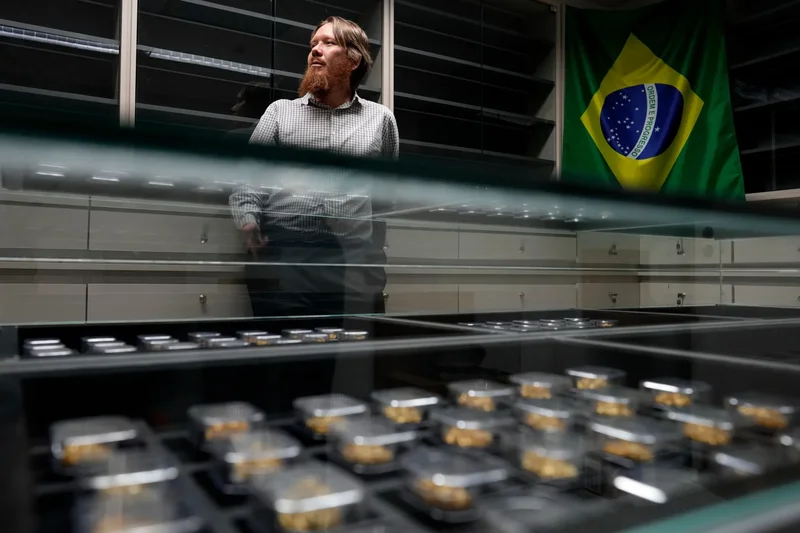
The work takes place at the National Institute of Criminalistics in Brasilia, the country’s capital, where federal police have set up a “gold lab” that collects and analyses samples from across the country.
The objective is to determine if a newly acquired sample — gold seized in a police raid, for example — comes from a protected area, meaning it has been illegally mined. It’s called “gold fingerprinting” — tracing the origin of gold samples with high precision.
Tracing gold is like looking at a person’s DNA, experts say
At the lab, sparkling gold flakes are kept in tiny, coin-shaped vessels, but the most valuable thing about them is the data they hold. Each speck is unique because while it forms in nature, inside a rock or a riverbed, the gold deposits absorb particles from the area, such as traces of silver and copper.
And that’s the fingerprint. It allows the investigators to determine if gold seized during a police raid was actually mined in the area its purported owner claims it came from, or if it was illegally sourced from a national forest or Indigenous land — in which case its analysis would match stored data from the protected area.
Gustavo Geiser, a federal police forensics expert, says the method has been developed since 2019 in collaboration with Brazilian universities. The investigators use tools such as X‑ray fluorescence spectrometry, scanning electron microscopy and laser ablation mass spectrometry.
“As we advanced, the forensic examinations became increasingly complex,” Geiser said, but the question before them was always the same: “Where did this gold come from?”
If the forensics prove a gold sample was illegally mined, the information then helps police build a case and move forward with further investigations and possibly charges.
Criminals insert illegally mined gold into legal markets
Those involved in environmental crimes in the Amazon frequently resort to fraud to introduce their goods into legal markets, not just when it comes to gold but also for cattle and timber. Lately, a worldwide surge in gold prices has only spurred on the mining rush in the Amazon rainforest.
Amazon Mining Watch, a platform that uses satellite imagery to track mining, estimates that about 496,000 hectares (1.2 million acres) of rainforest have been cut down for mining since 2023, including some 223,000 hectares (551,000 acres) in the Brazilian Amazon.
Brazil’s Federal Court of Accounts, its top audit institution, said last year there was evidence indicating that mining permits granted by the National Mining Agency to small-scale miners were being used to pawn off gold extracted from protected areas in the Amazon.
Greenpeace, in its own independent report in May, based on publicly available records, satellite imagery and aerial surveillance, detailed how the scheme works.
On paper, an owner of a legally authorized mine in the Amazon would declare that tons of gold had been extracted at that mine.
However, satellite and aerial imagery would show that there had not been any activity at the site of the legal mine. Meanwhile, images of bordering Indigenous lands, where mining is banned, would reveal large-scale mining operations — a “ghost mine” scam as Greenpeace calls it.
A federal court in Para, a northern state severely impacted by illegal mining, issued an order this month for institutions like the Central Bank and the National Mining Agency to enact effective control and traceability of all gold, from the mines to the markets. Brazil’s federal prosecutors also filed a lawsuit against the National Mining Agency, seeking better oversight of mining permits.
Prosecutor André Porreca, who is leading the case, said the permits have become a front used “to launder gold extracted by criminal organizations from Indigenous territories and protected areas.”
Geiser, the forensic expert, says the Brasilia gold lab is an important piece of the puzzle that helps battle crime and strengthen global gold supply chains.
“Being able to state that it (gold) has a legitimate origin and therefore is valid for inclusion in a country’s or a bank’s financial reserves, I believe provides solidity not only to the market but also to the countries’ financial bonds,” he said.
There is no data on how many criminals the lab has helped put behind bars, but Geiser says crime networks have recently begun exploiting neighboring countries such as Venezuela, French Guiana and Suriname, to launder illegally mined gold. Samples from abroad have made it to his lab, where they have joined the constantly growing database, he said.
The growing crime has also forced regional countries to strengthen collaboration through the Amazon International Police Cooperation Center, headquartered in the Brazilian city of Manaus.
Illegal gold mining leads to devastating mercury contamination
The Amazon is the world’s largest rainforest and a key regulator of global climate, so anything that degrades it could accelerate global warming, researchers say.
A 2023 analysis by MapBiomas, a nonprofit that monitors land-use, said that over 90% of Brazil’s mining is taking place in the Amazon region, with nearly 40% of it illegal, in protected areas.
Though illegal gold mining is a relatively small driver of deforestation, compared to agriculture, the harm it inflicts on the environment is nearly impossible to reverse — especially because of the use of mercury to extract gold. Once the gold is separated, the mercury is released into the rivers, contaminating water sources and fish essential to Indigenous life.
A 2023 study by Fiocruz, a Brazilian science institute, said 21.3% of fish in Amazonian markets exceeded the World Health Organization’s safety limits for mercury levels — with children between 2 and 4 years old consuming mercury at levels up to 31 times the recommended maximum.
Brazil signed the U.N. agreement known as the Minamata Convention on Mercury, which commits it to eliminate mercury use in gold mining.
The Ministry of Mines and Energy published a draft this month on easing out mercury that’s up for debate, meant to take place until Aug. 7. Federal prosecutors have urged that Indigenous groups — the ones most affected by the contamination — be consulted, but that has not yet happened.
A total ban on mercury would both curb environmental contamination and also bolster forensics investigations, according to Geiser of the federal police, whose lab can detect any traces of mercury in its samples.
“It will make it even clearer that any mining using mercury … is illegal,” he added.
The Associated Press’ climate and environmental coverage receives financial support from multiple private foundations. AP is solely responsible for all content. Find AP’s standards for working with philanthropies, a list of supporters and funded coverage areas at AP.org.
Sign up here.