An increased reliance on a diet replete with traditional food combinations, which are rich in carbohydrates but low in protein, and low intake of vegetables and fruits are at the centre of the debate on Kerala’s obesogenic environment.
Research suggests that across cultures, food preferences are formed early in life.
Public health researchers have thus been increasingly stressing on the importance of teaching children what constitutes healthy/unhealthy food so that healthy eating habits are developed early.
“It is critical that we teach children at a young age the connection between food, nutrition, and health. Internationally, there have been several interventional experiments, which suggest that children are capable of classifying foods as healthy or junk as early as three years of age if we give them the right messages and that it can impact their food choices later in life,” says a Health official.
The mass media education wing of the Alappuzha district health administration has now taken up this challenge of catching them young and instilling clean, healthy habits in them, but through a fun way.
The Health department launched the comprehensive school health programme—‘Aksharam, Aarogyam’—last year, in cooperation with the General Education department, targeting children from Classes I to XII.
The main aim was to take health awareness from classrooms to homes by empowering children with the right health information and clean habits as they could play an important role in influencing their families to adopt healthier lifestyles.
“We thought we will target children in lower primary classes because young minds grasp food concepts better, especially when you link it to a function of the body. So when they choose a food, they will remember if it comes in the healthy category and what it can do for their body,” said R. Sethunath, deputy mass media education officer.
Interactive games
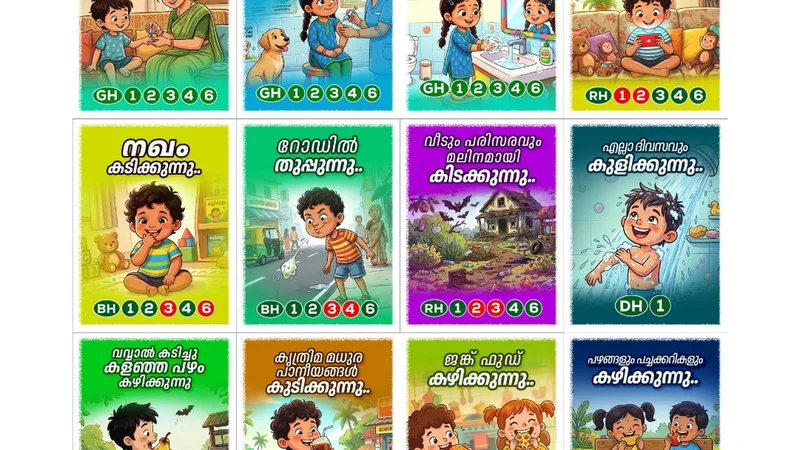
Instead of routine messages on healthy habits, the health education wing has turned these into interactive games of cards. Three card games, focusing on healthy habits, food, and nutrition have been devised. The plan is to print these and distribute it to all 532 lower primary schools in Alappuzha.
“We have used AI-generated, attractive and colourful images to convey the concepts and printed them as cards. So there is a sweet, chubby potato rolling its eyes, a sprightly green cucumber or a colourful healthy plate of food and each of the images convey its health benefits,” he added.
One of the games promoting healthy habits uses the ‘snakes and ladders’ format, healthy habits taking one up while unhealthy habits can pull you down. The games on healthy eating, food, and nutrition are like a regular game of cards where one picks up or discards cards to form sets.
The cards thus help young children pick up cues on what foods to choose for good health, how each food group benefits the body, or what foods one should consume less of, to have good health.
The health education wing had done a trial run and collected feedback from tutors and nutritionists before finalising the games.
Dr. Sethunath said the themes can be changed seasonally or at regular intervals. “Instead of food, we can focus on a theme on environment or physical activity or disease prevention. This is an experiment in intervention, to encourage children to think about what they are eating and to guide them away from the path of obesity. We can refine on the model as we go along,” he added.
Published - July 24, 2026 08:41 pm IST