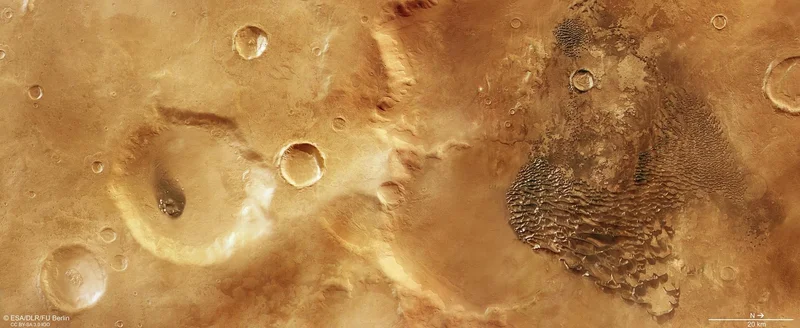
When we think of Mars as the âRed Planetâ, the image that comes to mind is just that - a lot of red. That comes from the oxidization of the dust and rocks that cover the planet's surface, but there are some instances where the Red Planet still has a few visual tricks up its sleeve. One such trick was recently captured by the European Space Agencyâs venerable Mars Express orbiter, which captured what seems to be a set of metallic waves inside a giant impact basin. But on closer inspection, it becomes clear they arenât liquid metal or some sort of alien architecture, but a manifestation of Marsâ complex environment.
The picture in question focuses on Kaiser Crater, a massive impact basin measuring 180 km across, and reaching a couple of kilometers deep. Itâs part of Noachis Terra, an area of the southern highlands that was heavily bombarded a few billion years ago, and lent the name the Noachian Period to that particular epoch of Marsâ history. Since Mars lacks plate tectonics or a thick atmosphere to constantly erase its surface features, craters like the Kaiser crater can remain preserved for billions of years.
One of the most striking parts of the image is the âmetallic wavesâ that cover much of the craterâs floor. Theyâre actually a set of sand dunes, which can reach over 100m high in some places, and stretch over several kilometers. So why do they look so metallic?
It comes down to contrast. The sand that makes up these dunes is very dark and volcanic, and composed of minerals like pyroxene and olivine. These images were also taken during the second half of the Martian southern winter - which means thereâs an unexpected feature on these dunes - hoarfrost. Seasonal frosting events creep up from the south pole and can reach into the Martian mid-latitudes, causing bright deposits of hoarfrost to cling to the southern side of the dunes. Its bright white gleam contrasts with the dark volcanic sand creates an optical illusion that almost makes it seem like the dunes are made out of polished metal.
In addition to being visually stunning, the dunes are also informative of the wind-driven geology on Mars. The dune field itself is broken into a mix of distinct shapes that provide insight into what the local air patterns look like. At the edges of the field, there are crescent-shaped dunes that seem relatively solitary. These are known as barchan dunes, which are common in Earthâs deserts, with their âhornsâ always pointing downwind. Closer to the center of the field, you can begin to see where the barchans merge into long, parallel ridges that run perpendicular to the wind. These transverse dunes are the most iconic in terms of visualizing a desert, but they also help scientists determine which direction the wind is blowing - in this case, from the west.
But the dune field itself isnât the only interesting part of the image. Nearby, the wind has stripped away the Martian topsoil to expose lighter-colored deposits beneath the volcanic sand. Those lighter color strips are most likely clay minerals - which means they were formed in the presence of water. Also, if you look closely at the steep inner walls of the craters, you can begin to see narrow gullies. Some of those might have been caused by dry landslides. But thereâs a possibility that some were caused by melting ice long ago, in Marsâ wetter past.
Bird's eye view of the blown dunes in the Kaiser Crater. Credit - ESA/DLR/FU Berlin
All of these images have come to us courtesy of the High Resolution Stereo Camera (HRSC) onboard the Mars Express orbiter, which has been orbiting the Red Planet since 2003. These latest images, which were released by the Freie Universität Berlin and DLR, Germanyâs space agency, prove that, even after more than 20 years, an old workhorse of an orbiter can still provide new, valuable science, as well as some pretty breathtaking pictures.
Learn More:
ESA - Metallic waves on ancient Mars