At the end of July in the year 711, the troops of General Táriq ibn Ziyad defeated those of King Don Rodrigo in the battle of Guadalete. Thus began the Islamic invasion of the Iberian Peninsula, ending the Visigothic Kingdom. But in the southeast of Hispania, there was a pocket of resistance. The region of Tudmir, which stretched across parts of the current provinces of Alicante and Murcia and was governed by a Visigoth nobleman named Teodomiro (or Theodomir), put up an effective fight.
As the territory was too large for the invaders to assimilate, they reached an agreement with the Visigoths. In April 713, the Pact of Theodomir was signed, allowing for the existence of a kūra — an Islamic administrative territory — in Tudmīr that would remain a Hispano-Roman population under the protection of the emirate and later the caliphate. Christians could continue to worship in exchange for a tax. A new study titled The Early Christian Church of Cerro de la Virgen (Calasparra, Murcia). Coexistence and Taxation in the Kūra of Tudmīr, published in the journal Saldvie, tells of the discovery of a Christian church that maintained its usual religious activity until the 9th century.
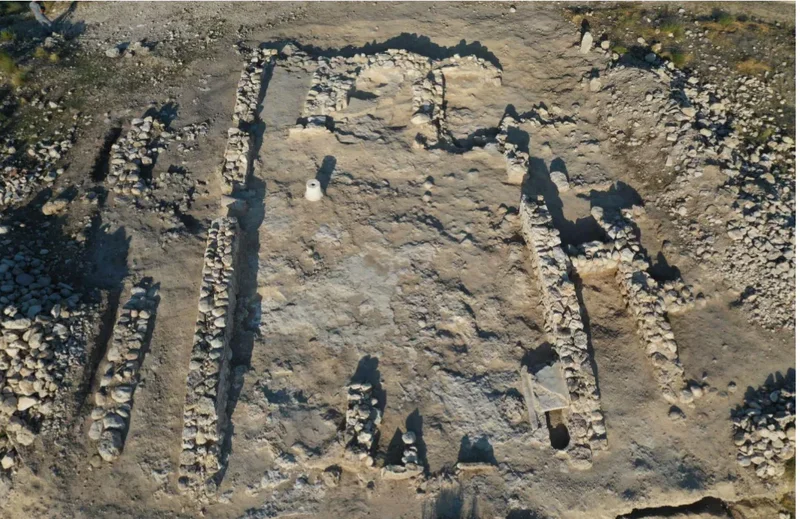
The first archaeological surveys of the Cerro de la Virgen site, surrounded almost entirely by the Segura River and located in front of the cave sanctuary of Nuestra Señora de la Esperanza (Our Lady of Hope), were carried out in 2021 and were followed by two excavations in 2024 and 2025. These excavations led to the discovery of the early Christian church, located in the highest part of the settlement. The church is a relatively small, single-nave structure with an overall rectangular layout. The central apse is semicircular and slightly oriented towards the southeast, flanked by two straight-sided lateral chambers or sacristies. The church was 15 meters long and 8.70 meters wide.
Inside the church, archeologists found a 6th-century tomb that contained the remains of a young woman and a fetus. The mitochondrial DNA points to “a common maternal lineage,” a burial of mother and child.
As David Martínez Chico from the University of Valencia and Rubén Fernández Tristante explain in the study, the walls of the nave were plastered with lime and its only two columns supported an arcade in front of the altar, although only one of these has been found in situ.
“This represents an architectural model with notable parallels to Visigoth churches such as Santa Cristina de Lena [Asturias],” according to the authors of the study. “The sacristies and apses have remarkable parallels to parish and episcopal churches in Syria.”
Architecturally, the building indicates a single phase of construction, dating back to the 5th century, in which a rectangular nave was erected, internally articulated in various liturgical spaces and topped to the east by a tripartite chevet. Between the 6th and 7th centuries, small annexed rooms were incorporated, especially on the southern flank. Both the nave and the annexes show signs of use corresponding to the 8th and 9th centuries.
After its abandonment and once the building was in a state of ruin and desacralized, the church experienced a phase of residual reoccupation between the 10th and 11th centuries, according to the study, which was part of a joint project launched by Valencia University and the Calasparra council. Many of these dates have been established via radiocarbon dating funded by Banco Santander and the Palarq Foundation.
Coins of Gallienus, Constantius II and Theodosius I have been found inside the church and in its surroundings as well as an Abd al-Rahman III dirham. Also unearthed was pottery from between the 8th and 10th centuries, a scales plate and three bronze Andalusian weights as well as an iron weight. Everything indicates use in the 9th century while a deposit appears to have been produced at the end of that century or the beginning of the 10th. One of the weights bears the words al-ʿadl li-llāh (justice comes from God), while the others bear an illegible Arabic epigraphy.
The researchers believe that “the pottery, with its containers and kitchen ceramics, should not be understood as evidence of a desacralization of the church or conversion into Islamic dwellings. On the contrary, such materials should be analyzed as indicators of a continued use of the space for community practices such as worship and resource management. The typological and stratigraphic study of the ceramics points to a persistence of the liturgical character of the church until well into the 9th century.”
The church of Cerro de la Virgen is tied to the populations of Mozarabs — Christians living in Islamic Spain — who survived well into the Caliphate of Córdoba in the 10th century. The researchers state that “the ecclesiastical hierarchy was unable to sustain the advantageous pacts of the time of the conquest, while the growing centralization and fiscal efficiency as well as the urban attraction of Córdoba eroded the productive base of churches, monasteries, and Christian elites.”
The Christian population “was progressively trapped between two converging dynamics: on the one hand, there was the growing capacity of the Andalusian State to reorganize the territory and ensure fiscal extraction; on the other, Islamization operated as a route to social and legal accommodation,” since it freed converts from paying taxes for their Christian beliefs (Gizya).
Thus the Umayyad Caliphate achieved full Islamization. The rest of the Christian settlements of the kūra of Tudmīr, such as Begastri (Cehegín, Murcia) and El Monastil (Elda, Alicante), may have survived until the 11th century but material evidence of this is very fragmentary. According to Martínez Chico and Fernández Tristante, “The cerro was a Christian community subjected to the taxes of the Islamic State and forced to insert itself into the regional fiscal and commercial circuits.”