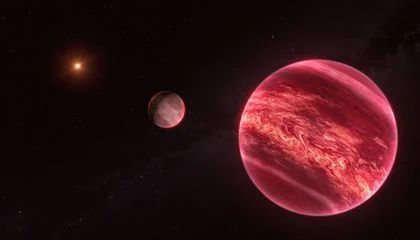
A newly discovered celestial object seems to blur the line between planet and moon, leaving some astronomers puzzled over what to call it.
Scientists have found thousands of exoplanets—those beyond our solar system—since the first two were discovered in 1992. But moons orbiting those distant planets have remained elusive, even though astronomers suspect that many exist. Now, they’ve found something that might be even stranger.
Astronomers have spotted an object estimated to be roughly as massive as Jupiter. Oddly, it orbits a brown dwarf—a “failed star”—which in turn orbits a small star. This unusual three-tiered hierarchy was seen in a star system called CD-35 2722 that’s located about 73 light-years from Earth. The findings, reported in the journal Nature on July 22, highlight the diversity of objects in the universe and forces some astronomers to rethink astronomical labels.
Study co-author Kevin Hoy, an astrophysicist at University Diego Portales in Chile, and his colleagues are calling the planetary-mass object an “exosatellite.” It doesn’t exactly fit the category of exomoon, since it’s not orbiting a planet, but the title exoplanet doesn’t quite work either, as it doesn’t circle a star, he tells Lisa Grossman at Science News. “The structure of CD-35 is so different from the structure of the solar system that all the words we invented to describe the solar system just aren’t really working anymore.”
The exosatellite label seems “appropriate,” says Mary Anne Limbach, an astronomer at the University of Michigan who was not involved in the study, to Keith Cooper at Physics World. “The field needs language for companions that do not neatly fit into the traditional categories of planets and moons, and ‘satellite’ seems to be the broader term that the field is gravitating towards.”
From October 2023 through February 2026, Hoy and his colleagues periodically monitored the brown dwarf in CD-35 2722 using the Very Large Telescope in Chile. That yielded 23 high-quality observations of the failed star’s stellar wobbles—the small shifts in an object’s position caused by the gravitational pull of an orbiting companion.
Need to know: What’s a brown dwarf?
Coincidentally, brown dwarfs are also odd objects that sit between planets and stars. They form the same way stars do—gas collapsing into a dense core—but they don’t have enough mass for nuclear fusion, which generates starlight.
Plugging the data into computer simulations hinted that a single companion completes an oval-shaped circuit around the brown dwarf every 170 days. The object is estimated to have at least 0.9 times the mass of Jupiter.
Still, there are many unknowns. For one, the exosatellite might actually be way more massive than the team calculated. Hoy tells Adam Kovac at Scientific American that the object’s size likely means it’s mainly made of gas instead of rock, ice or metal.
Additional data might also reveal that the odd body is simply a brown dwarf, Limbach tells Physics World. That’s what astronomer Nader Haghighipour suspects it is. “To me, the entire system is only a system of three substellar bodies,” says Haghighipour, of the Planetary Science Institute in Hawaii, who wasn’t involved in the research, to Colin Stuart at Sky & Telescope. “The Jupiter-mass body is not a satellite.”
And Roman Rafikov, an astrophysicist at the University of Cambridge who also wasn’t involved in the study, considers the star-brown dwarf combo to be a binary system, per the outlet, making the strange celestial object simply a planet orbiting one of the system’s components.
Hoy, for his part, welcomes the debate over nomenclature. The brown dwarf is “the perfect place to kick-start this kind of conversation because the system is like the perfect test bed for arguing about things,” he tells Scientific American.
“The star is clearly a star. The brown dwarf is also clearly a brown dwarf. Now we have this new object that is too big to obviously be a moon,” he says. “How we draw the line between what’s a moon and what’s a binary planet is all very fuzzy at the edges.”