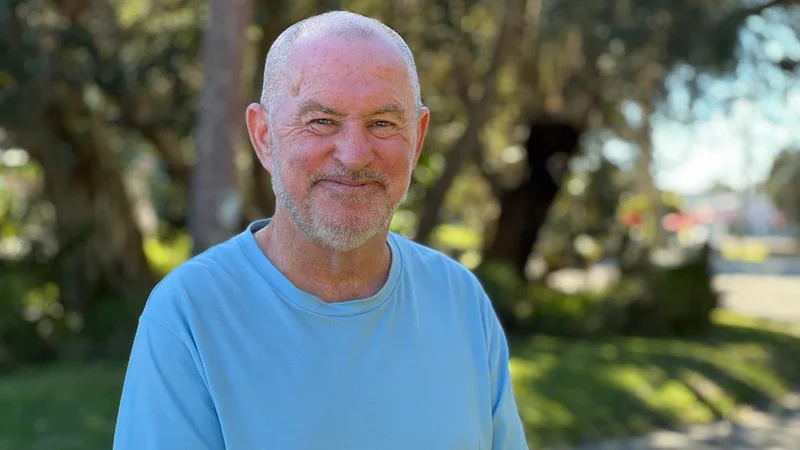
Former Socceroos captain Paul Wade has revealed he has been diagnosed with "probable" chronic traumatic encephalopathy, which has been linked to repeated head knocks and injuries.
In a statement put out by Professional Footballers Australia (PFA) on Wednesday, Wade said he was diagnosed in late 2024 with a suspected case of the disease after experiencing neurological symptoms.
He said this was upgraded after further assessments to probable in 2025.
The disease can only be confirmed after death.
"They did the tests … and [the neurologists] went, 'Oh, we've got a real problem here'," he told the ABC.
Symptoms of the disease can include depression, memory loss, tremors, poor impulse control and suicidal thoughts.
After scans showed it was probable CTE he said he just "stood there" and thought "am I going to die from this?"
Wade revealed a diagnosis of probable chronic traumatic encephalopathy. (7.30)
Wade's neurologist Rowena Mobbs made the "probable" diagnosis after two years of monitoring his symptoms and extensive testing.
Dr Mobbs said neurologists across Australia started using "probable" diagnoses to refer patients to the right treatment.
"It's not about fear, it's not about giving any definitive diagnosis, but it's about getting appropriate care and support to people,"
she said.
"I think Paul and his family want to see people in the community feeling confident that they can come forward for help and getting that right dementia care."
'He knew something was wrong'
Wade, who now lives on the Central Coast, north of Sydney, said receiving the diagnosis was "difficult" but wanted to share his experience to raise awareness of concussion and brain health across all levels of football.
"Football gave me so much. It gave me a life, a career, incredible experiences and the privilege of representing Australia," he said.
"But I also must be honest about the challenges I now face and the uncertainty that comes with living with a neurodegenerative condition."
Asked whether the probable diagnosis was linked to his time playing, he said "it must have had something to do with it".
"I think about the number of times at a training session I headed a ball."
Dr Mobbs said Wade expressed a level of "validation" when he received the "probable" diagnosis.
"He knew it in himself… He knew something was wrong, he knew it felt different," she said.
Head of neuropathology at Sydney's Royal Prince Alfred Hospital, Michael Buckland, said a "probable" CTE diagnosis should be used for research purposes rather than in a clinical context.
"We have no idea how accurate that [diagnosis] is, it's still being tested," he said.
"The authors of the paper, that defined what probable CTE is, strongly cautioned against using it in a clinical setting, and they and others recognise the real risk of harm in giving someone a diagnosis that you can't really be confident about."
However, Dr Buckland commended Wade for raising awareness of the condition.
"I think he's done a very generous and courageous thing by speaking publicly," Dr Buckland said.
Doctor urges ban to headers by children
Rowena Mobbs said Wade's diagnosis came after "extensive testing". (ABC News: Michael Nudl)
After 30 years of exposure to head knocks in soccer, including headers, Dr Mobbs said repetitive traumatic brain injury was the "main burden" for Wade.
Dr Mobbs urged Football Australia to ban headers for children playing soccer under the age of 12.
"We must hold onto our activity and sport in life, for our kids especially, but we need to lower the repetitive head injury burden,"
she said.
"That's where we need good care in the community, with our excellent health systems, the government to step in and provide funding for research, and for us all to be aware of our lifetime burden of head injury and try and prevent it where possible."
Sixty-four-year-old Wade, who led the national team for six years in the 1990s, said more understanding was needed about the long-term effects of repeated head impacts to "protect future generations".
"If sharing my experience can help someone seek support, create better education and prevention, or help the game take brain health more seriously, then it is worth doing," Wade, who also lives with epilepsy, said.
'Advancement of the game'
Wade's announcement comes less than a month after Four Corner's revealed 33 Australian Rules players had been diagnosed with CTE.
Wade (left) leading out the Socceroos for the 1993 Australia v Argentina FIFA World Cup play-off match. (Getty Images: Joe Mann/Offside)
He said people concerned should not stop playing contact sports "because if you do we're going to have an even bigger problem with mental health and wellbeing".
"To the people actually making the rules we've got to come up with ways we can make it safer," Wade said.
"If I could say to Football Australia, or even FIFA, if you're listening, let's put some protocols in there because you've got everything about concussion.
"[But] you don't talk about CTE and how we can change the game and change the training and change the age so that it's minimalised, so we're not exposing kids to CTE."
He asked who was going to "stand up and be brave and say no", and assert boundaries.
"Someone's got to say no. Kids are … heading a ball 12 years or under. Make it 14, I don't care," he said.
PFC Chair Francis Awaritefe urged sporting organisations to ban heading for young players, particularly until children learn the "proper technique".
"We shouldn't even be waiting, I think we should be doing it now," Mr Awaritefe said.
PFA chief executive Beau Busch said Wade's decision to open up about his diagnosis was an "important act of leadership".
"In sharing his story Paul has once again illustrated his truly remarkable commitment to the advancement of the game,"
Mr Busch said.
"He is doing so not only for himself but for the players and families who are facing, or may one day face, similar questions about brain health."
Mr Busch said Australian football must be proactive in tackling brain injuries "through better policies, research, education and support for former players".
A decorated career
Wade, who was born in England in 1962, came to Australia at 11 years of age with a passion for football, moving his way up to senior positions within Victorian clubs including Croydon, Green Gully, Brunswick and South Melbourne.
In 1985 he claimed a spot in the Australian team, playing his first full international against Czechoslovakia the following year.
He then captained the Australian soccer side from 1990 to 1996.
Wade was captain of the Socceroos for six years. (News Video)
On Football Australia's website Wade is credited with 345 national league appearances, 119 matches played for Australia, and 84 full internationals.
Wade also played in the 1988 Olympic Games and two World Cup qualifying campaigns.
After he retired as a player he became involved with TV commentary and coaching clinics for kids.
His career and the impacts of his neurodegenerative condition will be explored in an upcoming mini documentary being produced by PFA.