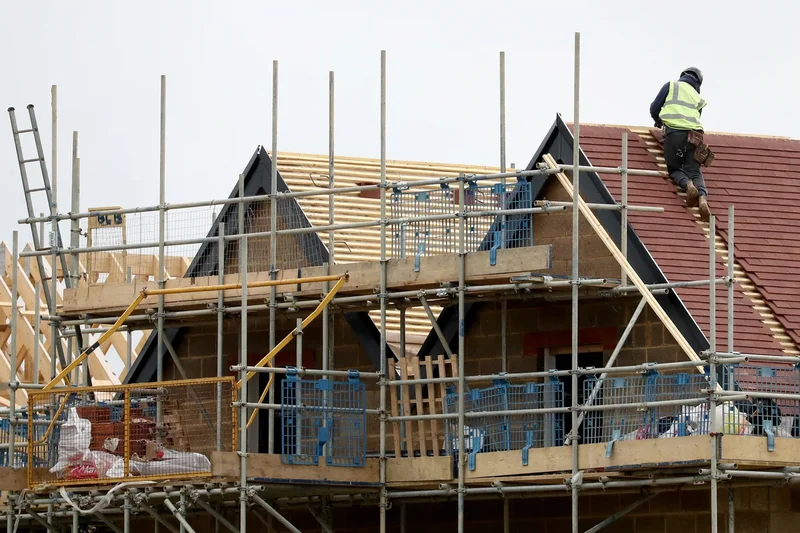
People have underestimated me all my life. If you tell me I cannot do something, I will fight like hell to get it done.” Angela Rayner, the reincarnated housing secretary, is thus defiantly sticking to the ambitious target set in the 2024 Labour manifesto to build 1.5 million new homes “over the next parliament”, due to end by 2029.
It is fair to say progress on the building sites is running behind schedule, with only 400,000 or so net new homes built so far. If Ms Rayner really thrives on reverse psychology, as she claims, the country should unite in telling her she’ll never hit her target whenever she appears in public – or even when she’s entertaining friends. It might be exactly the motivation she needs.
If only getting the residential construction sector and all the various arms of the state to meet the challenge was simply a matter of willpower – that, and the indefatigable spirit of Ms Rayner – all might be well. But things have plainly been going wrong. As she herself admits, such a project is long term: “Houses don’t go up in five minutes. I wish they did – but it takes time.”
The obstacles to success are as plain as a lorry load of breeze blocks. Raw materials have been subject to the same inflation as other commodities; there are skills shortages across all the trades needed to meet the challenge; and consumer and business confidence has been hit by international volatility and hikes in taxation. Sluggish growth in real incomes has damaged affordability.
Mortgage rates, a key factor, have also been left higher than expected thanks to the war in Iran. All the while, Labour’s relaxation of planning rules and the hiring of more planning officers doesn’t seem yet to have galvanised local government sufficiently to clear backlogs and face down nimbyism.
Moreover, the Labour plan was, above all, a matter for the private sector to deliver once the government had created the right conditions, including some selective subsidies for social housing. In other words, it wasn’t just about “affordable” flats; the six-bedroom, double-garage-plus-utility-room mock-Tudor executive homes also counted towards the target, but were usually more profitable. Success was never directly in the hands of ministers, even theoretically.
Enter, through the front door of No 10, a new prime minister, one who has a taste for direct action and a faith in state control and provision of “life’s essentials”. He wants council housing – owned and controlled by local authorities, and rented out at fair (ie, below-market) rents.
This would be a minor revolution – but, as ever, there is as yet no detail to add to the broad aspiration he sometimes mentioned. The private sector would be invited and contracted to build these new homes, but, again, they might well run into labour shortages even before Mr Burnham runs out of money.
All the same, Labour’s housing target is worth keeping, precisely because it is a stretch. Indeed, it is a noble, if not essential, mission. In that context, and by way of offering further backing to Ms Rayner, she is right to reject rent controls. Historically, these have led to slums. The issue is supply.
There is no single sector of the economy better placed to make a success of this government than housing. Building more homes would immediately boost growth, create jobs, raise vital tax revenues and reduce the cost of buying or renting a modern, energy-efficient home. That, in turn, would alleviate the extreme pressure on younger people, especially as they try to find a place of their own or simply make ends meet with a roof over their heads.
A property-owning democracy, and one with a healthy supply of social or council housing at affordable rents, would be a more stable and prosperous place. A secure home, no matter how modest, offers children a base from which to pursue their ambitions, as Sir Keir Starmer used to remind us.
Those Labour ministers, such as Ms Rayner, who grew up in poorer households, understand this just as well. Now, she has another concrete opportunity to prove her doubters wrong again.