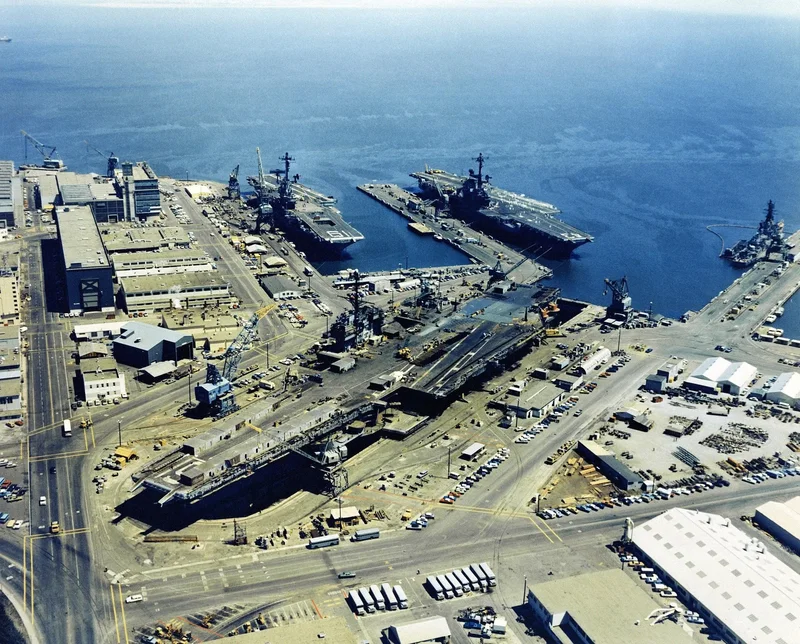
After decades of neglect, shipyard executives and forward-thinking politicians are finally realizing that workforce housing is important. In shipbuilding and advanced manufacturing, worker retention is critical in improving productivity. Access to affordable and nearby housing is a big part of that effort, and, in most shipbuilding centers, shipbuilders and politicians are taking a variety of collaborative approaches to address this fundamental human requirement. Shipbuilders do better work if affordable, high-quality workforce housing is available in nearby, livable communities. If not, the work and the workforce will go elsewhere.
New housing projects are springing up nearby every single big shipyard in America.
Shipbuilder Housing Is A Hot Topic
Solutions vary. In single-industry areas where housing costs are too high, shipbuilders are taking the housing challenge on by themselves. In Maine, General Dynamics Bath Ironworks is sponsoring dedicated workforce housing. The company maintains a “housing for shipbuilders” webpage, touting an 84-apartment complex located just a 20-minute walk away from the primary shipyard in Bath, Maine. It is a necessary project, as Maine’s waterfront communities have become recreational and tourist centers, pricing shipbuilders out of nearby homes. As such, General Dynamics plans to sustain their workforce by offering market rate rents, while reserving company-generated apartments for workers and Navy personnel.
In the submarine-building hub of Connecticut, the story is a little different. Like Bath, General Dynamics wants to hire thousands of new employees, and solid, affordable housing is at a premium. But the community is a little bigger and the local economy is diverse and relatively robust. With additional industries wanting workforce housing, state and local governments are simply trying to reduce zoning fights and ease the path towards accelerated development, subsidizing the construction of thousands of new units and converting properties that had been “sitting empty for almost a century.”
Hanwaha’s growing Philly Shipyard has been lucky enough to take advantage of long-standing residential development projects. The $285 million AVE Navy Yard housing development, has, after five long years, opened 614 apartments earlier this year, and 2000 more are planned—along with supportive commercial and recreational areas. It’s a first step in building a “City of Ships,” where shipbuilders can live, work and play.
Attracting investment is far harder in cities that have a more challenged economic outlook, and where a developer’s return on investment is limited. At fiscally-stressed Newport News, Virginia, home to Huntington Ingalls Industries’ aircraft carrier production yard, the Newport News City Council is embracing the challenge and focusing on innovation to become less dependent upon vanishing Federal support for workforce housing initiatives. The forward-thinking city council united around a “Strategic Housing Initiatives Plan”, otherwise aptly known as the “SHIP”, to meet anticipated workforce housing demands through 2050.
Rather than whine and engage divisive and community-destroying internecine warfare, the City of Newport News went an extra mile. The plan is packed full of innovative ideas, including a “Land Value Tax” that incentivizes housing by taxing only the assessed value of the land without the value of the buildings on it. It also proposes a “land bank” to support development of abandoned properties or conversion of troubled commercial structures that are, today, better suited for housing.
Other communities that have a diverse housing mix and wide demand are using tax credits to supercharge workforce housing. In Alabama, the state recently commissioned the “Alabama Workforce Housing Credit,” where workforce housing projects that qualify as Federal Low-Income Housing can be awarded up to an annual $2 million dollar credit for a decade. The first project funded in the shipbuilding center of Mobile, Alabama, a 70-unit project aptly entitled “Anchor Place” got underway earlier this year.
Shipbuilding Is Coming; Get Shipbuilder Housing Ready Now
Recent big shipyard collapses can trace back, in part, to workforce housing challenges. Louisiana’s Avondale shipyard, a chronically troubled facility, began a terminal collapse after the massive Hurricane Katrina wiped out nearby worker housing.
Grinding housing squabbles and restrictive building covenants have made existing shipyards like Bath Ironworks less competitive than their rival HII yard in Pascagoula. It is one of the reasons Bath Ironworks has struggled to get better terms for destroyers like HII, and why contracts for corvettes and other platforms have gone elsewhere.
For shipyards, worker housing is becoming such a priority that no big, new shipbuilding project in America is getting underway without a full housing plan—either one that is hidden and kept internal or one that is out there for all to see and debate.
Shipbuilding is a critical future industrial need. America will build a lot more ships and will, very soon, need workers to build them. In shipbuilding-ready locations throughout the West Coast, little extra housing is ready to absorb this new workforce. Without new housing, those workers will be forced into substandard housing.
This has happened before. According to author Doug Most, and his tour-de-force book “Launching Liberty”, housing demand was so high, inspectors at the World War II shipbuilding center of Richmond, California found 65 people living in a single house. In San Pablo, a few miles away, federal inspectors found “hundreds of families living in converted garages and sheds that were so horrendous they recommended burning the dwellings down.” A family of seven made a home out of a “windowless chicken coop.” While some California politicians seem to revere the prospect of a World War II-like shipbuilding recovery, without housing, a West Coast shipbuilding renaissance is impossible.
Workforce housing and the development of modern, sustainable worker-ready communities is an emerging national priority for every on-the-move political leader in America. Every presidential contender from the ranches of Sacramento, California to the ballrooms of Mara Lago, Florida are busy trying to crack the code for America’s high-tech maritime future. If America wants to secure the contested Pacific, enjoy global commerce, explore the vast sea floor, or be a good steward of the untamed Polar regions, America will need ships—and lots of them. The solution are contented workforces in shipbuilding cities. Get ready. Solid, affordable shipbuilder housing is an issue that will roil the next Presidential race.