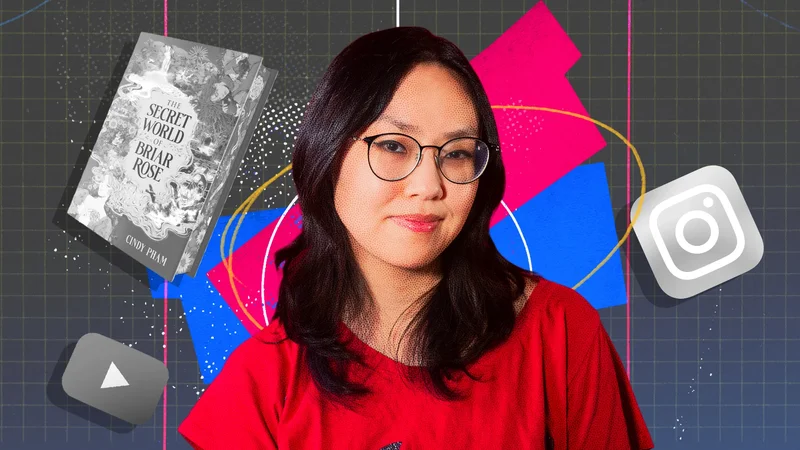
Before Cindy Pham became a New York Times bestselling author, she spent years building an audience on YouTube as Read With Cindy, where nearly 600,000 subscribers tune in for her thoughtful book commentary. In today's publishing industry, that's the kind of platform many authors dream of, one that can help sell books long before readers crack open the first page.
But Pham has always been wary of turning creativity into a commodity.
She still works full-time as a graphic designer, deliberately keeping writing and content creation separate from the job that pays her bills. It's a choice that gives her the freedom to write slowly, chase ideas that genuinely excite her, and resist the pressure to create for algorithms or sales numbers.
You May Also Like
That philosophy shapes every part of her career, from the way she approaches YouTube to the way she wrote her debut young adult novel, The Secret World of Briar Rose, a sapphic reimagining of Sleeping Beauty that asks one haunting question: What if Sleeping Beauty didn't want to wake up?
For this edition of Creator Playbook, Pham reflects on balancing three careers, navigating the blurry line between author and influencer, and why she believes the goal isn't representation — it's resonance.
Mashable: Before nearly a million people followed your book recommendations on YouTube and TikTok, what was your relationship with books and reading growing up?
Cindy Pham: I actually wasn't a big reader growing up. I started reading avidly after I graduated from college, and I think part of it was that no one was telling me I had to read anymore. Once it became something I chose for myself instead of an assignment, I became much more interested in it.
Writing actually came first. I'd been writing since elementary school as a form of escapism. Reading came later, and thankfully, that made my writing a lot better. You're probably not going to become a good writer if you aren't reading a lot of books.
I definitely came to reading later than most people. I missed the Twilight era, The Hunger Games, Harry Potter — which, in retrospect, maybe missing Harry Potter wasn't the worst thing. But once I started a YouTube channel dedicated to talking about books, it made me much more conscious of the stories I was consuming. It helped me understand what I loved, what I didn't, and ultimately the kinds of stories I wanted to write. It was a little backward, but everything came together in the end.
What came first: the YouTube channel or the idea for The Secret World of Briar Rose?
The writing always came first. In elementary school, I'd get obsessed with a video game or TV show and write novelizations of it. In middle school, I wrote fanfiction. By high school, I was writing original fiction, and during my senior year, I wrote the first draft of The Secret World of Briar Rose. Then I went to college and put writing aside to focus on becoming a designer.
After graduation, I started reading a lot more. I was reading so much that I needed somewhere to talk about the books because posting a photo on Instagram just wasn't enough. I wanted to rant about whatever shenanigans had happened in the story, so I started a YouTube channel. Honestly, I thought I'd lose interest after a week or a month. It was just something to do. But people started watching, commenting, and subscribing, and that encouraged me to keep going.
The channel really grew alongside my interests. I've always approached content creation by making videos about whatever I'm genuinely excited about, rather than thinking, I need to make a video about this because it'll perform well. As I became more immersed in books and storytelling, my brain kept returning to that novel I'd written in high school. Only this time, I had a fully developed frontal lobe. I was more socially conscious, more politically conscious, and much more widely read.
The core of the story stayed the same. I'd always wanted to write about depression and suicidal ideation, using Sleeping Beauty as an allegory. But revisiting it as an adult gave me the tools to tell that story with a lot more depth. Reading a lot of books doesn't necessarily make you a better writer. I think it makes you a more purposeful one. It helps you figure out what you actually want from a story instead of chasing whatever the average person thinks makes a good book.
One thing that really stood out to me is that you still work a full-time job as a graphic designer while writing books and making YouTube videos. A lot of creators wrestle with when, or whether, to quit their day jobs.
I like my job being just a job. It gives me financial security, which means I can write books and make videos because I genuinely enjoy doing them, not because I need them to pay my rent or because I need strangers on the internet to like me to make a living. That balance has been really important for me.
I see similar pressures with full-time creators and full-time authors. When your creative work becomes your entire livelihood, everything feels heavier because it's your whole world. I don't want to put all my eggs in one basket, especially living in New York. It becomes harder to enjoy what you're making when it's fully monetized, and you're constantly worrying whether you can live off it.
I'm also a very slow writer. I like to sit with ideas. I like to experience life and let that inform the story. That isn't always compatible with what publishing wants, so I'd rather create on my own timeline than someone else's.
I'm always amazed by someone like Brandon Sanderson, who's somehow writing thousand-page books every other year.
[Laughs.] That's definitely a particular kind of creative personality. I'm the turtle in that race. I like taking my time, and right now I'm also juggling three jobs: designer, content creator, and now author. That's been its own challenge.
One of the biggest buzzwords in the creator economy is authenticity. The creators who build the strongest communities are usually the ones who are the most authentic to themselves. Reading your book, it feels like that same philosophy applies here. This story feels deeply personal — not just because it draws from your experiences, but because it's rooted in the themes and worldview you wanted to explore.
I think there's definitely a lot of overlap. Being a content creator for so many years before becoming a published author helped shape that mindset. It thickened my skin when it comes to public perception, but it also reinforced something I've believed for a long time: I never want my livelihood to depend on whether people like me.
I want to create because I'm genuinely interested in something. If other people connect with it, that's wonderful. If they don't, that's OK too. I don't want validation, or my ability to pay rent, to depend on strangers enjoying my work. That's the attitude I've tried to bring into publishing as well.
Unfortunately, writers can't really just disappear into a room and write anymore. So much of publishing is now tied to your public identity. I think that's a shame, even if it's something that's ultimately worked in my favor.
We've written about that at Mashable — the way BookTok and social media have pushed authors to become content creators and marketers. Publishers increasingly want authors to have an online presence, to promote themselves alongside the book. You were already ahead of that curve because you had built a community before publishing.
I think it's a flawed system. Authors shouldn't have to become marketers. The book should be able to speak for itself.
At the same time, I recognize that I benefit from that system while also critiquing it, so I try to make the most of that privilege. One way I do that is by spotlighting other debut authors who don't have the same publisher investment or platform that I do. When The Secret World of Briar Rose debuted at No. 1, I made a point of highlighting other books that released the same day because there are so many incredible authors whose work deserves attention. A bestseller list isn't a pure meritocracy. It's also a reflection of which books publishers are willing to invest in and promote.
There's another downside, too. Because my name is so closely associated with the book, I don't think the novel will ever completely stand on its own. If someone thinks my videos are annoying, they'll probably approach the book with those assumptions. If someone loves my channel, they may expect the book to be a masterpiece before they've even opened it. Neither is really fair to the reader or the writer.
That's why it's so important for me to always come back to my North Star: why I wrote the book in the first place. It can't be about external validation or the credibility of being an author. It has to be about self-expression and writing something that would have mattered to my younger self, not writing for a market or an impossible standard. A lot of this is really about building the mental fortitude to resist the pressure of numbers, sales, and validation. I think creators and authors are fighting a lot of the same battles.
At least publishing gives you a team whose job is to worry about those numbers.
Exactly. [Laughs.] They're the ones who can worry about sales. I'm just here to have fun. The other thing that's been really meaningful is that everyone involved in the creative production of this book is a South or Southeast Asian woman. I'm Vietnamese. My editor is Pakistani. My cover artist is Filipina. My cover designer is Taiwanese. My interior designer is Black and South Asian. The imprint itself focuses on marginalized voices. So when something good happens to the book, it isn't just a win for me. It's a win for everyone who worked on it. Whenever I start getting too self-conscious, I try to think about the ripple effects. It's never just about me.
I know you're not supposed to judge a book by its cover, but I have to say: it's a gorgeous cover.
In this case, I absolutely think people should judge the book by its cover. I was lucky enough to have a lot of creative control over it. I got to put my designer hat back on and be really specific about the direction, even choosing the cover artist. That ended up being one of the most fun creative parts of the whole process.
I read your People essay
, which is beautiful, and you describe how public conversations around your book made you more self-conscious about your own identity and queerness. Looking back, do you think the internet made it harder to figure yourself out, or did it ultimately push you to ask questions you might not have otherwise?
I think it's both. The internet helped me become more socially and politically conscious. Honestly, I don't think I would've realized I was queer without it. I was exposed to more queer media and more conversations about identity and diversity, which changed how I understood both myself and the stories I wanted to tell.
Before that, my writing was very heteronormative. It was very colorblind. Becoming more aware of those things changed the way I approached storytelling. I was also the only "straight" person in my friend group for a long time. I met my girlfriend through the book community online, and even before I realized I was queer myself, I was participating in queer culture through friendships and allyship.
At the same time, being perceived publicly comes with its own pressures. Early on, people assumed I was a straight woman writing a queer story, and those conversations made me second-guess myself. I started wondering, What if they're right? What if I'm exploiting something I shouldn't be? I knew why I'd made those creative choices. The queer relationship wasn't there for representation alone — it reinforced the book's themes of escapism and the oppressive forces the characters were trying to escape. But the internet doesn't always leave room for that kind of nuance.
When my girlfriend first confessed her feelings for me, I didn't have an answer right away because I'd spent so much time compartmentalizing that part of myself. Even after we started dating, I worried I was somehow "queerbaiting" her. That's such an internet thought. A normal person who's never been online wouldn't think, "Oh my God, I'm queerbaiting someone." That's something that comes from living inside internet discourse.
Overall, though, I think the positives outweigh the negatives. As I've gotten older, I've become better at separating public speculation from who I actually am. People are always going to make assumptions about you online, but they don't really know you. That's why it's so important for me to have a balanced life and relationships outside the internet.
One thing you wrote that really stayed with me was the idea that your goal wasn't representation so much as resonance. What's the difference?
I completely understand why representation matters. When I see queer stories now — or Vietnamese women in books — that means something to me. But I don't think any marginalized group is a monolith. There's no single story that can represent every queer person or every Asian person. That's why I prefer to think about resonance. I'm not trying to write a story that represents everyone. I'm trying to write something that feels true to me.
If that resonates with another queer person, or another Asian reader, that's incredible. And if someone doesn't necessarily feel represented but still connects with the emotional truth of the story, that's meaningful too. For me, that's the priority. When I'm writing, I start with the character and the themes. Once I understand who this person is and what role they play in the story, then I ask how their identity adds another layer to those themes. I don't usually start with identity and build outward from there. I know other writers do that beautifully, but resonance is the framework that makes the most sense to me.
Looking back now, after more than a decade with this story, how does the finished book differ from the one you first wrote in high school?
It really grew up alongside me. The core idea was always there. I always wanted to write about depression and mental health. But high school Cindy didn't know herself or the world the way I do now. Living life, going through depressive episodes, going to therapy, growing older... all of that gave me the emotional intelligence to write richer characters.
Even when I wasn't actively working on the manuscript, I was still writing it in a way because I was living the experiences that eventually shaped it. The first draft was mostly interested in the personal. As an adult, I realized those personal choices are political, too. If your story is about characters escaping oppressive systems, then asking what it means to ignore politics is itself a political question. Those were ideas I never would've understood as a teenager.
I think of that original manuscript as a seed. Over the years, it just kept growing new branches as I learned more about myself and the world.
I love the central question of the novel: What if Sleeping Beauty didn't want to wake up? Even as a teenager, that's such an emotionally rich question to ask.
Thank you. I also think it's important that YA stories are allowed to be dark. I was a depressed, angsty teenager, and this is exactly the kind of book I would've wanted to read. Before you can get to hope, you have to acknowledge the darkness. Hearing platitudes like "It gets better" never really resonated with me because nothing is guaranteed.
I think it's more honest to say that there are objectively awful things in the world, and we still owe it to ourselves and to each other to stay here and help one another. Holding both of those truths at once is what growth looks like.
Crystal Bell is the Digital Culture Editor at Mashable, where she leads coverage of the creator economy, internet culture, and digital life. Her work focuses on the people, platforms, and communities shaping modern entertainment, from YouTube creators and livestreamers to fandoms, social media trends, and the evolving relationship between technology and culture. She also oversees the Mashable 101, the publication's annual list recognizing the internet's most influential creators.
Previously, she was the entertainment director at MTV News, where she helped expand the brand's coverage of fan culture, K-pop, and the internet's most passionate communities. Her work has appeared in Teen Vogue, Rolling Stone, PAPER, NYLON, ELLE, Glamour, NME, W, The FADER, and elsewhere on the internet.
She's exceptionally fluent in fandom and will gladly make you a K-pop playlist and/or provide anime recommendations upon request. Crystal lives in New York City with her two black cats, Howl and Sophie.