The United States military has burned through vast stockpiles of its ordnance, notably of its precision munitions and interceptors, specifically Tomahawk cruise missiles, Patriot air defense systems and Terminal High Altitude Area Defense interceptors. The ongoing conflict with Iran has seen more than 1,000 Tomahawks fired, exhausting roughly 10 times the annual procurement rate.
Inventories of the Patriot and THADD have been depleted by nearly 50%. As many as 1,100 long-range stealth missiles have also been expended, nearing total stockpile depletion for potential Pacific conflicts, The New York Times warned. It could take years for the supplies to be replenished.
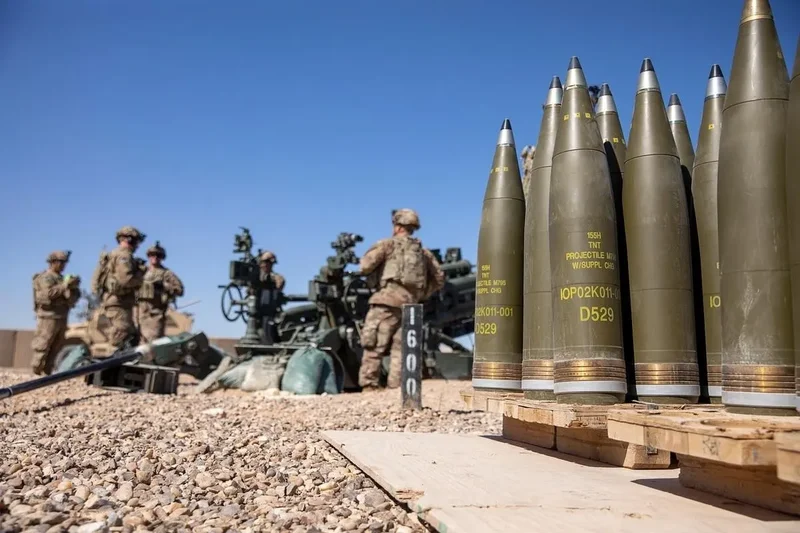
However, the United States military is also facing a shortage of another type of ordnance, the much easier-to-produce 155mm artillery round, which has been adopted throughout NATO and dozens of other militaries around the globe.
The United States has been among the nations providing the 155mm round to Ukraine. Since February 2022, when Russia launched its unprovoked invasion, the U.S. military saw its stockpile significantly depleted. More than three million were sent to aid Kyiv’s war effort alone.
New Plants Were Meant To Address The Issue
The issue with the ammunition shortage was so significant even three years ago that the Biden Administration announced plans to open new plants to increase shell production from just 14,000 rounds per month to 100,000 by October 2025 to meet the demand.
Unfortunately, the production effort continues to fall short, and as of this March, it had reached just 36,000 shells produced per month.
A newly released report from the Pentagon’s Office of the Inspector General found that the General Dynamics Ordnance and Tactical Systems facility in Mesquite, Texas, one of the facilities built specifically to produce 155mm artillery rounds, has not delivered the necessary components. That plant, which opened to significant fanfare in May 2024, cost U.S. taxpayers around $469 million and has failed to produce any of the metal projectile parts required in the production of the 155mm artillery round.
Supply chain issues have also been an issue, as there has been a shortage of key explosives – notably IMX-104 and TNT – that are required for the production of the 155mm shells. Each round requires 22 pounds of explosives, meaning the U.S. needs 26.4 million pounds of explosives monthly.
To help meet the demand, production at the Holsten Army Ammunition Plant in Tennessee increased its production to five million pounds of IMX-104 annually.
Currently, there remains no TNT production in the U.S. The Radford Army Ammunition Plant in Virginia stopped manufacturing TNT in 1986, and there remain strict regulations against toxic production wastewater, which is known as “red” or “pink” water, making domestic manufacturing costly.
U.S. supplies of TNT continue to come from allies including Australia and India.
Poland is also a major supplier, and while the U.S. Army signed a contract with the Polish Nitro-Chem chemical plant in October 2024, Warsaw is also struggling to meet its own demands. The war in Ukraine and geopolitical shifts have further cut off previous suppliers, notably Russia and China.
The only good news in the current situation is that Kyiv’s demands for 155mm have also diminished as its forces have increasingly employed drones. The artillery duels that were commonplace on the frontlines are no longer the endless slug matches.
Bombs Away
The situation that the United States military faces isn’t exactly dire, at least not yet, even as it could take years for U.S. supplies to be replenished. It is certainly nowhere as bad as the “Shell Crisis” that the British Army faced during World War I.
That shortage of artillery shells on the front lines, which was brought on in part by war profiteering, was so great it led to a political crisis that resulted in the fall of Prime Minister H.H. Asquith. The government also responded by enacting the Munitions of War Act 1915 to maximize munitions output and brought private companies supplying the British military under tight control of the newly created Ministry of Munitions.
Today’s 155mm shells are significantly more advanced than the ordnance of the “Great War,” yet are both mechanically very simple while still complex to build. The manufacturing process of each 155mm shell requires specialized tooling, including hydraulic forge presses, CNC lathes, and exact thermal-treatment equipment. One issue that has caused delays is that the legacy tooling is old and new manufacturing requires heavily calibrated and untested equipment.
In the case of the General Dynamics facility in Mesquite, Texas, Army officials and the contractor accepted high risks by purchasing and installing unique production machinery that had not been tested to meet strict U.S. military specifications. Moreover, an attempt was made to modify the plant’s production equipment, which designed for the older M107 shell introduced in 1958, to build the modern and much higher-specification M795 projectile parts.
New advanced automation processes also failed across the entire forging and metal parts lines, resulting in technical snags that then failed to deliver contract-compliant steel bodies.
The DoD Inspector General report found that roughly two years after the $469 million production facility opened, it had not delivered a single qualifying metal projectile body. The plant even faced an eight-month work-stoppage order last summer to allow the U.S. Army to evaluate if the issue could be addressed.
Another New Facility Opening
Even as the situation in Mesquite has yet to be fully addressed, this month, the U.S. Army broke ground on another 155mm ammunition production facility at the Iowa Army Ammunition Plant with a ceremony attended by local officials and Iowa Governor Kim Reynolds.
The Future Artillery Complex is part of a multi-million-dollar expansion and modernization of the Army’s artillery production industrial base. It will replace the current World War II-era M795 artillery production line that is nearing the end of its operational life after seeing multiple upgrades over the past eight decades.
“The FAC is central to the Army’s strategy to enhance its industrial base and ensure a resilient supply of its cornerstone artillery munitions for decades to come,” the U.S. Army explained. “Designed in collaboration with the U.S. Army’s Combat Capabilities Development Command’s Armaments Center and prime contractor MSM North America, the complex is engineered for maximum flexibility and efficiency.”
The facility was designed in collaboration with the U.S. Army’s Combat Capabilities Development Command’s Armaments Center and prime contractor MSM North America.
Once operational, the planet should employ greater efficiency that is meant to optimize resources. It will produce a “versatile suite” of 155mm rounds, and scale operations to meet both surge-level wartime demands and lower minimum sustaining rates of the ordnance.
“Throughout our nation’s history, America's military strength has always depended on America’s industrial strength. IAAAP has been central to our nation’s ammunition production since 1941, and this new facility builds on that proud and historic legacy,” said Maj. Gen. Christopher Schneider, Portfolio Acquisition Executive for Agile Sustainment and Ammunition and commanding general of Picatinny Arsenal, New Jersey. “We are not simply modernizing another manufacturing facility. We are strengthening America’s defense industrial base, increasing our nation's readiness, and making a lasting investment in national security.”
Even as new plants continue to be opened, time will tell if the 100,000 rounds per month goal can actually be met.