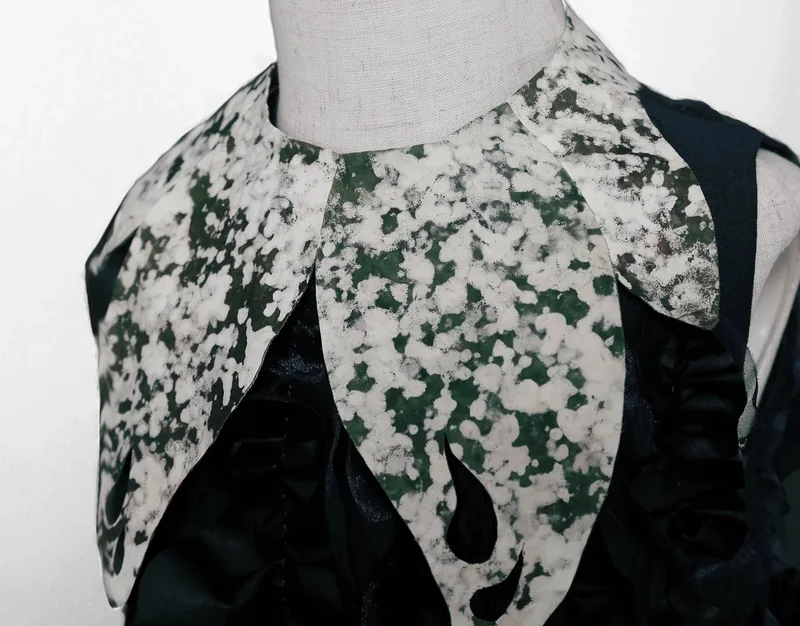
Some people might live for fashion but what if your clothes lived for you? That’s the premise behind a new material made of fungi—the textile remains alive even after it’s manufactured.
In a new paper, researchers describe how this biodegradable material works. It can regrow its surface, enabling it to renew itself if damaged. It can also host engineered microbes that add a little extra flare; organisms that change its color, or which add a layer of ultraviolet protection.
Making mushrooms into materials is not new. Mycelium— the branching network of microscopic filaments that makes up most of a fungus—has been made into leather alternatives, packaging, insulation and even building materials. But these products are typically dead, which limits what they can do, the researchers say.
On supporting science journalism
If you're enjoying this article, consider supporting our award-winning journalism by subscribing. By purchasing a subscription you are helping to ensure the future of impactful stories about the discoveries and ideas shaping our world today.
“We wanted to ask whether a mycelium material could remain alive and programmable while still behaving as a freestanding, flexible textile,” says Bolin An, a research professor at the Chinese Academy of Sciences and a co-author of the study.
Why do this? Alexander Bismarck and Mitchell Jones, researchers in the Polymer and Composite Engineering Group at the University of Vienna who were not involved in the work, say that while the researchers show that a living material is technically possible, that doesn’t mean it is better, safer or preferable to existing textiles.
Reasoning aside, An and his colleagues’ work is visually striking and technically impressive. Instead of weaving fibers, the team grew dense mats of mycelium, the thread-like filaments of which naturally intertwine into cohesive sheets. They then soaked the material in glycerol—a syrupy compound that acts as a plasticizer, making the mycelium softer and more flexible without killing it. The result was a supple, living textile.
When supplied with nutrients, the fabric sprouts a layer of fuzzy fungal filaments across its surface, effectively renewing itself.
The material can also host engineered microbes. By embedding a pigment-producing yeast, the team created colored patterns. Adding a second fungus that naturally produces melanin endowed the textile with ultraviolet protection. Together, the experiments suggest the material can acquire new capabilities even after its initial fabrication.
“The individual components are mostly established,” say Bismarck and Jones. “The novelty lies in bringing them together within a single living-material platform.”
This is not ready-to-wear. And even if the technology matures, it won’t solve fashion’s sustainability problem. Much of the industry’s waste stems from fast-fashion business models and consumer habits, rather than from the materials themselves.
Keeping the material alive also isn’t easy—it needs stored in certain conditions to prevent contamination, for example. The fabric also almost completely biodegraded within about six weeks. That would make it a poor choice for a winter coat but an intriguing candidate for products such as disposable packaging or temporary structures, such as installations.
“A living curtain could provide passive ultraviolet shielding, self-cleaning surfaces or, in the future, even environmental sensing or air purification,” An says.