Sign in. It’s quick, free and it’s up to you.
An account is an optional way to support the work we do. Find out more.
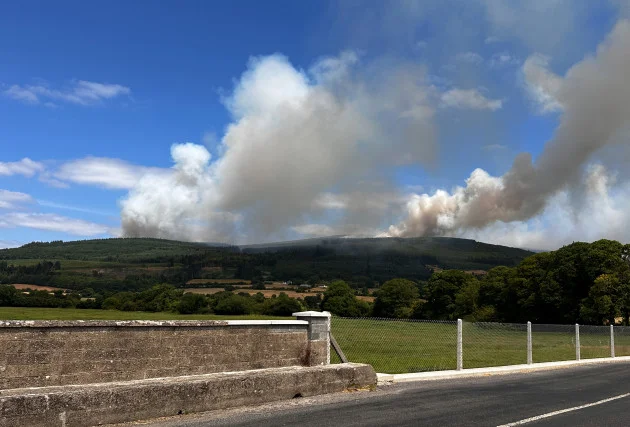
IT IS FIVE days and counting since a fire broke out on Slievenamon in Co Tipperary, razing sprawling acres and wreaking havoc on wildlife.
Emergency services had appeared to have brought the blaze largely under control until, on Wednesday, a sharp change in wind saw the flames pushed towards a nearby Coillte forest on the mountainside.
Lining the landscape where the fire is burning are plantations of Sitka spruce trees.
Sitka spruce, which originates in North America, is a staple of Coillte forests, owing to its preference by the industry for being easier to grow and fell at a faster rate than many other types of tree.
Ecologist Pádraic Fogarty believes the wildfires have been exacerbated not just by the hottier, drier conditions of the past fortnight, but by the local woodland being made up of Sitka spruce.
The oil and resin in the wood can mean the trees also light on fire easier than other species and the conditions used to create Sitka spruce plantations also make the land more susceptible to wildfires, said Fogarty.
“When the flames get into a woodland, the tree goes up very quickly,” Fogarty contended.
This is worsened, Fogarty said, due to how land is prepared for planting Sitka spruce.
“To get them to grow they have to drain the peat they are under, so that land is artificially drained to dry them out – all those factors together with climate change make for a very flammable situation.”
The semi-state body responsible for Ireland’s forests, however, has a different view.
When contacted, Coillte strongly rejected Fogarty’s contention.
“There is no evidence that Sitka spruce plantations are inherently more likely to cause or increase the risk of wildfire than any other vegetation type,” the semi-state company said.
Instead, it argued that wildfires are “complex events influenced by a range of factors”, including the weather, prolonged dry periods, topography, fuel conditions and ignition sources.
Coillte drew attention to how a fire is started, as it said that wildfires in Ireland “almost always arise from man-made sources of ignition”, whether that is the burning of gorse or if a disposable barbecue set left behind on arid land.
It added that recent major wildfires in Ireland show that “all vegetation types” are vulnerable under extreme fire conditions.
Fogarty disputed Coillte’s statement as he argued that native and broadleaf trees are less flammable as a species.
He also pointed to a research paper published last year that found that forest plantations in temperate regions, which can have a similar climate to Ireland, were “twice as likely” to suffer devastating wildfires than natural forests.
A system known as ‘firebreaks’, where strips of land are cleared of trees and grass as a way of slowing the spread of wildfires, has been employed by Coillte in areas including Slievenamon. It has become more common in Ireland over the past decade following success in the UK.
While this preventative action worked at first, the strong winds on Wednesday saw the flames reach woodland.
Fogarty said that the industry has to protect its assets in the form of its forests, but he warned that it’s not sustainable long-term.
“They’re not addressing the problems as far as I can see – it’s very difficult as the whole system has been built around monoculture forestry, including the sawmills and nurseries. It needs fundamental reform.”
These reforms, added Fogarty, include the government and industry pushing for forests to transition away from being solely Sitka spruce, particularly when forests are felled in future.
“Instead of replanting with another round of monocultures, we need to be redesigning those forests,” he said.
However, Fogarty is not hopeful of this happening anytime soon – unless future wildfires begin to harm the bottom line of forestry owners.
“We’ll see more of these plantations which are economically compromised because of extreme weather events,” he said.
The environmental argument isn’t working. The only thing I can see that will shift the attitude is when we see the risk of these plantations, managing them as commercial assets, exceeds the value from an insurance perspective.
Fogarty’s concerns are not new, however, as he pointed to a previous large-scale fire that destroyed approximately 1,500 hectares of Sitka spruce plantation in May 2017.
“We’ve been having these same conversations as back then about forestry and climate change,” Fogarty said.
He claimed that the forestry industry has been “desperate” to maintain its business in the face of growing pressure from environmentalists, due to the harm caused by the conifers on biodiversity, soil health and water.
“When you put it all together, it’s a disaster from an environmental perspective,” Fogarty said.
To embed this post, copy the code below on your site