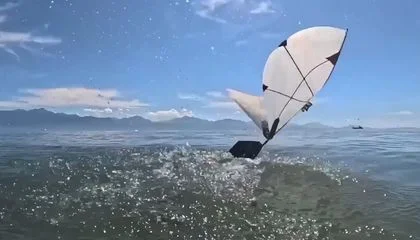
Many birds can traverse both air and water, transitioning between the different elements according to their needs. Gulls, puffins, loons and petrels are all such boundary crossers.
This special group has recently been joined by a new member. However, it’s not an animal.
A robot can now mimic these aquatic avians’ ability to fly and swim—and seamlessly switch between the two activities—researchers reported July 9 in a study published in the journal Science. Their creation aims to shed light on how diving birds master both environments, and it could eventually help researchers monitor ocean habitats.
Designing the device was challenging, as creating wings that could work in both air and water initially seemed impossible. Water is about 800 times denser than air, so flight should theoretically require significantly faster wing flapping than swimming—each activity demanding very different mechanics in a robot.
“There was a very good chance that this would have not been possible at all,” study co-author Raphael Zufferey, a mechanical engineer at MIT, tells the New York Times’ K. R. Callaway. “I took that risk because I believed that if birds could do it, with good engineering we might also be able to.”
Zufferey and his colleagues first studied published data about the nearly 100 species of birds that can fly and swim. The analysis revealed that smaller species flap their wings at a rate of about ten times per second in the air and four times per second in the water, while larger birds’ frequencies are a bit lower because they have wider wingspans.
In about two years, the team created the flapping-wing aerial-aquatic vehicle, or FAAV, which looks vaguely like a headless and legless bird. It weighs roughly half a pound and has a wingspan of around three feet, although it has interchangeable wings of different sizes. The robot consists of a central body with a battery and waterproof electric motor, two flexible wings and a moveable tail, which helps the device dive down and fly up.
To test the FAAV, the researchers put the robot about 20 inches below the water’s surface in a tank in the lab and in Lake Geneva in Switzerland. Experimenting with different aspects of the robot revealed that five flaps per second led to swimming speeds of up to around three feet per second and flying speeds of around 20 feet per second. The transition from water to air requires the FAAV’s tail to be at a 70-degree angle, the team found, which keeps the tips of its wings out of the water during the switch but also doesn’t allow the device to fall over into the water.
“Clearing the wings from the water surface just after transition was the most difficult part,” Zufferey tells ZME Science’s Jordan Strickler.
While the FAAV’s flapping frequencies and speeds were akin to those of real diving birds, it showed some key differences. The robot was able to swim and launch into the air from the water without feet, which birds typically use as paddles during these activities, suggesting that paddling isn’t necessary.
“This is a beautiful robot,” Glenna Clifton, a biomechanist at the University of Portland who didn’t participate in the study, tells Ari Daniel on NPR’s “All Things Considered.” “The biology inspires the robotics, but then also the robotics are used to understand the biology.”
The FAAV could have useful practical applications, too. Current ocean research often involves big ships, which are expensive and pollute the environment, Zuffrey says in a video by the Associated Press.
“Our dream vision is for oceanographers, marine biologists and members of coastal communities to launch this robot from a boat or from shore, and it would fly close to the area of interest, such as an iceberg or a port facility or over a pod of whales,” Zufferey says in a statement. “It would dive into the water to take a measurement or collect a sample and fly back to deliver the data at a fraction of the cost of traditional methods.”
The team is currently working to give the FAAV’s wings the ability to turn. They also plan to see how it fares in difficult environmental conditions, like wind and choppy water, and then put it in the service of ocean science.