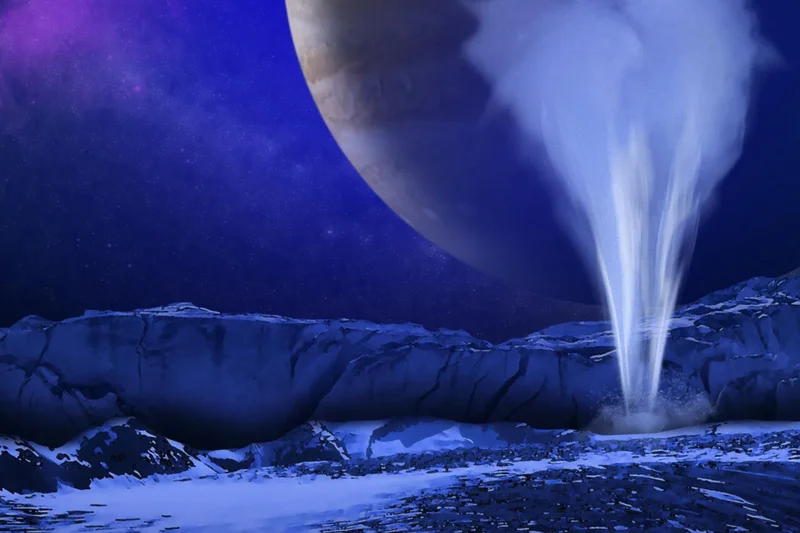
Earlier this year, researchers warned against the dangers of âfluffy iceâ on Europaâs surface. If unaccounted for, missions headed to Jupiterâs moon could drown themselves in its deep, icy oceans. A new study suggests that this wonât happenâbut for reasons that wonât make our Europa trips any easier.
A paper published yesterday in Nature Astronomy challenges the assumption that the shallow pools of water on Europaâs surface represent a direct access route to the moonâs deep, icy oceans. In theory, this supposed access route could make it easier for a probe to explore how liquid water from Europaâs deep oceans traveled through cracks in the ice to the surface. Unfortunately, we’re not sure if this even happens.
âThis is exactly what we wanted to test,â Lujendra Ojha, the studyâs first author and an earth scientist at Rutgers University, told Gizmodo. âIn particular, we asked whether the water could travel this distance before losing enough heat to freeze and whether the fractures could remain open long enough to transport a meaningful amount of water.â
Prospects real icy
For the study, Ojha and colleagues simulated the movement and cooling of water inside the fractures of Europaâs icy shell. In a Rutgers statement, Ojha explained that earlier models âoften treated water rising through Europaâs ice as if it moved in a relatively orderly way.â They also draw an analogy between volcanoes and icy volcanoes, although there are âfundamentalâ differences between ice, liquid water, lava, and volcanoes, he added.
The latest approach, on the other hand, takes a more realistic approach by accommodating for numerous factors, such as water velocity, the size of the crack, turbulence, and supercooling. The simulations arrived at a simpleâperhaps discouragingâconclusion. All things considered, there are too many obstacles for deep ocean water to reliably arrive at the surface. For instance, if the water rises turbulently, it would âlose heat rapidly to the surrounding ice and form small ice crystals that could eventually clog the fracture,â Ojha told Gizmodo.
For the Europa fans
So the small pools of water weâve observed at the surface probably come from melted sections of the icy crust, rather than from deep down below. Having said that, Ojha told Gizmodo that the findings donât necessarily warrant drastic shifts in our missions to Europa. But if spacecraft detect shallow liquid-water reservoirs on Europa, weâd be smart not to âautomatically assume that the water came from Europaâs deep ocean,â he said.
âIn that case, the chemical, physical, maybe biological constraints we are able to derive from studying the shallow liquid water layer may not at all reflect the chemistry of the underlying ocean,â Ojha concluded. âFuture missions should, therefore, focus not only on finding shallow water but also on determining its origin and whether it is connected to the deeper ocean.â