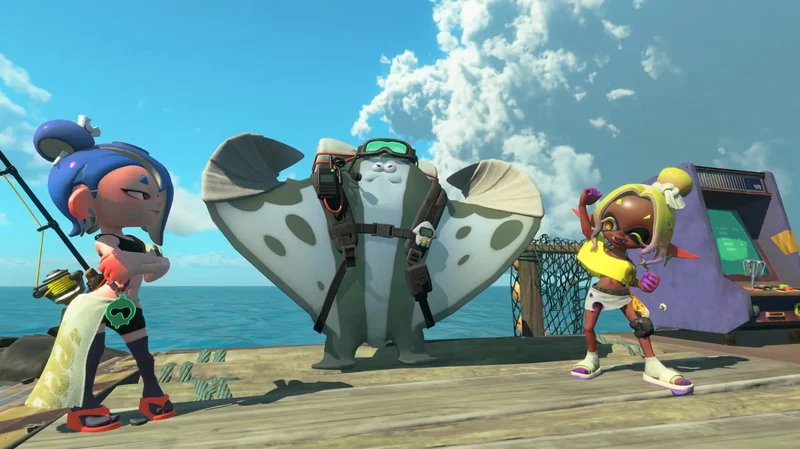
Splatoon might look all cutesy and approachable, with its turf wars and stylish squid kids. (And no, that's ink, not blood.) And sure, it's a lot less brutal than Call of Duty. If you jump in thinking the single-player campaign was enough of a tutorial, though, you're in for a rude surprise. For as casual as Splatoon is, it's a sweaty, unforgiving series that happily stomps newcomers into the ground before they have a chance to learn. Enter Splatoon Raiders, a game that, despite ostensibly being single-player (unless you want to play co-op), teaches you a lot of the skills you need to succeed in Splatoon's standard Turf War mode.
Splatoon's weapons are one of its biggest learning curves. The gap between feeling confident using a weapon in the training grounds, where everything moves slowly and nothing hurts you, and an actual Turf War match, where everything hurts you before you realize what even happened, is massive. There's just no chance to learn how weapons are supposed to function in a realistic scenario and, perhaps to keep the illusion of Splatoon as a casual competitive series, there's no clear categorization — no "Splattershots work best at mid-range" or "use the Paintbrush for quick, aggressive forward pushes." You can learn by doing, which is always satisfying, but the doing involves running up against much more experienced players obliterating you repeatedly. It's as much a matchmaking problem as it is a tutorial one, but that doesn't make learning any less discouraging.
Raiders dishes out new weapons at a regular pace and puts you in low-pressure scenarios where you're free to learn the best ways to use them. Things ramp up after a few hours, but you can swap weapons and return to earlier raids if you need the space. That’s is how I learned I'd been using things like the Bloblobber wrong for far too long. It's an artillery weapon, not a frontline one! If only I'd known that years ago.
Maybe my experience isn't universal. For reference, I also learned how to play certain Overwatch heroes via Stadium mode, which is backwards from how that learning is meant to happen. But backwards or not, at least there was some means by which folks could suss out how things work (until Blizzard killed it).
Defensive play is the other big thing Splatoon relies on and never explicitly teaches you. Time-to-kill in Splatoon is blindingly fast, to the point where it's often hard to realize what just happened to you. The temptation to rush in and start covering ground is always present, but without a coordinated effort and strategic caution, you're just setting yourself up for pain. Raiders eases you into that kind of defensiveness at an approachable pace. Early raids are comparatively easy to manage, with two, maybe three enemy types that behave in predictable ways. Then you start facing more of them, and more kinds of them, and there's a time limit in some raids. By the mid- to late-game, you're fending off massive hordes of varying enemy types on multiple fronts and managing ability cooldowns and ink levels like a pro.
You've learned how to make a little safe ink zone to refill your tank or to splat an escape route if things start to look hairy. You know how to identify enemy formations and deal with them appropriately — when, for instance, it's wise to rush in for a big move with your carefully chosen gadget and weapon and when it's best to hold back and make your foe come to you. You can quickly move around the battlefield and find a more advantageous spot, and gauging the distance and locations that work best for your favorite weapons is second nature. And you did all this without getting eliminated every 10 seconds, or worrying about dragging your team down and performing even worse for it. Mainline Splatoon is multiplayer, but individual choices and knowing what you're meant to be doing (even if your teammates aren't doing the same) really makes all the difference.
So if you've ever tried Splatoon and thought everything was just too fast and too much all the time, you're definitely not alone. Splatoon Raiders may be a spinoff, but it's the perfect way to learn how the main series works.