Please publish to Country page and Country Life page (CLI) by * Saturday 8AM **
"Six days a week, rain or shine, hail, sideways, wind, lightning ... put a raincoat on and carry on."
That's Luke Franklin, standing in a field of celery on a grey winter's day, describing the almost daily harvest which has been going on in the Franklin family for 120 years.
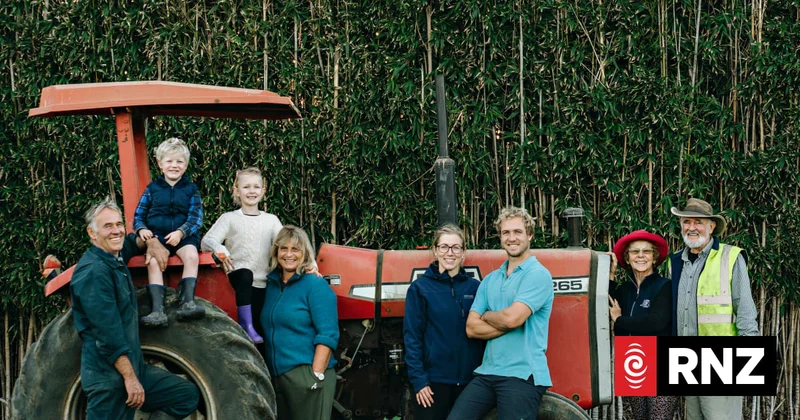
The present owner of Franklin Farm is the fifth generation in the business and the third at this 28-hectare site near Waimauku, north-east of Auckland.
It was 1906 when Sid Roskill first planted celery in Mount Roskill. Fifty six years later, Luke's grandfather Graham moved the Franklin legacy to Waimauku. He and wife Lucy started off with just 2.4ha before gradually buying up neighbouring farms.
The 85-year-old is still on the tools, driving the forklift and helping around the packing shed.
Big celery bunches are out these days, neatly trimmed and packed stalks are in, Graham told Country Life. And of course there's no horse and cart to take the crop to market.
"Things have changed, but not a hang of a lot. We still cut by hand, we still bring it all up, pack it much the same."
Celery, butterflies and Travis the goat
Graham's son Alan is standing at one of the benches packing, alongside workers from the Philippines and Tuvalu.
"I think with the amount of hard work that we do and the long hours that we do, it makes it sustainable. I think there's no member of the family that's a shirker," Alan said.
"There's times where there's more competition comes into the market and there's times when you're having weather events or disease events.
"It can wipe out the crop, but you've just got to see past it and just enjoy the job and hopefully your bank account lasts long enough to come out the other side."
Alan's been out in the celery fields since he was a baby, when his mother Lucy would be out helping her husband Graham.
"Oh, my goodness me, you get up and it's freezing cold or it's pouring with rain, you still had to go out there," Lucy said.
"No babysitters in those days. The children come out with you. Yes, one in a pushchair, one in a pram.
"They were raised on slugs and snails," she laughed. "It doesn't really hurt children to be out in the soil."
Peak celery season is October until Christmas and when that winds down, the visitor experience winds up.
Families can visit from Boxing Day during the summer to visit the Franklin's butterfly house and experience the release of thousands of butterflies, wander through sunflower fields and visit a farmyard of small animals.
When she's not in the packing shed, Alan's wife Monique can be found in the paddocks with small goats, a flock of chickens laying different coloured eggs and a "micro miniature" cow called Bubba Gump.
"I find the little children really can connect with them because they're a nice size."
She said many children are surprised to find eggs are laid by chickens and don't just come in cartons at the supermarket.
Travis, an energetic pygmy goat, was one of the stars last summer, "Chewing people's bags, their flowers, he's hopping in kids' prams, chewing ladies' dresses. He was just getting into everything, and everyone just loved it."
Opening Franklin Farm to visitors is a great way to connect farming with the public, Luke's wife Jasmine said.
"People enjoy the raw, honest truth. So sharing crop failures or sharing animals that we can't contain, people love that because it's genuine and real, and they find it quite entertaining, and people like to come along and see, for example, our goat Travis that we struggle to contain.
"In a way, sharing our problems and failures keeps us real and relatable, and people like to come along and check that out as well."
"They're entertained, they're getting lots of exercise, just connecting back to nature and our roots. Yeah, it's like a big YouTube."
Learn more: