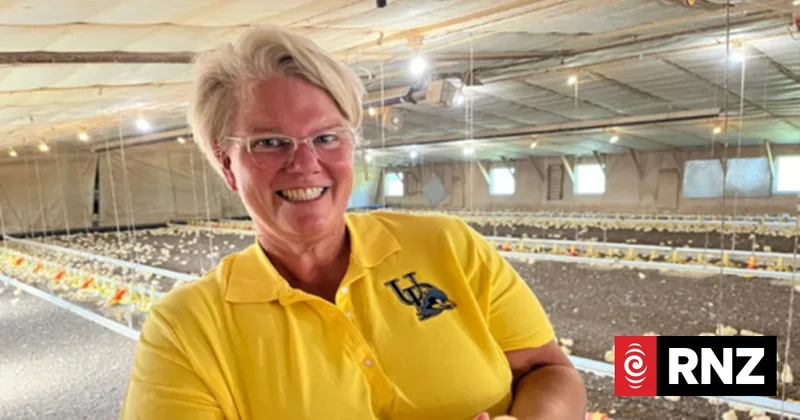
Disbelief and a sense of failure swirled through Georgie Cartanza's mind as she found more and more dead birds at her broiler chicken farm on the eastern coast of the United States last year.
In January 2025, the Delmarva Peninsula - where many migratory birds converge - had already had seven cases of highly pathogenic avian influenza (HPAI) and her "angst" was building.
"Over the 20 years that I've grown chickens, I'd never observed a dead snow goose on my property, but [...] I found eight dead snow geese in close proximity to the poultry houses," she told Country Life.
What New Zealand can learn from a farmer who lived through H5N1
Cartanza is not only an experienced chicken farmer, she also educates poultry farmers on good practice as extension agent for the University of Delaware's Cooperative Extension programme.
She had noticed water and feed levels were a little off in one of her four chicken houses, each housing 37,000 birds.
"My mortality started to pick up, but it wasn't tremendous. It wasn't anything that would have been earth shattering, but I really started feeling uneasy on a Friday evening."
By 2 o'clock on Saturday afternoon HPAI was confirmed.
"I think it's, it's a little bit of disbelief. I think it's a little bit of, 'you know, I've done everything I can. I've done everything I know to do.' It's an overwhelming feeling because it's a sense of failure."
All farms within a three kilometre radius were quarantined.
"You're thinking, 'what did I do wrong? This is impacting me, but it's now impacting my neighbour as well.' It's a pretty traumatic experience to go through and so it's changed me as a human being."
The houses were then "depopulated" - the chickens euthanised in situ via "ventilation shutdown plus heat" overseen by state agricultural authorities and a vet.
"They actually didn't expect me to be present during the process itself, and that's good because you've invested yourself into a flock of chickens and it's hard regardless."
The hardest time for Cartanza was going in the next day to deal with the remaining feed, surrounded by dead chickens.
"It's a really bad feeling to have to do that. I wouldn't wish it on anybody for certain."
Then came the composting process - the bedding, chickens and other material decomposing within the chicken houses for 14 days to contain the virus, subjected to heat with the temperature monitored, deemed virus free after 28 days.
"Then the cleaning process starts - to get the house cleaned up and disinfected."
Changing the way she farms
After the initial shock, Cartanza wanted to figure out where the virus had come in.
"So I kind of put my extension hat on and really started trying to think about that as far as what could I do to help somebody else."
Still poultry farming, she said she has changed a number of things, aside from maintaining a line of separation between clean and dirty.
"Anything outside of where the chickens are is considered dirty. And then once you come into the area where you cross that threshold where the chickens are present, that's now your clean area."
Aside from footbaths, dedicated footwear, hand sanitizer and signs, each chicken house now has its own tool box and other equipment.
"There's no reason you're going to bring something from the outside into this house. It's all about touch points and opportunities where, whether it's your feet, your hands, or an inanimate object, that virus could be carried into your house."
Cartanza grows organic broilers and said certifiers had allowed them to keep them indoors when they deem the risk is greatest - during peak wild bird migration times.
"What tends to happen is people almost get burned out and they're like, 'well, nothing's happened, you know, it's no big deal', and they let their guard down."
It was an "odds game," she said, and a clearly defined high level biosecurity plan implemented consistently was key to lowering the odds of getting the virus, noting New Zealand's "phenomenal biosecurity system".
"I've been to New Zealand, I went through the airport, I saw what they did to my shoes, but the (wild migratory) birds, they're not going through that.
"So we have to do whatever we can to prevent that from getting into our poultry houses."
Learn more: