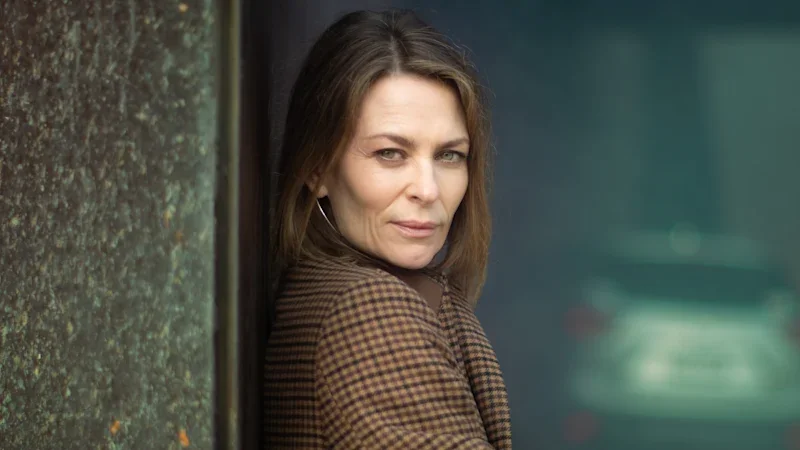
When actor Kat Stewart and director Sarah Goodes were hunting for a script to collaborate on, they started with the classics. “The usual suspects, the Albees, who I adore, Tennessee Williams, a couple of Sam Shepard plays,” says Stewart. “The recurring theme was the American dream, the heartbreak or the disappointment of the American dream.”
But then Goodes brought in Break of Day, a script by veteran actor and playwright Steve Rodgers. A heartfelt and moving ode to the dreams and disappointments of ordinary yet recognisable people, it felt like an Australian version of those US classics. “Why aren’t we exploring that?” Stewart asked. “This is real. This is right now. And this is what we’re not shining a light on.”
Stewart plays Pam, a single mother barely making ends meet by pulling the night shift at one of those gargantuan warehouses that ship every product imaginable 24 hours a day. The customer unboxing their new smoothie machine or beard trimmer or yoga ball never spares a thought for the many hands that got it there. Pam is one member of that invisible army.
As in Arthur Miller’s Death of a Salesman, this isn’t the life our protagonist envisioned. Pam juggles her night work alongside caring for her wildly incapable dad and her 17-year-old daughter Rae. She’s devoted most of her adult life to giving her daughter chances she never had, but has reached a point of crisis: to give Rae those opportunities, she has to let her go.
Stewart has two kids of her own, so she can connect with how conflicted Pam must be. “She’s made her life all about elevating Rae,” she says. “She’s on that really interesting cusp, which I’m dreading, where Rae’s doing year 12 and she’s got so much potential. She’s about to leave the nest and start making her own decisions, which leaves Pamela at a real pressure point where she’s working out who she is in that context and how she can best look after her beautiful girl.”
In putting her daughter first, Pam doesn’t know who she would become if Rae does end up leaving. Her lack of self-identity is only compounded by the way her job is designed to depersonalise workers, hide them from public view. All of these factors mean that Pam finds herself facing a dilemma familiar to many women as they age: she feels she’s growing invisible.
If Pam’s circumstances sound grim, Rodgers’ handling is a reminder that Australian humour thrives under pressure. “What really rang true for me in Stevie’s writing is the humour of it and the way Australians talk,” Stewart says. “We use humour to deflect. We’re really great at that. It’s our armour.”
The armour that Pam has donned is the kind that’s instantly recognisable. “She’s really funny,” says Stewart. “She’s dry and she’s tough, but she’s funny. She takes the piss out of [her boss] Sunny a lot, but they’re really dear old friends. And she’s got a fraught relationship with her dad, but they really like doing quiz shows together on telly.”
One of the reasons Break of Day brings to mind those classic American plays is in the way it humanises its characters, warts and all. Pam makes decisions that are questionable, though we never doubt the motivations behind them.
“Pam’s not a saint,” says Stewart. “She’s not exceptional. But we’re all on our own hero’s journey, trying to map things out as best we can and make the best decisions we can. I always work with the adage that it’s impossible to hate a person whose story you know. At the beginning people will make assumptions about Pamela, but hopefully by the end they will see her in a more complete and compassionate way.”
Rodgers’ script stipulates that the production be set in a satellite city, the kind of semi-regional urban centre that is itself often overlooked by outsiders. We’re more accustomed to romanticised portraits of rural Australia or gritty dramas set on the streets of a bustling metropolis. It’s less common to see a play set somewhere in between.
Which is, coincidentally, not dissimilar to the town where Stewart grew up. “It’s bigger now, but in those days Bairnsdale’s population was about 10,000,” she says. “That’s what rang true for me, the vernacular humour, the way the characters talk to each other. They’re voices that I grew up around and still hear.”
Stewart lived in Bairnsdale until she was 14. She understands Rae’s ambivalence, torn between the lure of city life and the familiar world that’s all she has ever known.
“I didn’t want to leave. The whole family left, so I had to, but I left kicking and screaming. I loved it and I had great friends there. I understood that there was a bigger world and that this might be the best thing for the family but I didn’t want to go.”
The kinds of warehouses Pam works at are often built in towns that are economically depressed, and so they give rise to another kind of ambivalence. They can put huge demands on employees, but they’re also providing work to regions that sorely need it. “This warehouse would be the lifeblood of this town, you know?” says Stewart.
This isn’t poverty porn: the playwright himself has worked in such a warehouse, and there’s a real authenticity to the details that are littered throughout the script. It’s less about grand tragedy and more about the quiet frustrations that the cost of living today invokes in most of us.
“I have so much respect for these characters and I feel so protective of Pamela’s dignity,” says Stewart. “Stevie has written something that’s kind of like a love song to the unseen workers. To family and to sacrifice and to yearning.”
Break of Day is at Malthouse Theatre from August 7.