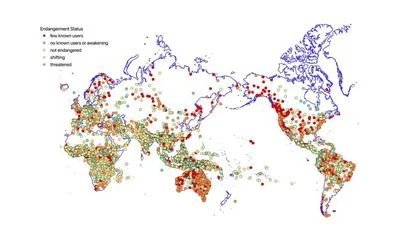
From Mandarin and English to the many Indigenous languages spoken around the world, humans today communicate via roughly 7,500 tongues. But humanity’s linguistic diversity may once have been far greater, according to a new study published in the journal Science.
Researchers think humans may have spoken as many as 20,000 to 75,000 different languages during a period they’ve dubbed the linguistic “golden age.” But that linguistic abundance did not last. As multinational states like the Roman Empire expanded, scientists think their languages spread too, wiping out many others.
Since many ancient languages may have vanished without a trace, researchers attempted to piece together the global history of linguistic diversity using other clues. They used computational models, population estimates and ethnographic data to trace the rise and fall of languages around the world during the Holocene, starting from about 12,000 years ago.
Their modeling suggests that, before agriculture took root some 12,000 years ago, humans spoke between 4,500 to 6,200 languages. After we domesticated plants and animals, however, the planet’s population ballooned—and so did the number of languages. Linguistic diversity peaked between 1000 B.C.E. and 1000 C.E., before falling off again “as multinational empires first spread along with their languages, pathogens and cultures,” the researchers write in the paper. Since language and culture often go hand-in-hand, the researchers suspect many cultural traditions also vanished.
The study does not identify specific empires, regions or historical events that might have contributed to this global decline, suggesting only that linguistic diversity underwent a major decline in the not-so-distant past.
One surprising result was “how recent the peak appears to have been,” study co-author Claire Bowern, a historical linguist at Yale University, says in a statement. “The period of greatest linguistic diversity may have occurred not in the remote Paleolithic, but during the era of expanding states and early empires.”
Global linguistic diversity continues to decline today, with at least four languages dying out every year, per the editor’s summary of the new research. Experts predict as many as 1,500 known languages might disappear from use before the end of the century.
Some hypotheses have linked this modern language-endangerment to the rise of European colonialism 500 years ago. But the new findings indicate the loss of linguistic diversity predates that period, stretching back at least 1,000 years. The study suggests it “takes much less than a colonial powerhouse to destroy linguistic diversity,” lead author Damián Blasi, an anthropologist and computer scientist at Harvard University and the Catalan Institution for Research and Advanced Studies, tells Scientific American’s Cody Cottier.
Though today’s languages represent a fraction of those that existed historically, they still encompass a wide variety of features, from click sounds and tonal shifts to unique approaches to grammar. If the researchers are right, even this vast modern diversity may represent only a small share of humanity’s linguistic capabilities. “Are there people who developed languages with some traits that we can barely imagine now?” Chiara Barbieri, a geneticist at the University of Cagliari, tells ScienceNews’ Sujata Gupta. “It makes your head spin.”
Researchers often assume that certain linguistic features are widespread today because they offer some kind of advantage—maybe they’re easy to learn or efficient to use. But “extinction may have shaped linguistic diversity much more profoundly than we previously appreciated,” Blasi says in the statement. The languages and linguistic features that persist today might not be “inherently superior,” Blasi adds. Rather, they may simply be the survivors of a “massive and highly selective historical bottleneck,” preserved as the populations that used them grew and spread, he says.
However, not everyone is convinced the study’s findings accurately capture the history of linguistic diversity. Though the researchers might be “on the right track,” their work is “highly speculative,” Lyle Campbell, a linguist at the University of Hawai'i at Mānoa who was not involved with the study, tells Scientific American. The scientists are “grappling with stuff in the remote past that is hard to get a solid purchase on,” he adds.