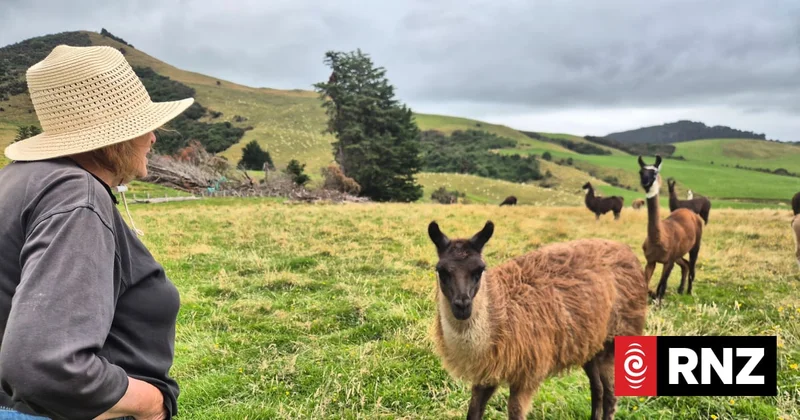
Already addicted to llamas' yarn, Janette Buckingham thought she'd give farming the animals a spin.
That was over 30 years ago and in that time her herd of camelids has grown to include a few ovine cousins - Gotland sheep - also raised for their fibre which she spins and sells from her home studio in Southland's Waikawa Valley.
"For me, I like just being able to turn fibres over to people who will use them, and certainly the money's good too," she told Country Life.
It was a high school friend who first got her wheels spinning - literally.
Addicted to yarn: Llama herd follows love of fibre
Buckingham has been spinning since 1973 when she was first introduced to the craft.
"I was terribly uncoordinated, but I just stuck with it," she said.
"Nobody showed me what to do. I just felt my way sitting up 'til God knows what time at night, trying too hard, but eventually ... I got the hang of it and could even spin a lumpy yarn. Anyone will tell you that's the breakthrough."
Since then she's taught a few people to spin herself. The trick is in knowing how to coordinate one's hands and feet.
She looked quite at ease, tucked up by the fire on a squally afternoon, working away on her electric spinning wheel - a massive timesaver which helps when she's trying to rapidly replenish her stock of yarns.
Her love of spinning is what got her started on the llama farming. She'd bought a packet of caramel-coloured alpaca fibre in the 1980s which she "fell in love with".
"It was absolutely beautiful, like nothing I'd ever spun before, just sort of buttery smooth. I became addicted to it."
It was a time when many farmers were looking to diversify their farming operations, and the llama's cousin, the alpaca, was starting to become more well-known.
However, it was a herd off llamas near Canterbury that caught her eye.
"We managed to get three, and one was a guanaco male. The fine-fibred guanaco is also a cousin to the llama.
"They weren't as popular then because people just wanted alpacas or llamas. The guanaco was something else again."
Crossed with a llama, she said they can produce "very fine fibre".
"They're a bit more of a challenge to handle, but they're something that perhaps make my business a little bit different from a lot of other people's."
Today she has about 40 llama and guanaco which she runs alongside the Gotland sheep on her 25-acres in the Catlins.
The Gotland sheep came later, a breed popular for their dark and grey-toned wool and originally from the Gotland Islands off the coast of Sweden.
"There seemed to be a lot of interest in the Gotland wool because of its lustre, its colour, not much crimp in it, but it's just got certain characteristics that appeal to people."