The humble blackboard is serving as the canvas, and colorful chalk the paint, for young Japanese artists.
“Kokuban Art Koshien " is an annual national chalk art championship for high school students. Combining the word for “blackboard” ("kokuban") and the famous stadium where high school baseball is contested, the contest attracts artworks, all drawn on blackboards, usually over summer break, from about 300 high schools and junior high schools.
Each work — many dazzling in their artistry and often dreamlike themes — is a collaborative endeavor bringing together anywhere from one or two youngsters to dozens, all delivering a lesson in creativity and teamwork.
The images range from energetic depictions of dinosaurs, dogs and whales; popular manga scenes; Hokusai ’s Mount Fuji or the Mona Lisa, as well as slices of everyday life, except they aren’t all that everyday, such as an underwater classroom.
Some works even show a person writing on a blackboard.
Innovative and experimental art
Kazunari Minamishima, an art teacher at the Saitama Prefectural High School of the Arts, whose students have taken part in the contest, believes it appeals to students because it offers the chance to be more experimental than established forms of art, such as oil painting and sculpture.
“It’s still a work in progress,” he said.
The contest began in 2015 by Nichigaku Co., a Tokyo-based blackboard maker. The annual judging is done by examining the photos of the works, given that the medium, blackboards, can’t be moved easily. The winners will be announced in November.
The use of blackboards for creating artworks existed before in the Japanese school system. It was a stunning replica of Da Vinci’s “Last Supper” by an unknown artist on a school blackboard that caught Nichigaku’s eye.
“Back then, there was graffiti, but there was no genre called blackboard art,” said Nichigaku President Tomohiro Yoshida.
The contest doesn’t really work as a direct marketing tool because schools already have blackboards. But some contestants become professional artists later, Yoshida added proudly.
Chalk powder gets scattered over the blackboard for an almost stardust effect. Smudging with fingers and tissue paper creates shadows and muted tones.
A skilled blackboard artist can depict the shiny translucence of a dragon’s eyeball. One award-winning work used chalk powder mixed in water sprayed a la Jackson Pollock.
‘Better friends while doing it’
All schools in Japan can enter the Kokuban Art Koshien contest, including international schools. Nichigaku hopes the contest can expand overseas some day.
But unlike the paint-on-walls graffiti of the West, blackboards can be erased. The students get permission from the schools to draw on the blackboards in advance, reflective of Japan’s conformist orderly culture.
“The challenge of trying to sort out the conflicting opinions of my two collaborators is the biggest memory about taking part in blackboard Koshien, as opposed to doing your own artwork,” said Kento Misumi, who took part in the contest as a high school student and now works at Nichigaku.
It’s harder than you think, and he and his friends devoted several days to one drawing, Misumi recalled, demonstrating how to draw an apple with chalk on a blackboard.
“I want young people today to go through the experience,” he said.
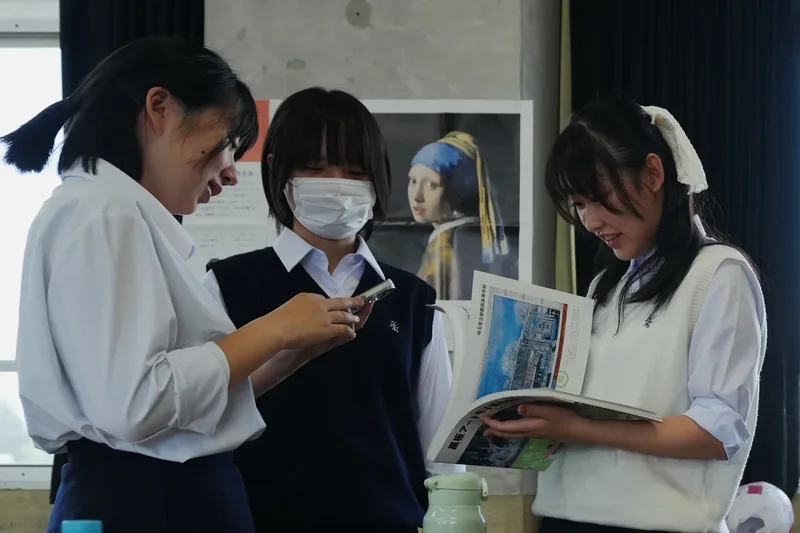
It was exactly the kind of brainstorming that was going on among a huddle of several students at the Kumagaya Girls' High School, north of Tokyo, in nearby Saitama Prefecture.
They were taking part in the contest for the first time, although their upper grade schoolmates have taken part and won prizes in the past.
“I see it as a chance to deepen my relationships with my schoolmates,” said Chiho Ninomiya, one of the students. “It's our first time so I'm not sure we will be able to do a good job. But even if we don't win, it'd have been worth it as long as we become better friends while doing it.”
Lesson on the impermanence of life
Among the ideas discussed for this year's entries were what they called parodies or spinoffs of well-known artworks like Renoir, juxtaposed with images of high school students in their uniforms, their skirts fluttering.
A blackboard may be a longtime familiar object in classrooms. But drawing art on them with chalk is different from using paints or pencils, Ninomiya said, so they are still learning, drawing, rubbing, wiping.
It can be heartbreaking when the arduously created pieces get erased. But the artists are able to share that heartbreak with their collaborators.
Proponents say it’s a great educational tool to deliver the lesson on the impermanence of life, the fragility of creation and the courage to keep going. For when the work gets erased is the moment that the art is considered to be truly complete.
Yuri Kageyama is on Threads: https://www.threads.com/@yurikageyama