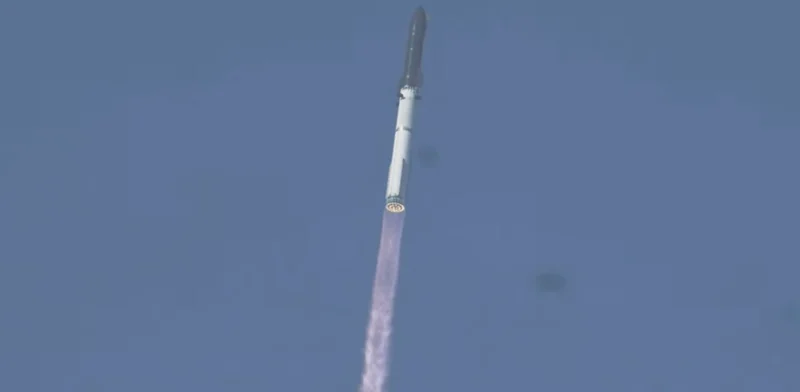
SpaceX on Thursday pulled off its second consecutive successful test flight of its Starship megarocket. The launch hints at sustained progress after years of botched tests, but there is a caveat.
Just after 6:50 p.m. Eastern, Starship lofted into space atop SpaceX’s Super Heavy V3 booster from the company’s Starbase launch complex in Boca Chica, Texas. After two-and-a-half minutes, the booster separated from Starship, returning to Earth. SpaceX was aiming for the reusable booster to make a pinpoint landing in the Gulf of Mexico, but that part of the mission didn't go according to plan. The booster’s landing burn appeared to fail, resulting in a spectacular explosion as it hit the water.
Once in space, however, Starship successfully deployed its payload of 20 Starlink V3 satellites, some of which were armed with cameras to check its heat shield—and offer audiences on the ground in-flight views of the rocket in space.
On supporting science journalism
If you're enjoying this article, consider supporting our award-winning journalism by subscribing. By purchasing a subscription you are helping to ensure the future of impactful stories about the discoveries and ideas shaping our world today.
The Starlink satellites are the same as those SpaceX is planning to use to further build out its orbital broadband internet constellation. But for the purposes of this test, the Starlink craft merely attempted to establish laser communications with the wider network, before ultimately plummeting to their doom in Earth’s atmosphere.
Eventually, SpaceX wants to use Starship as its workhorse rocket, replacing the smaller Falcon 9. Starship, able to carry 100 tons of cargo to orbit, will be able to loft many more Starlink at a time than the Falcon 9.
Alone in space, Starship also showed improvements over its last test flight, successfully reigniting one of its six Raptor engines for a brief burn. The spacecraft didn’t attempt this feat during its previous test flight in May, because the Raptor engine shut down prematurely during launch.
The flight, which was originally slated for last week but was delayed, ended after an hour and five minutes. After deploying its satellites, Starship splashed down successfully in the Indian Ocean north of Australia, although it did briefly catch fire in the water.
The mostly successful test is good news for SpaceX’s ambitions—but it also matters for the future of human space exploration. NASA hopes to use Starship to get humans to and from the moon as part of its Artemis program.
If SpaceX can get a lunar-lander variant of Starship ready on time, NASA could use it to send humans to the surface of the moon for the first time in more than 50 years as soon as 2028.
A watchdog report published in March found SpaceX is lagging on that effort, and the space agency is also funding development of a Blue Origin lunar lander for the task.
The clock is ticking for both companies: NASA’s Artemis III, a crewed mission to test key capabilities for both vehicles in low-Earth orbit, is targeted for launch before the end of next year. The current plan is to try to dock NASA’s crew capsule, Orion, with Starship—but SpaceX still needs to show it can get Starship to orbit in the first place. That means many more test flights, if nothing else.