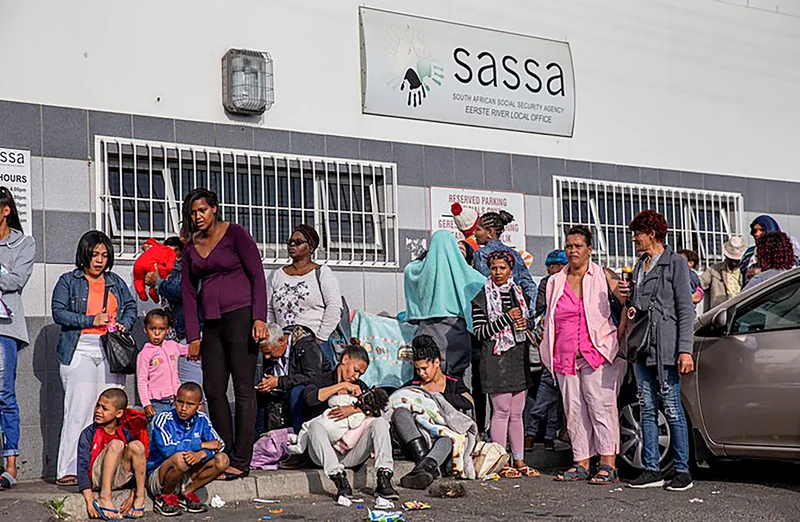
Living near the coastal edges of Amanzimtoti, KwaZulu-Natal, Buhle Sibya was unemployed and viewed the Social Relief of Distress (SRD) grant as a chance to take care of herself and her daughter. In March 2021 she successfully applied for the grant, then only R350. It was paid to her every month until January 2023 when she was notified that her approval for the grant had been declined.
In her testimony to the Pretoria High Court, she explained the reason for the decline: It âwas said to be that the bank verification process had determined I had additional income. This was not true. The only income I had received was the amount of R1,000 towards the burial of my late mother⦠who had, at the time, just died. Because of the loss of support of the grant, I can no longer support my daughter or my own self.â
Her testimony was one of 79 brought forward to the high court in 2023 documenting the inadequacies of amended regulations related to the SRD grant introduced in 2023. The case was brought against the Department of Social Development (DSD) and the South African Social Security Agency (Sassa) by civil society organisations the Institute of Economic Justice and #PayTheGrants, with National Treasury joining later to oppose the case.
An important issue in the case was the flaws in the digital income verification using banks to assess SRD grant beneficiariesâ income status. The DSD insisted: âThe bank verification system is one of the most effective and accurate mechanisms used to retrieve the SRD applicantâs financial means for the particular month concerned.â
However, on 23 January 2025, Judge Leonard Twala declared the use of income verification through the banks in SRD applications unconstitutional.
The judgment deemed verification through the banks to be exclusionary and ordered the government to improve it. Additionally, it ordered the R370 payment be raised to R624 and that it is unlawful for SRD grant applications to only be conducted online.
On 13 February 2025, the DSD, Sassa and National Treasury appealed the judgment, arguing the entire ruling is flawed. The case hearing is set for 25 August 2026 in the Supreme Court of Appeal. As a consequence, Twalaâs court ruling is suspended until the appeal is heard. In that time, government can continue to expand its digitised processes in grants administration.
Documents obtained by Open Secrets reveal that Sassa contracted Absa Bank, African Bank, FNB, Nedbank, Standard Bank and Tyme Bank to conduct means tests on SRD grant applicants and beneficiaries, as well as for other social grants, between 1 March 2025 and 31 July 2027.
They provide detailed information on how this process with the banks works. In this article, we explain why the South African government relies on banks in the income verification process for social grants, and how addressing current failures requires more inclusion of what grant recipients need from the new digital system.
The SRD grant and inaccurate public databases
Six years ago, the Covid-19 pandemic decimated the livelihoods of millions of people across South Africa, leaving many with no source of income. In response, the government introduced the special R350 Covid-19 SRD grant. Due to the nature of the pandemic, the SRD grant became the first grant where applications took place completely online.
In late September 2025, Sassa executive manager of grants operations Brenton van Vrede sat down with Open Secrets investigators for an on-the-record interview. Reflecting on the Covid crisis, Van Vrede noted that the agency needed an immediate approach to deliver a new grant:
âThe Covid SRD grantâ¦required a very rapid, quick response⦠Itâs about how do you reach as many people in a lockdown situation as fast as possible without any human contact due to the nature of Covid.â
The answer: digitalise the SRD grant and administer it fully online. But Sassa faced a problem. An effective digitalised administration of a new social grant requires efficient technological infrastructure where computer systems execute algorithms that analyse and process the accurate data of social grant beneficiaries with human oversight.
The state entities contracted to administer social grants applications and payments â the South African Post Office and Post Bank â did not have this technological infrastructure. Though Sassa was taking applications through its offices and call centres, it remained under capacity to take on the number of applications coming in.
The state turned to the private sector to fill the gap. Three digital application platforms for the SRD grant were created. One was a website portal created by a company called Prosense Technology where applications were made through email. The second was a zero-rated USSD platform created and maintained by Vodacom. Finally, a WhatsApp portal was created by a company called GovChat Pty Ltd. Though the online platforms for the SRD grant were privatised, the assessment of the data of applications was processed by Sassa itself.
The online platforms would send the captured information on to Sassa for assessment of applicantsâ eligibility. The information in the application included an applicantâs name, home address, cellphone number, choice of bank account and ID details. Applicantsâ data was checked against several public databases to assess if they were already receiving any income or another social grant.
These public databases included Sassaâs legacy database (Socpen), the Personnel and Salary System (Persal), the Unemployment Insurance Fund (UIF), the National Student Financial Aid Scheme and the South African Revenue Service (SARS) IRP-5 registrations database.
An important component of assessing grant applications is accurate data and as applications rolled in, a different problem emerged. Van Vrede explained to Open Secrets investigators that the issue Sassa faced during the early iterations of the SRD grant was that the public databases were either not up to date or did not provide real-time information.
For example, in the case of the SARS database, Sassa was unable to check information monthly since tax returns are often only filed once or twice a year, creating an 18-month lag on the information they had on record. The UIF database presented similar problems due to employers not always updating employee records consistently. As a result of these inaccurate database records, Van Vrede admitted that âa lot of people got excluded that should not have been excludedâ.
The government turns to a private database: The introduction of commercial banks
To counter the inaccuracy of the public databases the government introduced means testing through the bank account data from commercial banks. Van Vrede clarified that the use of means testing through the banks had already been âexperimentedâ with in the appeals process in early iterations of the SRD grant where it was used to reassess rejected applications. He continued:
âBut then we thought, okay, letâs see if we can use that [bank account data] as an actual part of the income assessment or the means testing process⦠we brought in banks as a private sector database⦠basically we would send a file to the banks. Banks would look at your bank account, sum up all the money that comes in, and send a file back to us [Sassa] saying you got money coming in more than R624 [income threshold].â
The governmentâs reliance on the banksâ data continues to be a key feature in the digital transformation of grants administration. Documents obtained by Open Secrets reveal that Sassa contracted Absa Bank, African Bank, FNB, Nedbank, Standard Bank and Tyme Bank to conduct means tests on SRD grant applicants and beneficiaries, as well as for other social grants, between 1 March 2025 and 31 July 2027.
The other grants include the Care Dependency Grant, Child Support Grant, Combination Grant, Disability Grant, Foster Care Grant, Old Personâs Grant and the War Veterans Grant.
The documents reveal that, within the contract period, means tests for the SRD grant are conducted each month while you are receiving it. These are conducted against the previous monthâs transactional data for the month being assessed. For all other social grants mentioned in the contracts, means tests are conducted every six months.
Sassa uses the income verification responses it receives from the banks, together with other information collected by Sassa, to determine whether the individual applicant or beneficiary remains eligible to receive a grant. Asked who oversees the accuracy of the bank verification assessment within the agency and banks, Van Vrede said:
âItâs all IT-driven. In the beginning if you complained that your bank record wasnât accurate, you lodged a complaint with our [SRD virtual] call centre. They would then feed that record to our IT department, who would retrieve the record to the bankâs IT person. They would check, did the bot or [program] make a mistake? And then feed that back and 100% of the time. Essentially⦠itâs a program that sums up all the money that came into your bank account. Chances of error is small.â
While the data of commercial banks is only one component in the governmentâs assessment of a grant beneficiaryâs income status, it is currently considered the most definitive because of its presumed accuracy. But the testimonies of grant recipients contradict that presumption.
Judge Twalaâs judgment emphasised that banking verification is incapable of accounting for fluctuations of income over time, can erroneously register income when no income was received by an SRD grant applicant, and it is unable to differentiate money that comes into an applicantâs bank account that is neither âincomeâ or âfinancial assistanceâ.
Importantly, the system is currently not designed with grant recipientsâ lived experiences in mind. As explained to Open Secrets investigators by #PayTheGrants coordinator Temoho Kgosipula regarding recipients adjusting to the new digital system:
âItâs stressful for everyone because it [digital system] is set up in a way where they assume everyone understands. Plus, thereâs no alternative to do a walk-in to ask for help with applying for the SRD or if you donât have a phone. You could be familiar with the technology, but you donât have a phone or data. Digital stuff is good, but the barrier is that thereâs no alternative. We have people living in not-so-urban establishments, townships, villages and they donât have access to digital stuff.â
In his interview with Open Secrets, Van Vrede emphasised that, at this stage, the volume of applications coming into Sassa offices for SRD grants does not match the staff capacity the agency has to conduct physical assessments and thus the process remains digital.
Regardless of Sassaâs capacity issues, the 2025 court ruling ordered the government to improve the bank verification systemâs flaws. The wait for the appeals process has suspended these orders but improvements must be addressed urgently as the government extends the process to other grants.
Conclusion
Digitalising social grants administration remains complex, with emerging risks that must be considered. Underlying all of it is the increasing reliance on private actors such as banks to help facilitate state services which may come with their own future terms and conditions. In the following article, we delve deeper on how much the banks are charging for their services and the risks that may arise from relying on their services.
In response to questions for this article, National Treasury replied: âMany of the questions fall outside the mandate of National Treasury and would be more appropriately addressed by Sassa or the Department of Social Development. Furthermore, several of the questions relate to the responsibilities and obligations of the Accounting Officer, as set out in Section 38 of the Public Finance Management Act (PFMA).â
Sassa media relations manager Andile Tshona replied: âWe have been advised that you request the information through the PAIA process.â DM
Research contributions by Raâeesa Pather and Cheriese Dilrajh for Open Secrets.
An AI transcription tool was used to transcribe the interviews conducted by Open Secrets in this investigation and the contents were verified by investigators. No AI was used in writing the article series.