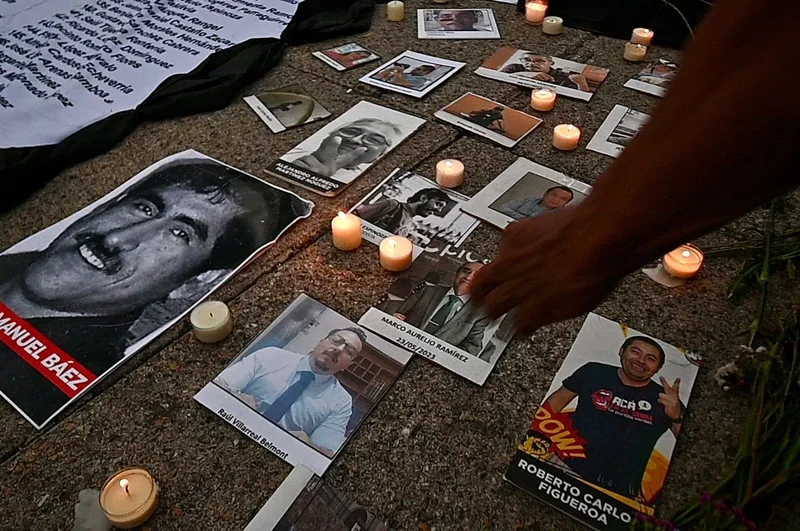
The press in Mexico is working under a climate of fear and terror following at least seven journalist murders recorded in the first six months of 2026. The latest victim was Francisco Alejandro Leyva Aguilar, who was killed on Wednesday while eating at a taco stand.
His murder comes just days after Josué Martínez Contreras, 39, was killed on July 16 in the community of San Lucas Atoyatenco, in the municipality of San Martín Texmelucan, Puebla. His 13-year-old son was with him when gunmen riding a motorcycle opened fire. The boy was the one who called emergency services, but there was nothing they could do when they arrived at the scene.
These killings add to the murders of independent journalist and environmental activist Manuel Alejandro Moreno Serna, murdered on July 3 in Zihuatanejo, Guerrero; Veracruz journalist Roxana Berenice Guzmán, who recorded her own kidnapping weeks before her body was found; Luis Ángel López Valdez, murdered on June 11 in Poza Rica, also in Veracruz; Juan David Gámez, killed in Nuevo León in March; and Carlos Castro, who died on January 8, also in Poza Rica.
Oaxaca journalist Francisco Alejandro Leyva Aguilar became the seventh reporter killed in Mexico this year after gunmen shot him dead at a roadside food stall in San Pablo Etla. Leyva, a veteran columnist known for his criticism of the state government, had reported receiving death threats to both state and federal authorities in 2025, but no protective measures were implemented. Press freedom groups have since questioned why officials failed to act despite being aware of the risks he faced
Meanwhile, investigations into the Martínez Contreras case have already begun, according to the Puebla State Attorney General’s Office. However, a video he uploaded to social media last November already showed the harassment he was experiencing from local authorities after he reported the existence of unauthorized connections to the municipal water system and the lack of transparency regarding public funds collected through water-service fees.
According to the recording by the journalist, who was also an academic and lawyer, the municipal president and personnel from Mexico’s National Water Commission (Conagua) came to his home and accused him of failing to pay several water bills. Martínez Contreras showed the camera receipts proving payment and stated that, although he had clarified the situation and presented the documentation, he was still forced to pay what amounted to a “fine” of 6,000 pesos (about $350).
“The crux of this whole matter is that we have not allowed them to run a lucrative business from the water supply [...] What they want is to get rid of me, push me aside,” he says in the video.
The video, which lasts just over five minutes, ends with the following statement: “Remember that it is better to die with the strength of the people than to die on your knees. I tell you this: we are going to fight for our people and for our municipality.”
Following his murder, Reporters Without Borders (RSF) in Latin America raised new questions for the Mexican government regarding the dangers faced by the press in the country: “How many have to die for the authorities to realize their response remains clearly insufficient? Opening an investigation after each murder is simply not enough,” said Artur Romeu, RSF’s regional director. “The Mexican government must be held accountable for the failures in prevention and protection that have allowed these crimes to recur, and present concrete measures to keep these killings from happening.”
The attack on journalist Roxana Berenice Guzmán was also captured on video. Guzmán was the founder of Pulso Informativo del Sureste, a Facebook news page she managed from Nanchital, in southeastern Veracruz, where she lived with her family. The footage revealed the terrifying moments she faced when several armed men, dressed entirely in black, smashed down her front door, pointed assault weapons into the house, and abducted her.
A month later, her remains were found on a ranch in Moloacán, about 30 kilometers (19 miles) from where she had been taken. Eight people have been arrested in connection with the case. Four of them are municipal police officers from the municipality of Ixhuatlán del Sureste.
The brutality of these crimes, in a country numbed by everyday violence, is not the only cause for concern among international organizations. Equally troubling is the message of impunity these incidents send and the vulnerability in which journalists continue to work. Of the seven cases documented so far in 2026, only in Roxana Guzmán’s case have suspects been detained.
The governor of Veracruz, Rocío Nahle of the ruling Morena party, whose state was the scene of the murders of Carlos Castro and Luis Ángel López Valdés, has repeatedly insisted that their deaths were unrelated to their journalistic work.
“Regardless of the profession they practiced, the investigations are being carried out by the prosecutors’ offices. There are several lines of investigation already made public by the state prosecutor, and it is not specifically because of their journalistic work. In my administration there is absolute freedom of expression, absolute freedom,” she said on June 15 during a press conference in which she referred to the murdered journalists simply as “the man from Poza Rica” and “the woman from Nanchital.”
Mexican President Claudia Sheinbaum, meanwhile, has been brief whenever she is questioned about a new journalist killing in the country, generally instructing her cabinet to ensure that the cases are addressed.
“This morning it was presented to the cabinet and they are under investigation,” she said on July 17 regarding the Martínez Contreras case.
The Inter American Press Association (IAPA/SIP) condemned Martínez Contreras’s murder, stating that “impunity in these crimes encourages further attacks against the press.”
Documented attacks
The situation is far from easy for local media outlets outside the Mexican capital. In addition to the co-optation of media organizations by governments in power, and in some cases by organized crime, journalists also contend with increasingly precarious working conditions.
It is no coincidence that the vast majority of local journalists, communicators, and reporters have additional professions or jobs to support themselves and their families. Salary levels vary across states, but a Mexican government labor category that groups authors, journalists, and translators places the average monthly wage at about 8,000 Mexican pesos (approximately $456) for work averaging 37.9 hours per week.
Dozens of attacks against journalists have also been documented so far this year. On July 17 alone, in Culiacán, the home of César Millán Lafarga, the general director of Grupo Adiscusión, was riddled with bullets by armed men.
Another case documented by Reporters Without Borders (RSF) occurred in March. Óscar Merino Ruiz, director of the digital news outlet OM Noticias, was shot on March 16 in Santiago Pinotepa Nacional, a city in southern Oaxaca. He survived the attack after spending several days in critical condition.
On May 24 in Sinaloa, Juan Manuel Partida Valdez, president of the state’s Journalists’ Association and author of the Altoparlante column, received death threats against his family and was targeted by stigmatizing comments from anonymous Facebook accounts. The harassment came after the journalist published information concerning alleged opacity and nepotism involving Rubén Rocha Moya, the governor of Sinaloa, who is on a temporary leave of absence.
On June 10, personnel from Mexico’s Navy Ministry (Semar) deleted photographic material and threatened legal action against journalists Karen Salas and Óscar Ramos of the Tamaulipas-based digital outlet Elefante Blanco after they documented an alleged fuel spill in the Pánuco River near Petróleos Mexicanos’ (Pemex) Francisco I Madero refinery.
Another case is that of journalist Marcos Ramos in Cintalapa, Chiapas, who survived a shooting attack. Ramos is the director and editor of Real Cintalapa, a news platform with nearly 150,000 followers that publishes information about the region.
“Sources close to the case indicated that Marcos, like other journalists in the region, had decided to stop publishing information about violent incidents as a form of self-censorship to protect himself,” the organization Article 19 reported.
Just a few days ago, on July 13, independent journalist Ángel Maldonado in Coahuila survived an attempted break-in at his home. Several men threw rocks and tried to force their way inside. The attack occurred shortly after he covered a protest over a sexual abuse case.
In states such as San Luis Potosí and Campeche, authorities have adopted measures aimed at restricting freedom of expression by applying or modifying existing laws. Journalists and international organizations have denounced these actions, citing cases in which media workers have been jailed on allegations related to terrorism or even simply for using artificial intelligence.