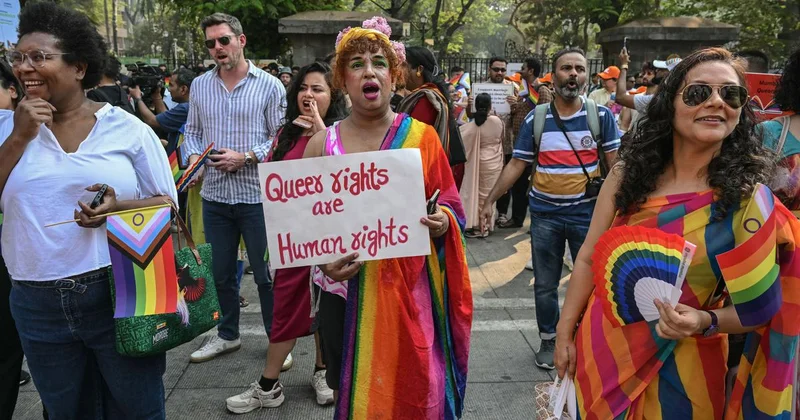
Edited by Dhrubo Jyoti and Dhamini Ratnam, Queer India Now holds the fraught, diverse, difficult, hopeful, rebellious and relentless lifework that queer and trans persons have been practising and embodying for decades. It rightly places itself in a long legacy of queer writing in India while revealing the material stakes of what constitutes living a queer life much more than most edited volumes that have been published before. This is not to say that previous volumes do not reveal material precarity but that, with Queer India Now, the contributions make visible a clear departure from exploring queerness only as this amorphous, liminal mode of being – to one where language, positionality, region and infrastructures of living are mapped between these two words “Queer” and “India”.
The citizen and the state
In other words, the messiness and differences across the pages represent robustly the plurality of what becomes “a movement” and its unevenness holds the many threads that negotiations with institutions involved. There is queerness that wrestles its way out of violent families, surveilling legal and medical systems and then there is also that which has one foot in the system, struggling to find the key to the lock. As the Introduction states, “Neatness is not always a friend of democracy”, and especially in the wake of the recently passed Transgender Persons (Protection of Rights) Amendment Act (2026), this shadowy idea called “democracy” is consistently made and unmade between the hands of citizens and the State.
Queer India Now makes it abundantly clear that there is no one way to be queer and Indian. This is a fiction of both the narrative we tell ourselves as a movement and what we offer up to the global sphere. There is, however, a deep sense of place to what these two words mean. What stands out in the collection is precisely the refusal of the global, metropolitan idea of a shared queerness, which is to say that language does not necessarily hold all the power for people’s sense of dignity and autonomy.
Kiran Nayak, a disabled Adivasi trans-man, writes in “Our Place in Democracy” about how growing up he had no way to identify himself but also how discovering the words did not necessarily change his condition, later pointing to the importance of intersectional infrastructures of support (housing, healthcare, education, employment) rather than the primacy of language. The NGO-isation of queer politics that creates a homogeneity around language and experience is also deeply challenged in the “11th Direction” by Disha Pinky Shaikh, where she pushes back against the framing of a “third gender”, asking instead who made the first and the second.
Conversations between Dr Aqsa Shaikh and Aryan Somaiya in “Is That Any Way to Treat Someone?” or Amritananda Chavkravorty’s “Queering the Law: An Advocate’s Tale” reflect deeply on the negotiation with systems that force surveillance and structurally disempower queer and trans persons. These are not easy positions to occupy – queer lawyer or trans doctor – but representation is not only about the presence of a singular identity; it is about creating a possibility that changes how we see the relationship between knowledge and experience.
The curse of caste
The contributions in this book most powerfully, deftly and unflinchingly address the violence of caste head-on, unlike the studied silence around it in the past. To think about questions of intimacy, family and kinship in India outside of caste is not only impossible; it is deeply dishonest. BR Ambedkar’s contribution echoes through the pages as the Indian Constitution becomes the only protagonist of hope in times of increasing despair. Simultaneously, his unparalleled work around questions of dignity, fraternity and questioning of Brahminical respectability plays a deeply foundational role in marking both the border and movement that people’s experiences and intimacies take them through.
In the stories from “When You Weren’t Looking: Tales from Small-Town India”, Dhrubo Jyoti and Dhiren Borisa show us that the geographies of desire are always already marked by caste as the stories are peppered with quotidian phrases such as “bade sheher ka tha” (he is from a big city), “waise ghar ka hai” (that type of house/background), “chup chaap milte the” (we met in secret), “hamari jati ka hai” (he is from our caste) and so on. Vasavi Kalluru’s “Bedroom” quietly holds the complexity of being Dalit-Queer and chronically disabled without naming any of these identities explicitly, revealing precisely how entangled they are in this collage we call a human body.
Whether it is about imagining anti-caste queer futures in the poetry of Shripad Sinnakar’s “Begumpura”, the possibility of freedom that the forest offers to Payal Rathwa, the delicate entanglements of Buddhism and queerness in Tashi Choedup’s “Neither Monk, Nor Nun” or the nexus between popular media, language and in/visibility in so many other incredible essays and poems in the book leave the reader breathless in holding the differences reflected. There are struggles of the city, struggles of the body and struggles of lexicon across different registers, but each contribution whispers a hope made under the vastness of the sky. A life made without a template. A night survived because of a friendship. Even in the dreams that became deferred, Queer India Now reminds us that “…the skies don’t forget what people under them choose to let go. The skies remember.” This collection is like the sky, remembering us all.
Shamini Kothari is a PhD student in Comparative Literary Studies at Northwestern University.
Queer India Now, edited by Dhamini Ratnam and Dhrubo Jyoti, Westland Books.
We welcome your comments at letters@scroll.in.