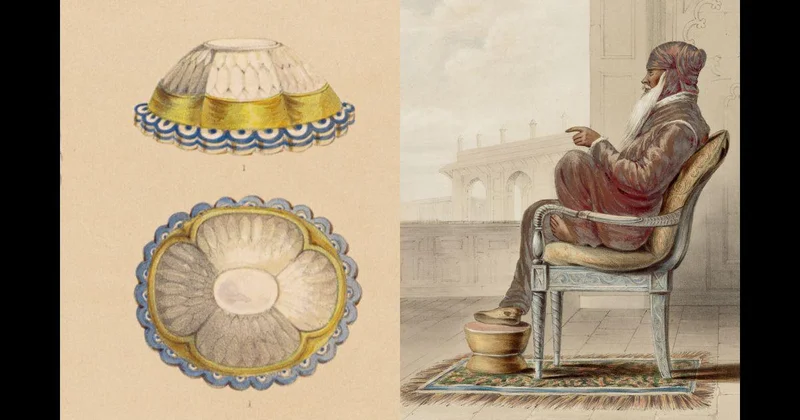
In the late 1830s, in north India, the artist and writer Emily Eden was fascinated by Sikhs – both royalty and commoners. She visited Sikh religious sites and experienced the hospitality of Maharaja Ranjit Singh.
Emily and her younger sister Frances (Fanny) accompanied their brother George, Lord Auckland, India’s newly appointed governor-general, on his progress across north India, from October 1837 to December 1838. Occasional mentions of Sikhs continue to appear in her correspondence till at least November 1839.
When Lord Auckland and his sisters met Ranjit Singh in December 1838, they probably knew little of the Sikhs’ distinctive religious and martial heritage.
Luckily there were interpreters, and Emily had a sharp intellect, acute powers of observation, liberal Whig values and a lively curiosity about people. She also had a keen sense of humour. She journalled and painted assiduously and prolifically.
Among nineteenth-century Western sources on Sikh history, historians have usually drawn on the more formal accounts published by male authors. The journals and letters of women, as well as their sketches and paintings, have been largely overlooked. So, consideration is overdue of Emily Eden’s insights into interactions between Sikhs and the British a decade before their annexation of Punjab.
In particular, for the encounters between Maharaja Ranjit Singh and the governor-general between 1838 and 1839, a time of crucial negotiations, her observations complement the only contemporary Indian record, in volume 3 of Sohan Lal Suri’s court chronicle, the five-volume Umdat- ut-tawarikh Daftar.
The Sikhs had a proud history of defending their faith against aggressors. In the eighteenth century, their persecutors were sacrilegious Afghan invaders. In response, the Sikhs had formed misls, armed bands, to protect their community. Indeed, one of these misls, the Sukerchakia misl, was headed by Ranjit Singh himself.
When the Edens visited Punjab, the most eye-catching Sikhs they encountered were Akali-Nihang warriors, with their extremely tall turbans, their war cries and an abundance of weaponry adorning their person.
During the nineteenth century, British-Sikh contact was increasing steeply: in the 1830s, the British East India Company was intent on expanding north-westward the area under its control, while the Sikh empire of Maharaja Ranjit Singh, too, was in the ascendant. Nonetheless, by 1838, when the Edens reached the Punjab, few Sikhs had encountered Westerners
Emily and Fanny were not the first British women to meet Sikhs. In Haridwar, a Hindu pilgrimage place, as early as 1809, Ann Deane had met with and described female members of the maharaja’s family and, in 1837, Isabella Fane similarly mentioned her Sikh encounters.
As neither Ann Deane nor Isabella Fane had visited the Golden Temple in Amritsar, Emily’s and Fanny’s descriptions of their visit in December 1838 are the first by any Western women, as opposed to male visitors. Thanks to Ranjit Singh’s patronage, the cladding of the upper part of the building with embossed sheets of gilded copper, had been completed just a few years before the Edens’ visit.
Emily reported how – remarkably – the maharaja personally took Lord Auckland, Fanny and her to ‘the famous Sikh temple where he had consulted the oracle about his present alliance with us.’ She commented, ‘This temple is the only thing that Sikhs are supposed to venerate in a religious way’ and reported:
The temple stands in an immense tank of holy water, and a narrow marble bridge leads to it. There is a broad walk all round the tank, and it is surrounded by palaces belonging to his principal sirdar[s], and by other holy buildings. The temple is of pure gold, really and truly covered completely with gold, most beautifully carved, till within eight feet of the ground, and then there are panels of marble inlaid with flowers and birds – very Solomonish altogether. There are four folding-doors of gold.
She noted that ‘large illuminated fish were swimming about the tank’ and, inside the temple, she saw ‘a large collection of priests, sitting in a circle, with the Grooht [i.e. Granth, as misread by her transcriber], their holy book, in the centre, under a canopy of gold cloth, quite stiff with pearls and emeralds.’ Indeed, so impressed was she that she declared that, despite the inconvenience and indignity of removing one’s footwear prior to entering, ‘I would have given up my shoes, and stockings too.’
Queen Victoria (in a diary entry dated 14 February 1839) appreciated Emily’s ‘most amusing account of Runjeet Singh.’ Regarding Ranjit Singh’s appearance, on her first encounter, she had famously noted, ‘He is exactly like an old mouse, with grey whiskers and one eye.’ Moreover, ‘Runjeet had no jewels on whatever, nothing but the commonest red silk dress. He had two stockings on at first, which was considered an unusual circumstance; but he very soon contrived to slip one off, that he might sit with one foot in his hand, comfortably.’
And confirming this initial impression, she wrote subsequently: ‘The old man himself wears a sort of red stuff dress with a little edging of the commonest grey squirrel’s fur, and a common red muslin turban.’
Importantly, Emily very positively summed up as follows the maharaja’s qualities as a ruler: ‘Still, he has made himself a great king; he has conquered a great many powerful enemies; he is remarkably just in his government; he has disciplined a large army; he hardly ever takes away life, which is wonderful in a despot; and he is excessively beloved by his people.’ More succinctly, Fanny observed, ‘I think we are all left with a great respect for Runjeet’s talents in the peculiar line of governing Sikhs.’
Emily’s journal contains testimony to the importance of horses to the maharaja. She quotes Webb, the Eden’s coachman, again on how ‘the old man was a-running about looking at ‘em, more like a coolie than a king,’ and Emily declared, ‘His strongest passion is still for horses: one of these hit his fancy, and he quite forgot all his state, and ran out in the sun to feel its legs and examine it.’ Her paintings bear out her observation that his finest jewels adorned his horses. She noted ‘quantities of their led horses trapped in gold and silver tissues, and all of them sparkling with jewels.’
Ranjit Singh’s interests were wide-ranging, and he had a reputation for interrogating whoever he met. So, Emily’s gift to him of her portrait of Queen Victoria in a jewelled frame met with a ‘volley of questions about the Queen’s costume, her orb and sceptre and her character.’ Emily mentioned Webb’s report that ‘Runjeet he asked me such a many questions.’ When hosting Lord Auckland in the Govindghur [Govindgarh] Fort, he ‘asked questions about cannons and shells, and mines, and forts in general.’
He was curious, too, about the religion of his English guests. On 21 December 1838: ‘Runjeet has got a fit of curiosity about our religion, from our having declined engagements for Sundays and for Christmas-day; and he has sent the fakeer [Azizuddin, the maharaja’s foreign minister] twice to Mr. Y. [their chaplain] to say he wants to have translations of what it is he says to the Lord Sahib every Sunday…’ On Boxing Day, Emily again referred to his inquisitiveness about Christianity: ‘Runjeet has been extremely curious about our Sundays and Christmas-days, and, ill as he was, he sent for Mr Y. to-day, to explain to him what it meant. Mr. Y. took him translations of the Lord’s Prayer, the Ten Commandments, and the prayer for the Governor-General.’
Ranjit’s own religiosity was deeply imbued with his Indic heritage, whether with regard to cow-slaughter or to bathing in auspicious rivers before embarking on a new venture. From Simla, on 1 July 1839, Emily recorded what happened the day before Ranjit Singh died: ‘The Maharajah sent for all his famous jewels, his horses with their splendid trappings, the surpêche [jewelled turban ornament] and pearls given him by G. [Lord Auckland], and ordered them to be sent to different shrines with directions that the Brahmins should pray for him.’
What was more, ‘he ordered the Koh-i-Noor (the famous diamond) to be sent down to the temple of Juggernaut,’ but then yielded o his sirdars’ remonstrances that such a valuable diamond could never be repurchased.
This is an excerpt from the essay, “The Edens and the Sikhs”, from the book Princes & People of India: Portraits by Emily Eden, accompanying the eponymous exhibition at DAG, New Delhi on display till August 1.
We welcome your comments at letters@scroll.in.