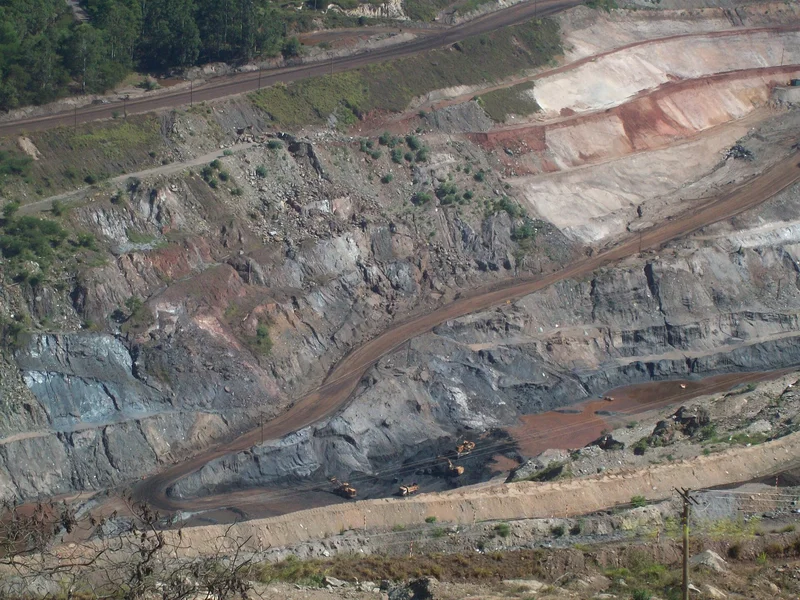
Key Facts
- Iron ore-linked Vale easedwith its New York-traded shares settling at 14.79 $ after a modest -0.27% d/d move.
- Brazilian peer CSN Mineracao outperformedclosing at 1.08 $ with a +1.89% d/d gain that contrasted with the broader iron ore softness.
- Global heavyweight Rio Tinto softened slightlyending the session at 91.22 $ after a -0.32% d/d move, mirroring a cautious tone on China demand.
- Vale remains the world’s second-largest iron ore exporteranchoring Brazil’s role as a key supplier to Asian steel mills, especially in China.
- China’s steel sector is the main demand engine for seaborne iron oreso shifts in construction, infrastructure and manufacturing policy there drive sentiment in Vale and its peers.
- Iron ore miners now trade as a proxy for the underlying ore pricebecause many investors do not see a live spot quote on their usual boards and read the sector through listed names instead.
Today’s Focus
Iron ore-exposed miners gave a mixed read on the market, with Brazil’s Vale a touch softer, CSN Mineracao firmer and Rio Tinto drifting lower into the latest close.
For foreign investors, these moves are the main visible proxy for iron ore itself, since the ore price often sits off-screen or on specialist commodity boards rather than standard equity feeds.
The day’s pattern fits a familiar narrative: steady but unspectacular Chinese steel demand, ongoing caution over the country’s property sector, and investors using Vale and its peers to express views on the ore market.
In Latin America, that translates into a nuanced picture where Brazil’s mining giants remain central to regional performance and to any broader call on China’s next policy steps.
What matters today. What matters now is whether Chinese steel demand—and the policy support behind it—can stay firm enough to justify current valuations in Vale and its peers.
01 The session in one read
Iron ore-linked equities pointed to a mildly softer tone in the latest session, with Vale and Rio Tinto closing slightly lower while CSN Mineracao advanced.
For outsiders looking at Latin America, this combination suggests traders are reassessing iron ore exposure around China’s demand outlook rather than reacting to any abrupt shock in the market.
Across the board, iron ore-linked miners are signaling a market that is stable rather than exuberant, with modest declines in Vale and Rio Tinto set against a gain in CSN Mineracao that hints at selective optimism in Brazil. For investors reading iron ore through equities, the key variable to watch is upcoming Chinese data and policy guidance on steel-intensive sectors such as infrastructure and property.
02 The board
Vale, Brazil’s mining flagship and the world’s second-largest iron ore exporter, settled at 14.79 $ with a -0.27% d/d move, offering the clearest local read on seaborne ore sentiment.
CSN Mineracao, a smaller but closely watched Brazilian iron ore producer, closed at 1.08 $ with a +1.89% d/d change, while Anglo-Australian giant Rio Tinto finished at 91.22 $ after a -0.32% d/d move.
| Asset | Level | Change |
|---|---|---|
| Iron ore (Vale) | 14.79 $ | -0.27% |
| CSN Mineracao | 1.08 $ | +1.89% |
| Rio Tinto | 91.22 $ | -0.32% |
Source: EODHD close, 2026-07-24. Where a commodity has no spot feed, an exchange-traded tracker or leading producer is shown as a labelled proxy.
Live Market IntelligenceThe live market board
Rio Times · Live Market Intelligence
Latin America — Cross-Market Board
| Instrument | Last | Change | YoY | Prev. | High | Low | Volume |
|---|---|---|---|---|---|---|---|
| IBOV | 174,041.95 | -1.52% | +30.07% | 176,723.62 | 176,720 | 174,042 | — |
| IPSA | 10,950.74 | +0.31% | — | 10,916.70 | 11,023 | 10,913 | 1,513,213,483 |
| IPC MEX | 66,383.68 | +0.21% | +16.39% | 66,247.47 | 66,748 | 65,760 | 111,291,170 |
| MERVAL | 3,283,854 | -1.07% | +53.80% | 3,319,522 | 3,343,876 | 3,275,510 | — |
| COLCAP | 2,274.53 | -0.38% | — | 9.04 | 9.05 | 9.02 | 4,133 |
| BVL PERÚ | 58,287.01 | — | — | — | — | — | — |
| USD/BRL | 5.08 | -0.18% | -8.00% | 5.08 | 5.09 | 5.05 | — |
| EUR/BRL | 5.78 | +0.08% | -10.91% | 5.78 | 5.80 | 5.75 | — |
| USD/MXN | 17.48 | -0.26% | -5.73% | 17.52 | 17.52 | 17.43 | — |
| USD/CLP | 948.45 | +0.27% | +0.04% | 945.90 | 948.65 | 942.31 | — |
| USD/COP | 3,218 | +0.07% | -20.28% | 3,215 | 3,280 | 3,156 | — |
| USD/PEN | 3.40 | +0.13% | -4.32% | 3.40 | 3.41 | 3.39 | — |
| USD/ARS | 1,496 | +0.47% | +18.88% | 1,489 | 1,497 | 1,480 | — |
| USD/UYU | 40.14 | +1.38% | +1.14% | 39.60 | 40.14 | 40.14 | — |
| USD/PYG | 6,022 | +1.26% | -18.40% | 5,947 | 6,025 | 6,022 | — |
| USD/BOB | 11.18 | +4.51% | +65.88% | 10.70 | 11.18 | 11.02 | — |
| USD/DOP | 57.99 | -0.28% | -3.43% | 58.15 | 58.19 | 57.84 | — |
| USD/CRC | 449.17 | +1.76% | -8.94% | 441.39 | 451.03 | 449.17 | — |
2 of 4names higher.
IPSAled, while
MERVALlagged.
Live Company IntelligenceVale SA ADR — the full investor dossier
Wall Street view
14Buy
12Hold
0Sell
$16.94· +15% vs 200-day
Valuation & profitability
Price & risk
$8.6052-wk high
$17.94
Revenue trend · 6y
$38.23B
Ownership
Dividend
What Vale does.Vale S.A., together with its subsidiaries, produces iron ore and nickel in Brazil, Asia, the Middle East, North Africa, Europe, the Americas, and Oceania. The company operates in two segments, Iron Ore Solutions and Vale Base Metals. It extracts, produces, and distributes iron ore, iron ore pellets, briquettes, nickel, copper, other ferrous…
03 What moved it
These modest price moves reflect a view that Chinese steel demand is holding up but not accelerating, as investors weigh infrastructure support against lingering property-market uncertainty and environmental constraints on steel output.
Because many investors do not track a real-time iron ore spot quote, listed miners like Vale, CSN Mineracao and Rio Tinto serve as practical stand-ins for the ore price, with their shares moving on expectations for Chinese steel production, shipping flows and policy signals rather than on local Brazilian factors alone.
04 The Latin American read
For Latin America-focused portfolios, Vale’s slight decline and CSN Mineracao’s gain underline Brazil’s dual identity as both a global commodity supplier and a regional bellwether for China-sensitive assets.
This makes iron ore miners central to any view on Brazil’s external accounts, regional market sentiment and the transmission of Chinese growth—whether through higher export revenues, currency implications or shifting capital flows into local equities.
05 The names to watch
Vale remains the primary name to watch for a real-time sense of iron ore demand, given its scale, logistics network and deep ties to Chinese steel mills as the world’s second-largest exporter.
CSN Mineracao and Rio Tinto round out the picture, offering complementary views from Brazil and Australia that help foreign investors across Latin America triangulate the underlying ore market, with Chinese steel demand the variable to watch.
06 The outlook
Looking ahead, the iron ore market will likely continue to trade on every headline out of Beijing, with property-sector policy and infrastructure spending the two main levers. For Latin American investors, that means Vale and CSN Mineracao will remain the most accessible way to bet on—or hedge against—China’s next move, even without a direct ore price on screen.
07 What to watch
- Chinese steel output data:Watch for monthly crude steel production figures from China’s statistics bureau, which signal real-time demand for seaborne iron ore and drive Vale’s share price directly.
- Beijing property policy:Any new support measures for China’s troubled property sector would lift iron ore sentiment, because construction uses roughly a third of the country’s steel.
- Iron ore port inventories:Weekly stockpile data from Chinese ports reveal whether supply is running ahead of demand; rising inventories tend to pressure Vale and its peers.
- Brazilian export volumes:Monthly trade data showing Vale’s shipment pace helps investors gauge whether the company is capitalising on steady Chinese demand or facing logistical snags.
Frequently Asked Questions
Why does Vale’s share price matter for iron ore if I cannot see the ore price?
Vale is the world’s second-largest iron ore exporter and its New York-traded shares are a widely available proxy for the underlying commodity, moving on the same Chinese demand factors as the ore itself.
What makes China so important for iron ore?
China produces more than half the world’s steel and buys about 70 percent of seaborne iron ore, so its construction, infrastructure and manufacturing activity sets the price for miners everywhere.
Why did CSN Mineracao rise when Vale and Rio Tinto fell?
Smaller miners can diverge on company-specific factors such as cost structures, domestic Brazilian demand or short-covering, even when the broader ore market is slightly softer.
How should a Latin America-focused investor read these moves?
Treat Vale and CSN Mineracao as a real-time barometer of Chinese commodity demand that flows through to Brazil’s exports, currency and equity market sentiment.
LatAm Markets: Live Signals → — real-time movers, turnover leaders and FX across Latin America.