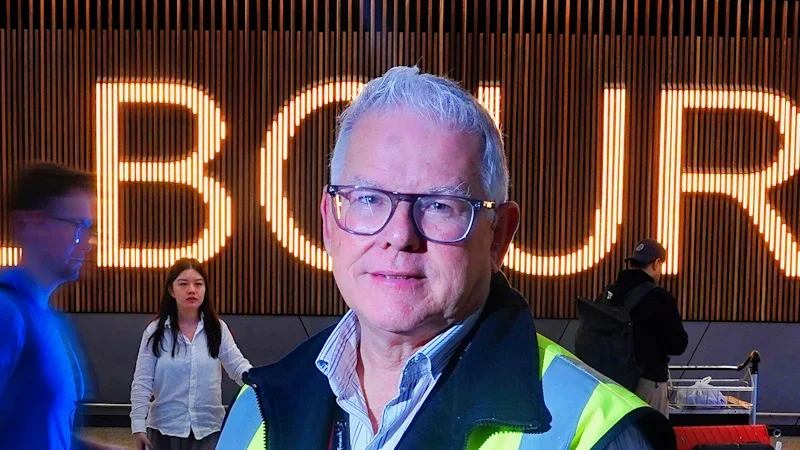
Martyn Scrimshaw has seen it all in his job as chaplain at Melbourne Airport: bereaved relatives meeting a flight their family member has died on, homeless people looking for a warm place to sleep and victims of romance scams waiting vainly by the arrivals gate.
He walks the corridors of the airport most days in a high-vis vest emblazoned with the word “Chaplain” on the back ready to help those in need with advice, assistance or a prayer for nervous flyers.
Scrimshaw has an unassuming air and kindly face. As a captain in the Salvation Army he has been in the role of airport chaplain for nine years, tending to some of the 10,000 people a day who pass through Melbourne Airport.
“My parish is this airport,” Scrimshaw says, taking a break from his duties at a cafe next to the arrivals gate.
“Everything that happens out in the community happens here and often very rapidly ... we deal with people with anxiety, mental health. You’ve got 23,000 staff who come to work in what is sometimes a pressure environment.”
The “big stuff” Scrimshaw encounters in the airport’s microcosm of society is when he gets a call to say there has been a death on a plane, which happens every few weeks.
“We come in and support crew, support ground staff, especially the grieving family,” he says.
“If there’s other family members that come to the airport, we’ll go and meet them and provide connection. It doesn’t matter what their faith is, it’s about providing the appropriate cultural support for them and being aware of what they may need.”
Usually, the death is caused by a cardiac arrest, but sometimes there may be underlying conditions.
“Our best outcome is when paramedics are able to get a pulse and get them to hospital,” he says.
Scrimshaw also checks on the homeless people at the airport and does whatever he can to look after their welfare.
“If it’s cold out there, unfortunately, we do get a few people rough sleeping,” Scrimshaw says. “We try wherever we can to connect them to support agencies, but it really is a broken system.”
One homeless man in his 80s was sleeping regularly at the airport. His health deteriorated and Scrimshaw took him to the airport pharmacist, who assessed him and said he needed to go to hospital.
Scrimshaw organised a taxi to get the man to hospital and contacted a social worker who connected the man with homeless services.
“Unfortunately, a month ago, I got a call from the agency saying, ‘Oh, we haven’t seen him for a while, but have you seen him at the airport?’” he says. “We haven’t seen him, so I’m hoping the worst hasn’t happened.”
A Nepalese woman also lived at the airport for more than three months, camping out at the terminal under an escalator.
“She made friends with quite a number of staff that had gotten to know her over the time, and she was actually going from one to the other and getting food,” Scrimshaw says.
“It probably came to a bit of a head when she brought her own rice cooker in and plugged it in and was cooking her meals.”
Scrimshaw says the real life drama playing out was reminiscent of the Tom Hanks movie, The Terminal.
The chaplain saw the woman’s passport and realised it was her birthday.
“I went out and bought a birthday card, I probably shouldn’t have,” Scrimshaw says bashfully. “We didn’t try to encourage her, but it was a struggle.”
Scrimshaw eventually worked with the woman’s family to get her home to Nepal, but it took months to build rapport with her in what was a complex situation.
“We all work together to make sure they’re safe, but also that everybody who uses the airport is safe as well,” he says.
Over the years, he has helped countless survivors of domestic violence referred by agencies, typically where mothers and children are relocating interstate for their safety and are worried the perpetrator might turn up at the airport.
Scrimshaw finds them a safe place to wait for their flight. Often, he stays with them until they board the plane.
Etched in his memory is a woman who was fleeing her abuser in Werribee in the city’s west. She jumped on a SkyBus. The driver, realising a man was chasing her, quickly shut the doors.
The driver called the airport and Scrimshaw met the woman at the terminal. He sat with her and went through the process of making reports to the police, before helping her get on a flight to her family in Tasmania.
In another case, a man was running through the airport trying to get past international departures and security to stop his partner and children boarding a flight.
Scrimshaw told the man he needed to go to the police to make a report and follow the proper process.
The next morning a woman arrived at the airport with her 11-year-old daughter and a baby saying she urgently needed to get on a flight to Scotland as she was running from someone in custody.
Scrimshaw helped her book flights with payments that could not be traced. He stayed with her until she got on the flight.
“It turned out the man the day before was the perpetrator and police held him for a breach of an AVO (Apprehended Violence Order),” Scrimshaw says.
“The thing for me was when she took the baby off to be changed, I stayed with the 11-year-old. The stuff she told me, no 11-year-old should see that. It broke my heart and made me even more determined to make sure that they were safe.”
His team has also seen an increase in people, often older, coming to the airport after being scammed.
“We find out they’ve been taken for a ride, and unfortunately some of them lost quite a bit of money,” Scrimshaw says.
“They might have handed money over, but hopefully we’ll stop them handing more money over.”
A typical romantic scam involves the victims turning up to the airport to meet somebody who they’ve transferred money to for a ticket; they wait at the arrivals gate for a scammer who never comes.
“We had another one where a guy came and said the person said they were meeting was being held by Border Force in the holding cells, and they had to pay money to have them released,” Scrimshaw says.
“You have to tell them that’s not how it works in Australia.”
Scrimshaw says he makes sure not to “push” religion on people. He sees his role as looking after humans who are struggling.
However, there are times when he is walking through the terminal and someone taps him on the shoulder and says: “I’m a nervous flyer, would you say a prayer for me?”
A spokesman for the airport stresses the nondenominational focus of Scrimshaw’s role.
“Melbourne Airport is proud to support the chaplain service, which provides care and support to passengers and staff across the airport precinct regardless of their faith or background,” he says.
He is one of only two airport chaplains in Australia. Sydney Airport got rid of its chaplain during the coronavirus pandemic leaving only Hobart and Melbourne with airport chaplains.
Scrimshaw’s role is set to get more attention after he helped a woman who is a film and TV producer track down her handbag, which she left on the back seat of an Uber. Their encounter is the inspiration for the upcoming movie and television series The Airport Chaplain.
Hugo Weaving is playing the role of the chaplain in the dramatisation, which is premiering at the Melbourne International Film Festival and will air on SBS.
Life at the airport really can be stranger than fiction.
MIFF runs August 6-23, miff.com.au