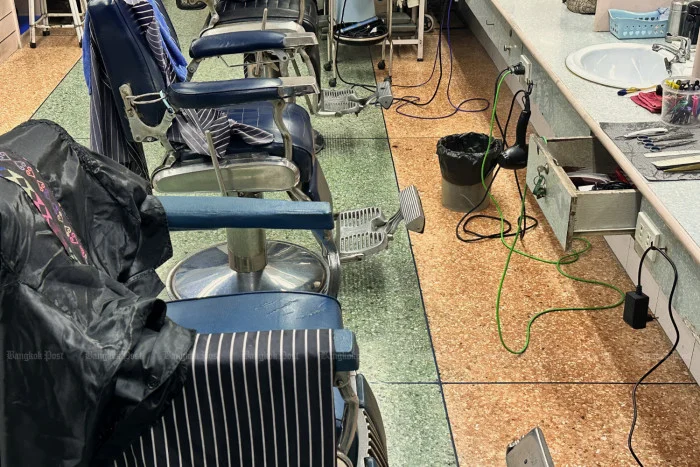
“Neighbourhood barbershops and salons are becoming places only for people who are too lazy to wash their own hair or who have certain physical limitations. For example, they may have just undergone eye surgery,” 53-year-old hairdresser Nong says with a laugh.
In every neighbourhood, there is a hairdresser. The profession has long provided a vocational career for Thais and, for some, a dream job. At a time when annual lists warn of occupations at risk of being replaced by artificial intelligence, hairdressers are rarely mentioned.
For a look behind this seemingly simple and low-profile profession, the Bangkok Post visited several barber shops and salons to speak with Thai hairdressers whose decades behind the chair reflect how society has changed over time.
From social attitudes, changing consumer habits to economic pressures, we found out how they are adapting to an industry that often goes unnoticed.
For Nong, the owner of Pimol Hair near Tao Poon Market in Bangkok, hairdressing has been her livelihood for nearly 25 years.
“At first, my mother wanted me to become a hairdresser, but I wasn’t interested,” she said. “Being a hairdresser also means becoming an emotional outlet for customers.”
After giving birth, however, she found herself unsure what to do next. She enrolled in beauty schools, trained under foreign instructors and gradually developed both her skills and passion for the profession. Along the way, she said, she learned that patience and emotional control were what she valued about the profession the most.
“It’s not just our customers’ emotions that we have to deal with,” she said. “Some services, such as hair straightening, take many hours and require a great deal of patience.”
Pimol Hair once employed several staff members, but they left after customer numbers and revenue began declining about a decade ago.
“The Purple MRT Line opened around that time, and customers could no longer park along the roadside,” she said.
Now running the shop alone, Nong serves about 20 customers a day. “It’s exhausting. But I feel proud when I count the day’s earnings,” she said, adding that hairdressers must continue learning through training courses, YouTube and keeping up with new trends.
Nong, 53, has been welcoming customers ranging from kindergarten children to grandparents, both men and women, for nearly 25 years at Pimol Hair.
While the business has always had its ups and downs, social changes have made it increasingly difficult to predict the future of neighbourhood salons.
After the Covid-19 pandemic, many people became accustomed to styling their own hair at home, while some salons that closed during the outbreak never recovered.
“Today, many people only visit salons for a haircut or because they don’t want to wash their own hair,” Nong said. “Local salons are increasingly serving people with specific needs, such as customers recovering from eye surgery who cannot wash their own hair. Beyond that, the business hasn’t grown much.”
While high-end salons in shopping malls continue to attract affluent regulars, neighbourhood salons have grown quieter year by year, she said.
“People are spending less. If they can do their hair themselves, they will. Men, for example, may stretch the time between haircuts to a month or even six weeks to save money.”
Building a stronger profession
Tate, a 39-year-old Bangkok hairdresser, looks back at his starting point more than 20 years ago and says, “hairdressing was widely seen as a profession for women. Men who entered the industry were often assumed to be gay.”
“Unless they came from a family that already owned a salon, people who entered the profession were often stereotyped as those who had failed university entrance exams, dropped out of school or couldn’t get into university.”
Tate, an architecture graduate, said attitudes have gradually improved as Thailand’s creative industries expanded, although some prejudice remains. Even his family questioned his decision to become a hairdresser.
“My thinking, however, was that if I ended up working in an office, I probably wouldn’t enjoy it. If I enjoyed hairdressing, I’d probably be good at it.”
After being an employee at other shops for seven years, he opened Roof Hair Salon in Sukhumvit in 2018. He soon realised that cutting hair was only part of the job, and running a salon also means managing finances, legal compliance and multiple permits, including licences for the use of hazardous chemicals.
“The regulations are complex. Even when shops apply, approval is not always straightforward,” he said.
Tate believes the profession would also benefit from stronger industry support.
“Hairdressers of different generations tend to work separately rather than as a coordinated industry,” he said. “That makes it harder to adapt to changes together, and some people inevitably get left behind.”
Thai-only profession
Hairdressing remains one of the few occupations reserved by law for Thai nationals.
While Tate said the restriction has helped protect local workers, he believes it may be time to reconsider how the profession is regulated.
Rather than imposing an outright ban, he noted that many countries allow foreign hairdressers to work if they meet requirements such as language proficiency and obtaining a local licence.
“As labour becomes increasingly mobile, Thailand cannot ignore the trend,” he said.
Foreign stylists could also meet a practical demand, he added, as clients often feel more comfortable communicating in their native language.
“Korean or Japanese hairdressers, for example, may be better equipped to serve customers from their own countries who live in Thailand.”
Opening the profession to qualified foreign workers could also encourage the exchange of techniques, skills and culture, making Thailand’s hairdressing industry more internationally connected, he added.
Enter the AI stylist
While robots are unlikely to replace hairdressers anytime soon, Tate said AI has already begun reshaping part of the profession.
“Many customers now come in with AI-generated hairstyles,” he said. “AI has already completed part of the creative process by helping people visualise what they want, and we simply bring those ideas to life.”
Beyond cutting hair, salons have traditionally been places where people share important moments in their lives.
“People come in before starting a new job, meeting new friends or beginning a new chapter,” he said. “A haircut often marks a fresh start.”
Hairdressers have long served not only as stylists but also as listeners and emotional support.
“Now, many people turn to AI first,” he said.
“Today, there is no formula for predicting trends or what customers want. The fashion landscape is fragmented, so hairdressers need a much broader perspective,” says Tate, a 39-year-old Bangkok hairdresser and owner of Roof Hair Salon.
Carrying on the family trade
For Kulteera, 54, becoming a hairdresser was never part of the plan.
Her father had run the family’s barbershop for decades before he died in 2005, after which the shop eventually closed after his employees left.
About a year later, Kulteera, then an office worker, returned home one day to find her mother and her older brother quietly spending their days inside the empty shophouse.
“I felt sorry that the place was just sitting there,” she said. “My mother would sit watching television all day, and I worried she would become depressed.”
She quit her office job and enrolled in basic barbering courses at a Bangkok vocational training centre. “It wasn’t easy, but I’d watched my father work since I was a child, so everything felt familiar,” she said.
What began as an effort to revive the family business 11 years ago gradually became a profession she genuinely enjoyed.
“I sometimes think I should have done this much earlier,” she said.
Her shop focuses on straightforward haircuts rather than trendy styling. Charging 150 baht per cut and employing two assistants, she said the business provides a steady living.
Kulteera believes hairdressing will remain a viable profession, provided stylists continue to improve their skills and be adaptive and open-minded.
“It’s still about the hairdresser’s craftsmanship. Learning the fundamentals properly, from cutting techniques to cleaning and maintaining their tools, could make a good hairdresser,” Kulteera said. “But what’s always important is having your own style.
“For me, I don’t need anything spectacular,” she continued with a smile. “When I get older, if I can still cut one or two heads of hair a day, I’ll be happy.”
“I enjoy talking with my regular customers. We greet each other like old friends,” says Kulteera, 54, a hairdresser says her greatest reward is the relationship built with the customers.