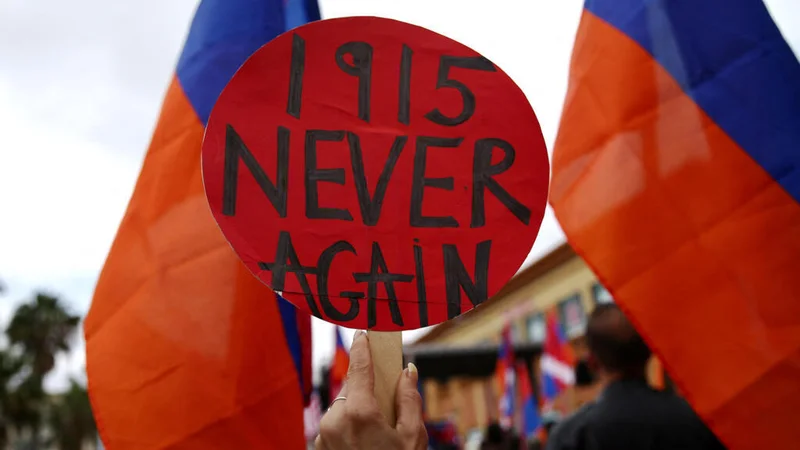
The Israeli parliament's decision to postpone a vote on recognising the Armenian genocide by Ottoman Turkey is being seen as a triumph for regional diplomacy, as Azerbaijan in particular seeks to avert a further escalation in tensions between its close allies.
The Israeli government gave no official reason for postponing the vote to formally recognise the Armenian genocide by Ottoman Turkey during World War I, which would have ratified a motion approved by the cabinet last month.
Ankara strongly denies the deaths of hundreds of thousands of Armenians constitute genocide.
While the motion's architect, Israeli Foreign Minister Gideon Sa'ar, called recognition a “moral duty”, critics say the move took aim at Turkey amidst rising tensions.
Based in Tbilisi, Israeli defence and security expert Eugene Kogan claims Israel badly miscalculated. “Foreign Minister Sa'ar could have waited and not just dropped a bomb that led to different repercussions coming from different sides,” he said.
Armenia, which is seeking to normalise ties with Turkey, reacted coolly, with Prime Minister Nikol Pashinyan saying he saw no need to comment. Meanwhile, Israel’s close ally Azerbaijan reportedly lobbied Prime Minister Benjamin Netanyahu to drop the motion.
“At the end of the day, it might be either dropped or dismissed, and it will not come again to the new parliament agenda,” predicted Kogan.
The Knesset dissolved on 17 July and won't reconvene until after elections scheduled for 27 October.
Azerbaijan's influence
The Israeli newspaper Haaretz reported that pressure from Azerbaijan tipped the scales, though officials deny it.
Azerbaijan supplies nearly 40 percent of Israel’s oil and is a major customer for Israeli arms. The two countries’ partnership involves frequent Israeli ministerial visits and strong military cooperation, especially crucial for Israel given Azerbaijan’s border with Iran.
Baku also maintains a deep alliance with Ankara, summed up in the phrase “one nation, two states”. As Israeli-Turkish tensions flare over the Gaza conflict and Ankara’s support for Hamas, Azerbaijan is walking a diplomatic tightrope.
Zaur Gasimov, a Caucasus expert at Istanbul’s Turkish-German University, believes Baku viewed the Israeli genocide motion as a direct threat to its difficult balancing act.
“I can imagine that there were negotiations and talks on various levels between political elites of both countries,” he said. “For Israel, Azerbaijan is still of paramount importance. I would even say it's much more significant than it used to be with regard to the situation in and around Iran. So Baku was and is maybe the key intermediary between Israel and the Republic of Turkey.”
In what may be a calculated move to turn up the heat on Israel, Azerbaijan’s President Ilham Aliyev welcomed Palestinian Prime Minister Mohammad Mustafa this month. It was the first visit by a Palestinian leader since 2011.
“They [Israel] perceive it with a great sense of caution,” claimed analyst Kogan. “They don't know exactly what came out of this particular meeting between Aliyev and the Palestinian prime minister. And so there is a lot of guessing games right now taking place in both Tel Aviv and Jerusalem about the outcome.”
Such ambiguity over Baku’s intentions could strengthen its diplomatic hand, he suggested: “If Aliyev is involved in this Palestinian issue directly and no longer indirectly, it makes the situation very different for the Israelis.”
Syrian precedent
Baku is already leveraging its strong relationships with both Israel and Turkey to cool tempers.
“We have organised meetings between Turkey and Israel in Baku, specifically at the very beginning of the change of the Assad regime in Syria, where both parties had their own legitimate concerns,” said Hikmet Hajiyev, chief foreign policy adviser to the Azerbaijani president.
Syria is viewed as a potential flashpoint, with Israel and Turkey having a military presence. One tangible outcome of Azeri-brokered talks was the establishment last year of a military hotline in Syria, providing a rare glimmer of hope as tensions continue to mount.
“It's not unavoidable that Israel and Turkey will reach confrontation. I think we can stop this process,” argued Gallia Lindenstrauss, a specialist in Turkish foreign policy at Tel Aviv University's Institute for National Security Studies.
“They have a hotline between the Israeli Air Force and the Turkish Air Force, making sure that we will not have a collision in the skies of Syria, because we know both air forces are operating there. And the hotline has managed to keep the situation quiet. If I'm trying to find some anchor of reassurance that Turkish-Israeli relations can be controlled, it's Syria.”
As Israel approaches elections, a temporary lull in Turkish-Israeli tensions is anticipated. Still, since the main opposition shares the government’s concerns over Turkey, relations are set to remain fraught.