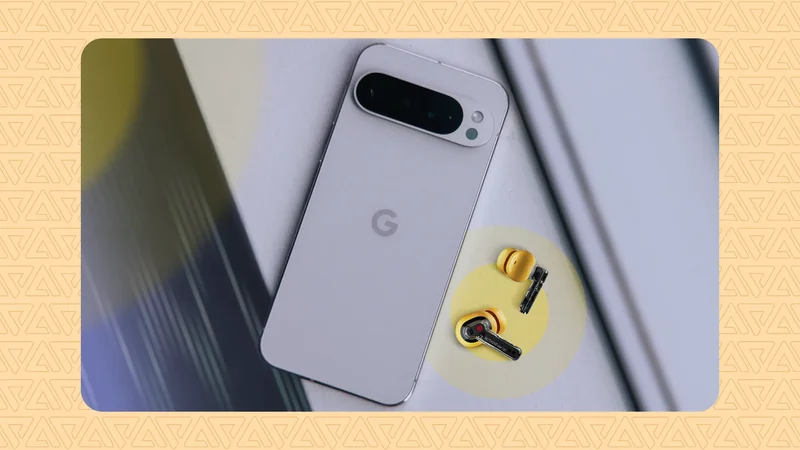
Audiophiles, rejoice. Android 17 has a surprise for you. Google has brought native support for the LHDC v5 codec to Pixel phones.
If audio codecs have never crossed your radar, here's why this one's worth caring about.
Pixels have historically been awkward for wireless audio. Anyone who wanted high-res sound without wires basically had to buy earbuds that spoke Sony's LDAC.
If you bought a pair from another brand built around LHDC, say the Nothing earbuds, your Pixel would drop the connection down to a weaker codec anyway. Android 17 puts an end to that, provided you know where to dig.
What LHDC v5 brings to the table
One megabit is a lot of headroom
An audio codec is a translator that compresses the audio on your phone, pushes it through the wireless link, and unpacks it again inside your earbuds.
Most phones default to codecs that don't try very hard. SBC peaks around 328 kbps. AAC comes at around 256 kbps. Both have to sacrifice some musical detail, so the connection doesn't stutter.
Newer standards like Bluetooth LE Audio and LC3 are out there, but they're tuned for power efficiency and low latency rather than raw fidelity.
LHDC v5 is a quality play. It scales up to about 1 Mbps and can push 24-bit audio at 96 kHz, which puts it shoulder to shoulder with LDAC.
|
|
|
|
|
| SBC | ~328 kbps | 16-bit / 44.1 kHz | Universal fallback |
| AAC | ~256 kbps | 16-bit / 44.1 kHz | Default for most phones |
| aptX HD | 576 kbps | 24-bit / 48k Hz | Reliable HD link |
| LDAC | 990 kbps | 24-bit / 96 kHz | Sony's high-res standard |
| LHDC v5 | ~1000 kbps | 24-bit / 96 kHz | Dynamic scaling, low latency |
The other half of the high-res equation
Bad fit ruins good bitrate
I want expectations to be grounded. Codec is one slice of the audio picture. Your earpiece and its fit, the driver tuning, and the mastering of the track itself still decide most of what you hear.
Not to mention forcing a compressed Spotify stream through a 1 Mbps pipe won't conjure background vocals that were never captured in the first place.
You need a high-res source to earn that bandwidth. Tidal's HiRes FLAC and Apple Music's Hi-Res Lossless both go to 24-bit/192 kHz, as do local hi-res FLAC files.
Spotify's lossless tier tops out at 24-bit/44.1 kHz, so it won't fill the pipe the way the other two will.
Switching on LHDC v5 in developer options
Pixel 6 through Pixel 10 are invited
The Android 17 update works on Tensor-powered Pixels from the Pixel 6 series through the Pixel 10 lineup. The LHDC v5 toggle is in Developer Options. Here's the setup flow:
-
Open **Settings**and tap**About Phone**. -
Scroll to **Build Number**and tap it seven times. -
Enter your lock screen PIN when prompted. Android will confirm **Developer Options**is unlocked. -
Go back to **Settings**, tap**System**, then open**Developer Options**. -
Scroll to the **Bluetooth**section and open**Bluetooth Audio Codec**.
Android lists LHDC v5, but it stays grayed out unless your compatible earbuds are actively connected at that moment.
Earbud brands usually favor battery life over fidelity, so they may limit the sample rate by default. While you're in Developer Options, head to Bluetooth Audio Sample Rate and push it to 96 kHz.
Don't skip the companion app for your earbuds, because you'll want Hi-Res mode switched on there as well. Without it, your buds may hold themselves to 48 kHz to preserve battery life.
Both sides have to be on board with high-res output, or the link falls back to standard definition.
Don't write off AAC just yet
Nobody needs studio-grade Joe Rogan
Transmitting nearly 1 Mbps over Bluetooth isn't cheap. Processing 24-bit, 96 kHz audio drains batteries faster. Stability may also take a hit.
A maxed-out stream needs a clean radio environment. In a busy subway station, an airport, or a densely populated city block, the connection must push through interference.
LHDC v5 scales dynamically and can drop to 128 kbps to keep audio playing without stuttering.
If you care more about a clean podcast during your commute than pristine fidelity, plain AAC might actually be the better call.
A third contender joins the high-res fight
The most interesting part of all this has surprisingly little to do with Pixels. A codec that most Western listeners have never encountered is on its way to becoming ordinary Android tech.
Because LHDC v5 is integrated into Android 17 at the system level, support is carried over with the operating system to any device that receives updates next.
High-res wireless had long been a private duel between Sony's LDAC and Qualcomm's aptX, and LHDC finally has a seat at the table.