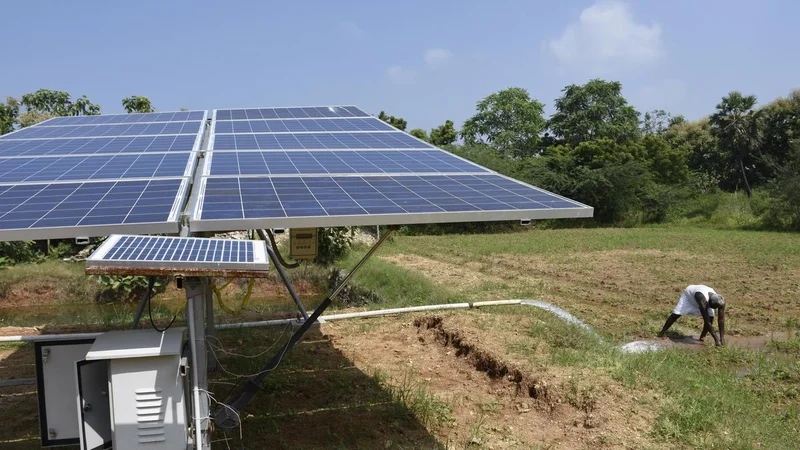
The Energy Department of Karnataka has proposed a total of 78,400 standalone solar-powered pumpset installations to the Ministry of New and Renewable Energy under PM KUSUM 2.0 (2026-2030). However, farmers across the State have said that the scheme needs two key changes to bring them relief.
While some farmers say the maximum capacity limit for a subsidised solar water pumpset should be expanded from 7.5 Horse Power (HP) to atleast 10 Horse Power (HP) to be able to draw water from greater depths, others stated that the companies allotted tenders for the installation must do it within 30 days so that farmers can reap the scheme’s benefits on time.
The PM KUSUM B Scheme is a union government funded scheme launched in 2019 under the Ministry of New and Renewable Energy that provides subsidised, standalone solar-powered agricultural pumps to farmers. While the Centre provides 30% subsidy, the State government provides 50% subsidy and the farmer’s contribution is 20%.
According to the data provided by Karnataka Renewable Energy Development Limited (KREDL), Ministry of New and Renewable Energy, around 40,000 solar pumps were sanctioned for the financial years 2024-25 and 2025-26 with the State government’s share of 50%, estimated to cost ₹750.64 crore, Centre’s 30% share at ₹450.4 crore and farmer’s share of 20%, valued at ₹300.3 crore, with the total cost coming up to ₹1,501.34 crore.
Since the implementation of the initiative in 2021, a total of 1,05,901 applications were received from farmers. A total of 56,000 installations have been sanctioned of which 28,437 have been installed till now.
During poor rains
Chandrashekar Reddy, a farmer from Chikkaballapur, explained, “Chikkaballapur and surrounding villages are semi-arid region. Hence, we depend on the borewell water for agricultural cultivation. I installed the solar-powered pumpset five years ago. For the initial two years, the pumpset worked well because of availability of ground water at 200 to 300 feet. But as the levels dropped, the pumpset stopped working. It works only when we receive good rains.”
Anjaneya Reddy, another farmer from Kolar district said that farmers had urged the State government to write to the Union government seeking to expand the limit.
“One yardstick under the scheme doesn’t work for all farmers across the country. The purpose of the scheme is to help farmers reduce the expenses incurred on diesel to run these pumpsets. However, that purpose is not being served here. The 7.5 HP pumpsets are useful only in Malnad regions or areas that receive good rains,” he said. Mr. Reddy said that he had been able to get groundwater only after drilling a borewell over 500 feet deep, that too with a bank loan.
Farmers dependent on groundwater for agricultural cultivation advised that the government must rejuvenate and desilt lakes in and around villages. Mr Anjaneya said, “Rejuvenating lakes will help recharge the levels of groundwater and it will be available at a shallow level.”
On the other hand, farmers also complain of delay in the installation of pumpsets by private companies that have been allocated tenders.
Jayachandra Sharma, a farmer from Tiptur in Tumakuru district, said, “The demand for these solar powered pumpsets is high because it saves atleast ₹4,50,000 incurred for installation and connection it to the electrical grid. But what is the use when the installations are delayed? Some companies take two months to install pumpsets and some have even taken six months.”
He urged the State government and Union government to monitor the installation of pumpsets within 30 days of sanctioning. “If it is delayed, then farmers end up borrowing loans just for drilling borewell and installation of pumpsets. Otherwise, it is a good scheme because the government provides all the components required for the installation.”
Centre’s yardstick
N. Shivashankar, Managing Director, Bescom, noted that the scheme was good farmers in places like Tumakuru, Davanagere, and Chitradurga which are semi-arid regions, but admitted to issues faced by farmers.
“I agree that there is the problem of non-availability of ground water at shallow levels in Bengaluru urban and rural and surrounding areas. because of overexploitation of groundwater. But the State government cannot do much with this scheme because 7.5 HP pumpset yardstick is fixed by the Central government,” he said.
Meanwhile, a senior official from Karnataka Renewable Energy Development Limited (KREDL) said, “The Minister of New and Renewable Energy is yet to release the guidelines and subsidy share pattern under KUSUM B 2.0. It is anticipated that the yardstick of 7.5 HP may be enhanced.”
In a recent review meeting, Divya Prabhu GRJ, Managing Director, KREDL, has instructed officials and vendors to speed up the installation of pumpsets and complete the pending ones before September 30, 2026.
Published - July 25, 2026 06:12 pm IST