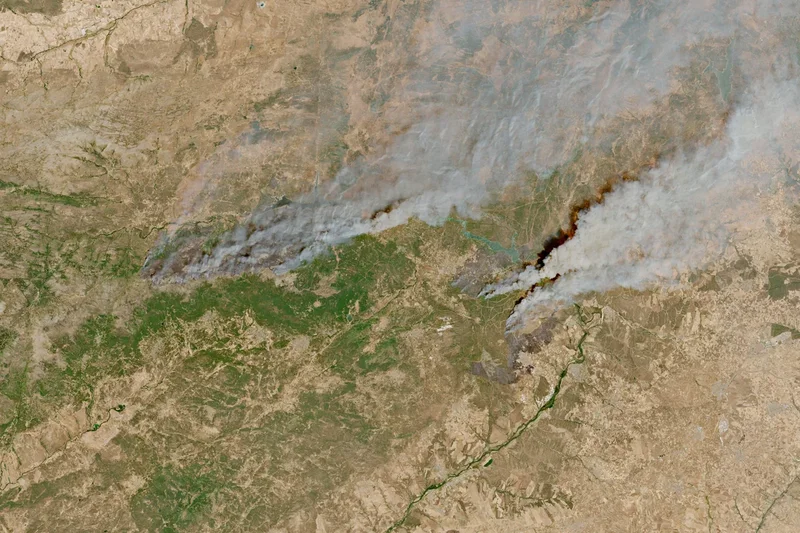
Over 280,000 people have been forced to evacuate their homes as wildfires continue to rage across Spain and France.
Government officials from both countries have commented on the historic nature of the blaze, with Madrid’s regional president Isabel Díaz Ayuso describing it “the worst fire in the history of the region”.
“The fires which are hitting our country have reached a level that has never been seen before,” French prime minister Sebastien Lecornu wrote on X on Saturday.
Lecornu promised that over 1.5 million face masks would be provided as even areas unaffected by the worst of the blaze saw air quality deteriorate and smoke spread.
Below we look at the areas affected and evacuated as a result of the wildfires.
**France **
The entirety of the Cap-Ferret peninsula has been cleared as the wildfires spread throughout the Gironde region, burning in Le Porge and Saumos.
The fire appeared to be advancing towards the French city of Bordeaux after fires continued to spread, with several suburban regions on the city’s outskirts evacuated on Saturday morning.
On Saturday officials ordered the evacuation of large parts of Bordeaux’s suburbs, including the areas of Le Haillan, Eysines and Merignac with over 197,000 people evacuated.
Local prefect Sophie Broca described the fast-spreading blaze throughout Gironde as an “XXL fire”.
After another major fire began further down the coast near the town of Biscarrosse in the Landes region on Thursday afternoon, several of the surrounding areas were also evacuated for safety.
The French army has also been drafted in to help with the crisis as the inferno showed no signs of slowing down.
France is experiencing worsening drought conditions following a heatwave and water shortages.
Spain
The government of Spain has declared a national emergency as the worst of the fires burned close to the country’s capital of Madrid, which is home to 6.8 million people.
Regional president Ayuso said that that conditions had been made worse by a combination of high temperatures, wind and the merging of blazes.
The Spanish interior ministry reported that a total of 70,000 people had been evacuated from villages outside Madrid.
While Spain’s meterological agency Aemet said that the fire risk remains at “very high” levels across vast areas of the country and “extreme” in the north-east and east, the threat was “lower that in previous days” in central and western Spain, according to an update on X on Saturday.
Spain’s health minister Monica Garcia warned people to be mindful of the air quality across Madrid as she advised residents to stay in doors and pay special attention to vulnerable people.
“Due to the fires, today's air quality in Madrid is not good, with PM2.5 levels well above those recommended by the WHO,” she wrote in a post on X on Saturday.
“Avoid physical activity and staying outdoors. If you go outside and there is smoke or ash, use an FFP2/95 mask and goggles to protect your eyes. Seek medical attention if you notice difficulty breathing, chest pain, or shortness of breath.
“Pay special attention to vulnerable people around you. Stay informed through official sources and follow the instructions from emergency services.”
Other areas impacted by wildfires include parts of Scotland where a major incident was declared following a blaze in Cairngorms National Park, with smoke drifting as far as Aberdeen nearly 150 miles away. Parts of Italy and Tunisia have also been affected.