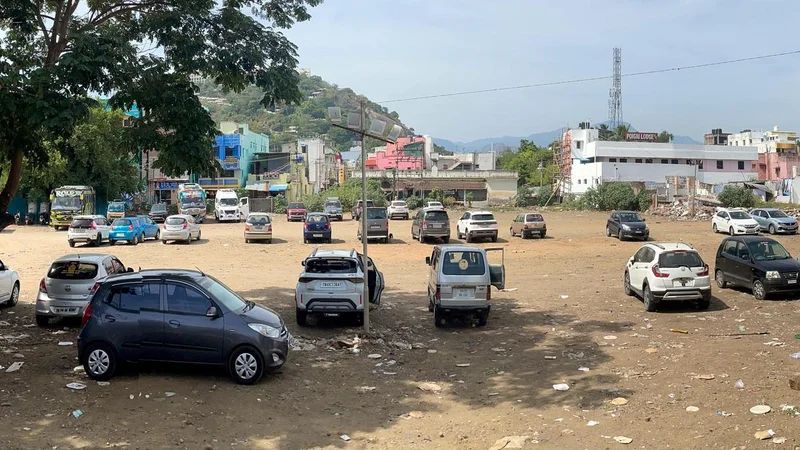
It is best to start at the foreseeable beginning of any story. This one begins here: a 1.40-acre patch of land located in Ward 3 of Palani town was originally owned by Kuppusamy Maniyakarar of Balasamuthiram, according to the records of the Hindu Religious and Charitable Endowments (HR&CE) Department.
He had donated the land through a gift deed to one Dhandapani Swamy as far back as 1888 with the objective of setting up a mutt. Later, the mutt was developed by several persons, and buildings were constructed to provide shelter to devotees coming to the Dhandayuthapani Swamy Temple. The proceeds from the land were stipulated to be used only for the maintenance of the mutt, the performance of pooja, and other services to the temple.
“No one was given the right to sell the land or to create an encumbrance on it, and hence the land became the property of the trust. The land belonging to the trust could not be sold by any individual,” then Joint Director and Executive Officer of Dhandayuthapani Swamy Temple S. Marimuthu said in a letter addressed to the Joint Sub-Registrar of Palani, days before the land was registered on July 7, 2026.
Interestingly, there have been multiple attempts to sell the land in the past. Dhandapani Ayya, a descendant of Dhandapani Swamy, in whose name the land had been vested for developing the mutt, had sold the land to private individuals in 1999. Then, with the objective of safeguarding the land, the HR&CE Commissioner, on June 17, 1999, appointed the Joint Commissioner and Executive Officer of the temple as the Thakkar or Fit Person to administer the sprawling land.
Meanwhile, all legal efforts made by Dhandapani Swamy to remove the JC as the Fit Person of the land in different courts, right from the civil court to the Madras High Court and the Supreme Court, failed. The High Court, in 2002, observed that Dhandapani Swamy was not the owner or possessor of the trust property.
A subsequent inquiry conducted by the then Joint Commissioner of HR&CE, Madurai, under the Hindu Religious and Charitable Endowments Act ruled that the mutt did not belong to any private person but was public property. This was confirmed by the Commissioner of HR&CE in 2016.
Against this backdrop, Mr. Marimuthu wrote a letter on July 2, 2026, to the Joint Sub-Registrar in the office of the District Sub-Registrar, Palani, revealing that attempts had been made in 2025 to register the land in the names of private individuals.
The flashpoint
And yet, on
Speaking to The Hindu, senior officers from the HR&CE, Registration, Police, and Revenue departments said that the persons behind the ‘deal’ seem to have exploited the loopholes in the law and elsewhere.
For instance, the timing of the registration (according to the sale deed, a copy of which is with The Hindu) appears to have been planned to coincide with the period when the Model Code of Conduct for the Assembly elections was in force. The election dates were announced on March 15, 2026, and the above deed was executed on March 27, when all the political parties and officers were directly or indirectly busy with electioneering. Hence, the needle of suspicion also seems to be pointing towards a few high-ranking officers.
Officers studying various documents pertaining to the ‘deal’ said that the seller, M.D. Murugadass, son of Dhandapani Ayya of the Thirupugal Swamigal Murugadas Swamigal alias Dhandapani Swamigal Trust, had stated in the sale deed that he was authorised to sell the property in order to reinvest the proceeds to generate income and fulfil the charitable objectives. He further stated that, through a public notice and bidding process, the purchasers – K. Vellaidurai of Tirupur and D. Sethupathy of Dindigul – were chosen, as they emerged as the highest bidders. The seller, in the sale deed, had stated that the purchasers were informed about the cases pending in O.S. No. 358/2018 and O.S. No. 545/2016. After that, they agreed to remit a sum of ₹2 crore, he added.
The current court case
As per the document, it is stated that the property originally belonged to Thirupugal Swamigal Murugadas Swamigal alias Dhandapani Swamigal, who had created a private trust, Dhandapani Swamigal Madam, for the purpose of carrying out charitable activities from the income derived from the trust properties. The property forms part of the properties dedicated to the trust.
Further, the document said that, after the demise of the earlier trustees, the trusteeship devolved upon successive trustees, including the father of the present vendor, Dhandapani Ayya, who administered the trust properties. The present vendor, being the lawful trustee, manages and administers the trust properties. As the property was not yielding sufficient income to carry out the objectives of the trust, a resolution was passed on March 18, 2026, authorising the sale of the property in order to reinvest the proceeds to generate income and fulfil the charitable objectives of the trust.
The vendor agreed to sell, and the purchasers agreed to purchase the scheduled property for a sale consideration of ₹2 crore. The purchasers moved the Madurai Bench of the Madras High Court in April 2026 after the authorities refused to register the document. They had presented a sale deed executed in their favour on March 27 for registration. However, the Sub-Registrar refused to register the sale deed.
The petitioners contended that the Sub-Registrar had no authority to adjudicate upon the question of title and that the mere pendency of civil suits could not be a ground to refuse registration unless there was an order of restraint operating against them. A Single Bench of the court allowed the petition and directed the Sub-Registrar to register the sale deed dated March 27, 2026, subject to the document being otherwise in order.
In July, 2026, the Arulmigu Dhandapani Swamigal Madam, represented by its Thakkar, preferred an appeal against the Single Bench order. The appellant was not made a party to the writ petition before the Single Bench. The court was informed that on the particular day when the regular officer was absent, the official in charge had registered the document. In response, the court said: “We are compelled to pass this order since fraud had been played, and fraud has to be nipped in the bud, failing which further innocent persons would only be misguided by the sale deed which had been registered by the registering authority.”
Further, the court said, “We are informed that the writ petitioners, while presenting the sale deed, had not even paid the requisite stamp duty, and the sale deeds are, therefore, kept pending for want of sufficient stamp duty. This makes the situation all the more worse… They were, however, able to convince the Sub-Registrar to still register the document.”
The court declared the document void. “We take this extraordinary step to issue such a declaration in view of the fraud, which is evident at every stage of the process involved… The writ petitioners will have to suffer owing to their acts of fraud. Since we have declared the document void, we would refrain from imposing costs, as we do not want the tainted money to flow further and cause further pollution,” the court said.
The accused in the case – suspended Sub-Registrar (in-charge) Justin Manikandan Subramanian and K. Vellathurai – moved the High Court seeking anticipatory bail. According to Justin, the document was originally presented for registration before then Sub-Registrar S. Balasundhar on April 1. Meanwhile, District Registrar Sasikala was also placed under suspension.
The entire process of presentation of the document, admission of execution, obtaining signatures, and completion of all other statutory formalities had already been completed by the then Sub-Registrar on July 3. Justin Manikandan Subramanian merely assigned the document number and forwarded the document to the Collector (Stamps), it was submitted.
However, the State said that although the document had been presented on July 3 and almost all the registration formalities had been completed by the then Sub-Registrar, it had not been finally registered. It was Justin who was in charge and completed the registration by assigning the registration number.
The court, considering the fact that a substantial part of the registration process had already been completed by the then Sub-Registrar and in order to balance the interests of the investigation and the liberty of the petitioner, granted interim protection to Justin, conditionally, till August 4. However, the court dismissed the anticipatory bail petition filed by Vellathurai. The court said that, though the nature of the mutt and the rights of the parties are under challenge and the matter is pending adjudication in appeal, as far as the criminal case is concerned, it is alleged that both the vendor and the purchasers colluded and created documents for the purpose of grabbing the properties of the mutt.
There is no material to show that, as agreed between the parties, the sale consideration of ₹2 crore was passed on to the vendor. The non-payment of the sale consideration for the registration of properties of this nature clearly indicated a mala fide intention on the part of the parties. It strongly supported the case of the prosecution that it was a sham document and that there was collusion between the vendor and the purchasers.
Apart from that, it is stated that the guideline value of the property is nearly ₹16 crore, whereas the vendor hurriedly sold the property for a total consideration of ₹2 crore. This also raises serious doubts regarding the bona fide nature of the document.
The court said that the allegations against the officers involved in the registration of the document and that the trustees, who reportedly passed a resolution to sell the properties, were paid a total of ₹1 lakh should be investigated.
Under these circumstances, the chairperson of Palani Municipality P. Uma Maheswari Pradheep had filed a petition before the Madurai Bench of the Madras High Court, seeking a CBI probe.
The Registration Department has formed a committee to conduct an inquiry. The HR&CE Department has also constituted a committee to inspect the properties of the Palani Dhandayuthapani Swamy Temple and submit a report. The CB-CID officers, headed by its DSP Ajay Thangam, with five Inspectors and assisted by over 20 personnel, are also camping conducting an investigation. The CB-CID zone SP Shajitha is supervising the investigation.
Temple property?
Officials in the HR&CE Department said that the property, now in question, belonged to the temple and that the administration had evicted the encroachment following a court directive. However, the seller (Murugadass), denying it, claimed that he was the trustee of the said property and that he had submitted evidence dating back to over a century, the officials added.
Sources in the Department of Registration said that Sub-Registrar Justin Manikandan Subramanian had given the approval for registration after the High Court order.
Some of the questions that remain unanswered are: if the land did not belong to the temple administration, as claimed by the seller (Murugadass), why did the Division Bench of the Madras High Court Bench in Madurai cancel the registration and declare it null and void?
Secondly, if the land belonged to the Dhandayuthapani Swamy Temple, how did Sub-Registrar Justin Manikandan allow the high-value registration to take place in a day?
On July 14, Minister for Commercial Taxes and Registration D. Logesh Tamilselvan acknowledged that there was a mistake on the part of the Sub-Registrar (in-charge) in registering the land, and that a departmental inquiry has been initiated against him.
Former Minister P. Moorthy of the DMK, who held the Registration Department portfolio in the previous regime, said in a press meet on July 19 that it is clear in law that temple or waqf properties cannot be registered. “How did the registration take place?” he asked.
Bigger conspiracy
Hindu Munnani State leader Kadeswara Subramanian has demanded a CBI probe and described it as a mega land scam worth ₹100 crore. He further said that the Hindu Munnani would observe a day-long fast in Palani on Sunday (July 26, 2026) over the issue.
After the temple Superintendent (Land Section) S. Muruganantham lodged a complaint, the Palani Adivaram police registered a case on July 13 under various sections of the Bharatiya Nyaya Sanhita, 2023 – Sections 318(4), 49, and 61(2) – for forgery, cheating, and criminal conspiracy. The complaint mentions that the value of the land was around ₹100 crore. Pointing to this, Vishwa Hindu Parishad functionary D. Senthilkumar wondered how land worth ₹100 crore was registered for a meagre ₹2 crore.
“The officials had deliberately allowed the State exchequer to suffer a huge loss of revenue by way of stamp duty [assuming that the land belonged to private persons]. This raises the suspicion that this deal could not have occurred without pressure from some highly influential person or persons,” he added.
Published - July 25, 2026 08:00 pm IST