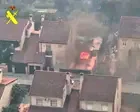
When David Olivares went to bed on Thursday night, tired from a four-hour motorbike ride, the fire creeping towards his home town of Robledo de Chavela seemed a distant menace.
He woke up the next day, saw the white smoke behind the mountains and decided the threat to Robledo, which lies an hour west of Madrid, had probably receded. The feeling of idle security would not last long. A second look at the horizon revealed the white smoke was beginning to give way to black.
“Then I saw the fire at the top of the mountain,” said the 27-year-old as he ate a sandwich in the leisure centre to which he had been evacuated in Las Rozas, a municipality on the north-western outskirts of the Spanish capital.
“It started to spread down the mountain and then I got the emergency alert on my phone at about 5.30pm, telling us we had to leave.” Even so, he wasn’t unduly panicked.
“I thought to myself, come on, it’s 2026 – the firefighters will get it under control with all their drones and planes,” he said. “But that wasn’t the case.”
Just as his mother told him they needed to leave, Olivares looked up at the sky, which had also begun to change.
“It turned orange and looked very apocalyptic,” he said. “Then there was black smoke in Robledo and you could see the fire. People were shouting – a kid was screaming to his dad: ‘Let’s go now’ – and there were cars and people everywhere. It felt like the end of the world. We grabbed our three cats, got in the car and left.”
María Rosa Marín, a fellow evacuee from the nearby town of Valdemaqueda, nodded along at the recollection.
“The sun was so strange; you could hardly see it,” she said. “It looked like something from the Bible.”
On a cushion next to her lay her dog, Jeffery, who dozed on, blissfully unconcerned at finding himself so far from home and under such dramatic circumstances.
Marín, Olivares and 300 or so other people who were evacuated from Robleda and the surrounding towns had spent the night in the sports centre in Las Rozas, where council workers were preparing stacks of ham sandwiches and local police officers were lugging in huge bottles of water.
They are just a few of the 87,000 people who have been evacuated or ordered to lock down as central Spain battles huge wildfires that scientists say are being fuelled by climate breakdown and plentiful dry vegetation on a continent that is heating at about twice the global average rate.
David Santos, Las Rozas’s councillor for safety and emergencies, said people had been arriving at the centre since 1pm on Friday.
“They’re pretty worried and pretty anxious,” he said. “We’re talking about people who’ve been evacuated from their homes and their home towns and who don’t know when they’ll be able to return. On top of that, they don’t know whether their homes will be intact, so they’re living in a state of uncertainty.”
Santos said three emergency psychologists were on hand at the centre to help people, as well as paramedics and a doctor.
For the young, games and books were available on the top floor of the sports centre and there were plans to screen a film on Sunday.
The councillor, who has overseen the town’s response to everything from the heavy snowfall of Storm Filomena five years ago to the Covid pandemic and the hosting of an large influx of Ukrainian refugees, said nothing quite compared with the blaze that Madrid’s regional president has described as “the worst wildfire in our region’s history”.
José Celaya, another evacuee from Robledo, sat at a nearby communal table, working his way through another of the many ham sandwiches. The 61-year-old, who had arrived at the sports centre late on Friday night with his wife, two children, sister-in-law and mother-in-law, shook his head at the suggestion that Spain’s wildfires were becoming more frequent because of climate change.
He laid the blame squarely at the door of successive governments, which had turned their backs on the huge rural and semi-rural swathes of the country.
“I think it’s complete negligence, a totally misguided policy by the governments – and I don’t care which government is in power,” he said. “Their policies have nothing to do with how we used to look after the hills: there’s no livestock to graze them now and no one to clear all the vegetation. They don’t let people gather firewood, which, after all, is flammable material.”
Still, he said, indignation and frustration would serve no purpose at the moment. And besides, he added, all the staff and volunteers at the sports centre had been amazing.
“There’s no point getting wound up, because getting angry isn’t going to solve anything,” said Celaya. “Everyone just has to cope as best they can. Everything depends on the weather now – on how windy it is and on which way the wind blows.”