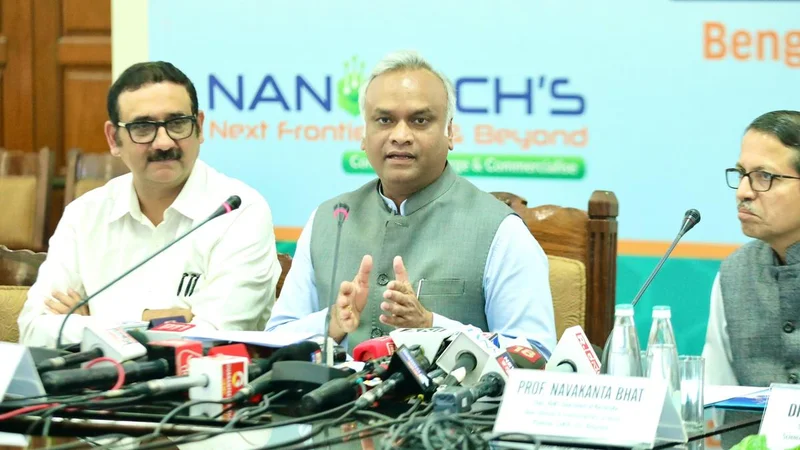
Karnataka has the scope and potential to lead the growth and development of the emerging nanotechnology industry in India, and to accelerate its growth, the State government has decided to focus on the development of talent required for the industry, stated Priyank Kharge, Minister for Home, IT, BT and E-governance, on Saturday.
The nanotechnology sector is highly interdisciplinary, requiring a combining of core sciences with advanced engineering, and Karnataka has the potential to lead the growth, said Mr. Kharge.
Talent creation
“It is very important to develop enough talent that is required to support an accelerated growth of this nanotech sector in Karnataka. We are committed to work on talent creation in collaboration with IITs, research organisations, the academia in general and industry,’’ he said, speaking at a curtain raiser event for Bengaluru India Nano 2026, the 14th edition of Karnataka’s nanotech exposition.
Bengaluru India Nano 2026 is themed on ‘;Nanotech’s Next Frontier: AI & Beyond: Conceive, Converge and Commercialise’. It is scheduled between August 3 and 5 at The LaLiT, Bengaluru.
Nanotech mission
To streamline focus on the sector, the government would set up a Nanotechnology Mission in association with the industry, he said. In terms of infrastructure required to build a nanotechnology ecosystem, he said the State was considering setting up a Nanotechnology Manufacturing Corridor.
Mr. Kharge also highlighted the importance of nanotechnology in improving safety for houses and governments. It can enhance home and government safety by introducing highly sensitive sensors, ultra-strong protective materials and advanced chemical neutralisers. Manipulating matter at the nanoscale completely changes how materials interact, making security systems faster and protective gears more resilient.
Many applications
Elaborating on nanotechnology’s various applications, Navakanta Bhat, chair, Vision Group on Nanotechnology, and Dean, Division of Interdisciplinary Sciences, CeNSE at IISc, said a huge amount of terrestrial energy was currently consumed by data centres.
“The human brain requires about 20 watts of electricity to function while a single modern data centre GPU consumes 35 to 50 times more electricity than the entire human brain,’’ he noted, adding that nanotechnology has application in all technologies including AI, all devices that can work with very little electricity. “Scientists have developed nano robots that can swim into human blood streams and kill cancer cells,’’ he said.
Anil Kumar P.S. chair, CEC, 14th Bengaluru INDIA NANO and Dean, Administration & Finance, Department of Physics, IISc, observed that India has been witnessing a paradigm shift in its semiconductor aspirations, expecting to see rapid progress across advanced manufacturing, nano-fabrication, and lithography to build a self-reliant electronics ecosystem.
Published - July 25, 2026 10:18 pm IST