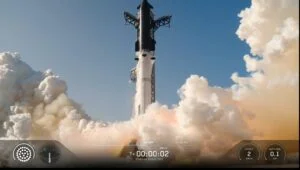
The 13th Integrated Flight Test of SpaceX’s Starship system, IFT-13, was mostly a success. One week after the launch was scrubbed at the last moment because of engine failures, and a day after a weather delay, yesterday’s liftoff went perfectly as did the flight from Texas to the Indian Ocean. The only wrinkle was when the first stage made a hand landing in the Gulf after several engines did not fire for the landing burn.
All 33 Raptor 3 engines on the Super Heavy first stage fired at 6:51 pm ET, sending the rocket (“Booster”) and the Starship second stage (“Ship”) on their way. This was another suborbital test flight. Starship flew through space, but didn’t attain orbit, splashing down about an hour later near Australia.
One surprise was that Starship did not explode after splashdown, but remained intact floating on the ocean’s surface. On prior flights, residual fuel would cause Starship to burst into flames after tipping over. Although there were some flames, the water quickly extinguished them. SpaceX said the softer landing meant they could get “critical views of an intact heat shield for the first time.”
The first attempt to launch IFT-13 on July 16 failed at ignition when four of the 33 Raptor 3 engines did not ignite. Communications Manager Dan Huot explained during the webcast that they can launch with two engines out, but any more than that triggers an automatic shutdown. They later discovered that six engines actually had off-nominal behavior. All were replaced.
SpaceX planned to try again on Thursday, but visibility wasn’t good enough to get detailed imagery of the heat shield tiles, a key goal. Huot stressed that Starship can launch in many weather conditions that would ground other rockets, even lightning, but they needed clear imagery as they were flying at a higher dynamic pressure.
Yesterday’s liftoff was picture perfect, but as happened on IFT-12, Booster’s landing in the Gulf did not go as planned. Only eight of the 13 engines that were supposed to relight for the first part of the landing burn ignited and it hit the water hard. SpaceX plans to routinely “catch” Boosters back at the launch tower as it did on IFT-5, IFT-7, and IFT-8, but has not attempted a catch since then as it introduces new versions of the system. IFT-12 and IFT-13 are Version 3 of both the Raptor engines and Super Heavy/Starship.
During the flight, Starship deployed 20 of SpaceX’s new Starlink V3 broadband Internet communications satellites. Unlike previous missions where Starlink V3 simulators were used, these were actual satellites. Since this was a suborbital mission, they did not go into orbit, but “demised” as SpaceX calls it, burning up during reentry about 20 minutes after release. They communicated with operational Starlink satellites during that time, transmitting imagery of Starship and especially the heat shield.
Starship is critical not only to SpaceX’s own plans for constellations of thousands of Starlink V3 satellites as well as one million orbiting data centers, but to NASA’s plans to put astronauts back on the Moon.
Starship is one of two lunar landing systems for NASA’s Artemis program. Blue Origin’s Blue Moon is the other. NASA plans to launch the earth-orbiting Artemis III mission next year to test rendezvous and docking operations between its Orion crew spacecraft and both Starship and Blue Moon.