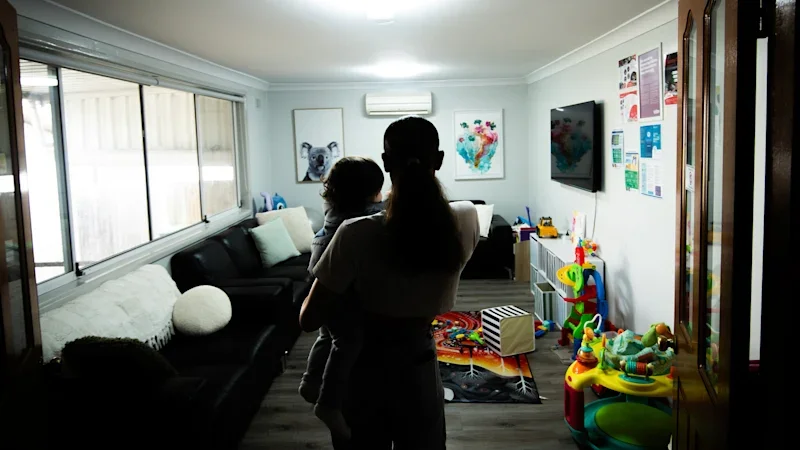
Dozens of young women, heavily pregnant or with babies in their arms, arrive at the Wiyanga House in Sydney’s west every year facing homelessness.
Run by Uniting, the refuge is one of a handful of specialist services in the state. The single-storey refuge near Parramatta caters to young women aged 16 to 24 who are expecting or raising children. Some young mothers arrive with suitcases and bags; others come with only the clothes on their backs and their infants.
Nearly all are fleeing domestic violence.
Last October, 23-year-old Jenny and her son Ben, 3, were preparing to spend the night sleeping in a park.
Jenny had previously been living in temporary social housing, where agreements required her to actively apply for private rentals to maintain her placement. But she said these requirements were difficult to achieve with a baby and a tight $450 weekly budget, well below Sydney’s median unit rent of $780.
After applying for a rental that exceeded her case-plan budget by just $10, she was evicted for non-compliance. She then found shelter at a motel, only to be evicted again after her weekly rent jumped from $510 to $700.
Carrying suitcases with her infant bundled in blankets, she had nowhere else to go. Jenny was terrified when police and social workers approached them in the park, fearing Ben would be taken away from her.
Instead of being separated, they were brought to Wiyanga.
All five beds at the house are usually filled. In 2025-26, the refuge supported 52 women and their children – a 25 per cent increase from the previous year. But amid increased demand, Uniting is forced to turn away dozens more.
Since arriving at Wiyanga, Jenny has been paired with a financial counsellor, mental health counsellor, parent groups, and Parent Pathways, which offers financial support and employment training. She recently found long-term accommodation and is hoping to re-enter the workforce.
“There were heaps of times that I wanted to give up. Nothing was going the way I wanted it to,” she said. “My message to other mums is don’t give up. We got there in the end.”
Services in crisis
How NSW supports vulnerable mothers has remained under intense scrutiny since a woman gave birth to twins, one of whom did not survive, while living in a makeshift camp in the NSW Riverina.
Data modelling from Homelessness NSW estimates up to 80,000 people may be experiencing homelessness in NSW, with nearly 700,000 more at risk. Street counts show the rate of people sleeping rough has doubled since 2022, with 2308 identified during this year’s Homes NSW statewide street count.
Women and children affected by domestic violence make up one third of all people experiencing persistent homelessness in NSW and nationally, according to Australian Institute of Health and Welfare (AIHW) data.
At the same time, the capacity to provide help is shrinking. In 2024-25, there were 21,500 requests for homelessness services in NSW that went unassisted – a figure that has almost doubled over the past eight years. There is an average of 59 unassisted requests a day.
In 2024-25, Uniting was forced to turn away 91 young people seeking housing due to a lack of space.
Wiyanga is funded under state government specialist homelessness packages. But Uniting’s Jasmine Aspinall said there hadn’t been a substantial increase in over a decade, and the house operates on a shoestring budget.
The house’s weekly grocery budget is $250 for five women and their children, and the centre relies on donations for clothes, formula and other necessities for the mothers.
“It’s so difficult. We really do depend on other services,” Aspinall said.
Aspinall said the centre was in dire need of another case manager to help the women once they transitioned out of Wiyanga.
“A lot of these clients are returning clients. If they had had somebody with the continuity of care, that might be prevented,” she said.
Staff armed with panic buttons
From the outside, Wiyanga House looks no different from other homes on the street. However, the location of this single-storey brick building near Parramatta is kept strictly secret.
Security cameras monitor the driveway, and staff carry duress buttons to alert authorities should violent partners show up. A staff member is present at the six-bedroom cottage 24/7.
If a violent ex-partner does appear, house co-ordinator Shanique Toonen said staff must find the mother alternative emergency accommodation.
“They threaten to put the safety of all our mums and babies at risk,” she said.
One of the first conversations Toonen has with new arrivals focuses on safety, with many women yet to come to terms with their experience of domestic violence.
“We do a lot of work around what is a healthy relationship,” she said.
Termination and contraception are also discussed sensitively, with some women unfamiliar with proper contraceptive use or available options.
Teenage pregnancies make up less than 2 per cent of all births in Australia, according to AIHW data, though Toonen said the women referred to Wiyanga are increasingly skewing younger.
Most are leaving households where there’s violence, overcrowding, or drug issues, realising the environment is unsafe for their child. Many residents are from Aboriginal or non-English-speaking backgrounds, or live with intellectual disabilities.
The home operates with set rules, including a curfew and chore roster, but avoids policing its residents. Staff provide support rather than supervision. Residents pay $210 a week rent.
“We try to be flexible. This is their home,” Toonen said. “Nobody wants to live in a refuge, and they’re not lucky to be here. This is usually the lowest point of their life.”
A chance at breaking the cycle
Noelani*, 20, has been living at Wiyanga for almost three months with her 13-month-old, Eli. She said she was on a “destructive path” before becoming pregnant.
“I was getting into arguments with his father, going into custody, drinking and smoking a lot,” she said.
Noelani has experienced intermittent homelessness since age 14, frequently ending up on the streets following conflict with her mother.
“I was getting by day-to-day with temporary accommodation, motels, frozen meals and then stealing just to get breakfast,” she said.
Her own childhood was marked by domestic violence and adults drinking.
“I wanted different for my son,” she said.
Change wasn’t easy, and it took her a few months to find her feet. After being referred to Wiyanga, she accessed mental health support and feels she is on the right track.
Without Eli, Noelani believes she would still be drinking, “running a muck” and lacking direction.
“Falling pregnant was a blessing in disguise because I’m not just thinking about myself; I have to put him first,” she said.
*Names changed for privacy.
Support is available from the National Sexual Assault, Domestic Family Violence Counselling Service at 1800RESPECT (1800 737 732) or the Men’s Referral Service on 1300 766 491. For crisis support, contact Lifeline 13 11 14 or lifeline.org.au.