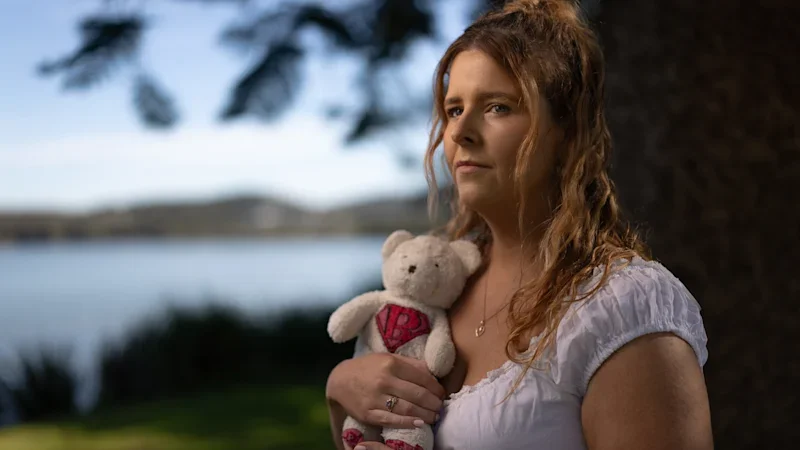
In her last six months of life, four-year-old Brooklyn Wangmann put on a show every night.
“She’d go and get herself dressed up. She had these little glitter heels in a few different colours. Sometimes she’d be in ballet attire. Sometimes it was just jeans and a T-shirt,” her mum, Rebecca Wangmann, said.
Brooklyn was born with hypoplastic right heart – half her heart never developed – and was also missing part of her right lung. While Wangmann understood her daughter may not live a full life, she hoped she would at least make it into adulthood.
In August 2023, Brooklyn died in the surgery that was her last option. Wangmann said she and Brooklyn’s dad “don’t always agree on things”, but when they were approached by staff about organ donation, the decision was instantaneous.
Brooklyn gave another child her liver in a direct transplant at Westmead Children’s Hospital.
“We just felt that Brooklyn was the type of little girl who would want to help someone, and for us, it was a way for a part of her to live on,” Wangmann said.
The letter she received from the recipient last September changed her life all over again.
While the recipient of Brooklyn’s liver must remain anonymous under Australian legislation, Wangmann said both families have sent each other letters, which have become “lifelines” through her grief.
“The child seems just as cheeky as what Brooklyn was,” she said.
The most recent letter was written by the recipient themselves.
“Thanks to your daughter’s gift, I’ve been able to enjoy life more fully, and I carry her memory with me always” the letter read. “[I] cherish this life she has given me.”
Paediatric organ donation remains rare in Australia. Last year, only nine children aged four or under became organ donors nationally.
Paediatric donation specialist nurse Mel Short said meeting with parents on the worst day of their life was “the biggest privilege”.
“I just can’t believe how generous families are in this time,” she said.
There are currently 136 people on the waitlist for a liver transplant in Australia, while 72 Australians died on that waitlist over the past five years.
In NSW, registrations to become an organ donor have dropped over the past five years. A spike in 2021 saw 110,000 new registrations, while only 34,000 people registered last year.
Co-State Medical Director of DonateLife NSW Dr Michael O’Leary said the jump was easily explained.
“Everyone had to use the Medicare app to get their COVID vaccine certificates,” he said, with the organ donor sign-up button next to the certificate.
While a majority of Australians are in favour of organ donation, O’Leary said lethargy was the most common reason people do not sign up to become a donor.
“They think about it once and then forget about it, and never actually get around to it. But if you put the opportunity in front of them, more will actually sign up,” O’Leary said.
South Australia has the most organ donors registered of all states and territories, O’Leary said, and is also the only state that still lists organ donor status on driver’s licences.
While families can still overrule the wishes of a registered organ donor, they are far more likely to consent if they know that it was what their loved one would have wanted.
“It’s really important that people talk about donation, tell their loved ones what they want, and more importantly, go on to the register,” O’Leary said.
In NSW, organ donor rates are highest in the Blue Mountains, where 62 per cent of the eligible population is registered, and in the Sydney LGAs of Mosman (60 per cent) and the Northern Beaches (58 per cent).
Registered donor rates are the lowest in Fairfield (17 per cent), Cumberland (18 per cent) and Strathfield (19 per cent).
O’Leary said LGAs with low donation trends tend to be areas with a mixed population of ethnic and cultural backgrounds.
“I think that just illustrates that we’ve not been very good at disseminating the information,” he said. “We haven’t perhaps ensured that information is available in all of the necessary languages for people to read and understand. We haven’t engaged adequately with community leaders to press the importance of donation.”
Actual donation rates have remained relatively steady both in NSW and nationally. A decade ago, there were 127 organ donations in NSW, compared to 160 last year. Across Australia, there were 435 donations in 2015, and 557 last year.
If Brooklyn had survived her surgery, she would have needed a donated organ at some point in her life – most likely, a liver.
“Nothing will ever take away the pain of losing a child, but knowing we were able to save another child is something that’s changed my life forever,” Wangmann said.
“It is that little bit of light in all of the darkness.”